
A university help agent uses classic topic matching. Its handbook is already connected as knowledge, but any question that misses a trigger phrase gets the fallback message that the agent does not understand, and the handbook is never consulted. What should the architect change?
Select an answer to reveal the explanation.
Short Explanation
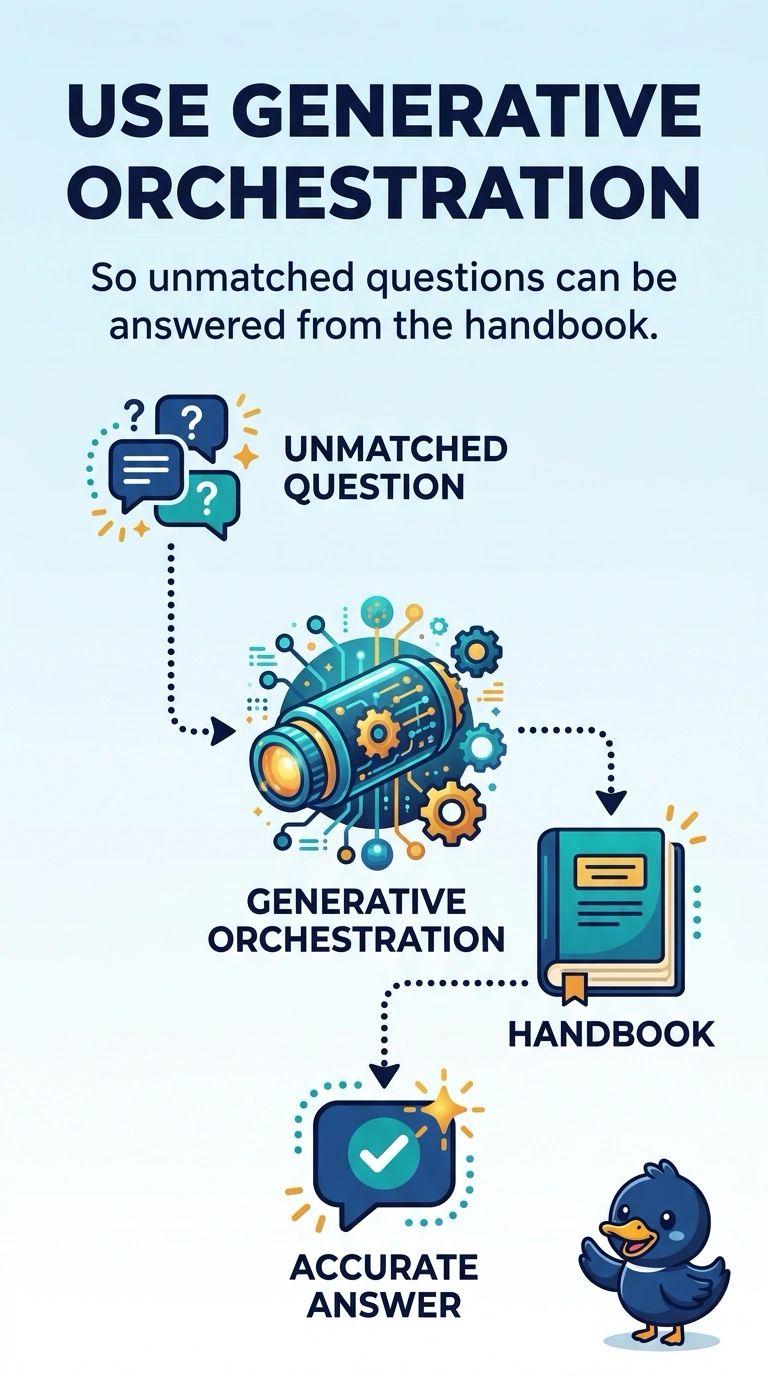
The book is on the shelf, but the agent never opens it because the only path it knows is a list of memorized phrases. You turn on generative orchestration so a question that misses every topic can still be answered from the handbook. Deleting the fallback topic only removes the apology.
Full Explanation
Under classic topic matching, an utterance that misses every trigger phrase goes to the fallback topic, even when a connected knowledge source contains the answer. Generative orchestration lets the agent use that knowledge for questions no topic claimed, which is the behavior the university wants. The fallback topic should remain for questions the handbook also cannot answer, but it should not be the first stop. Deleting the fallback topic removes the honest I-do-not-know path and still does not cause classic matching to read the handbook. A second channel publishes the same logic to another place, so the handbook stays unread there too. Replacing the knowledge source with more trigger phrases abandons the handbook and pushes the team back into maintaining phrases for every way a student might ask. Exam caveat: connecting a knowledge source does nothing for unmatched questions until the orchestration mode is allowed to use it. Operational check: ask a handbook question that matches no trigger phrase and confirm the reply cites the handbook instead of the fallback message.