
An operations lead runs an agentic triage workflow that drafts incident summaries but hallucinates service owners because it lacks live access to the CMDB and on-call roster. The team hosts those APIs behind an MCP server with least-privilege tools. How should the team connect the agentic workflow to the MCP server to improve context?
Select an answer to reveal the explanation.
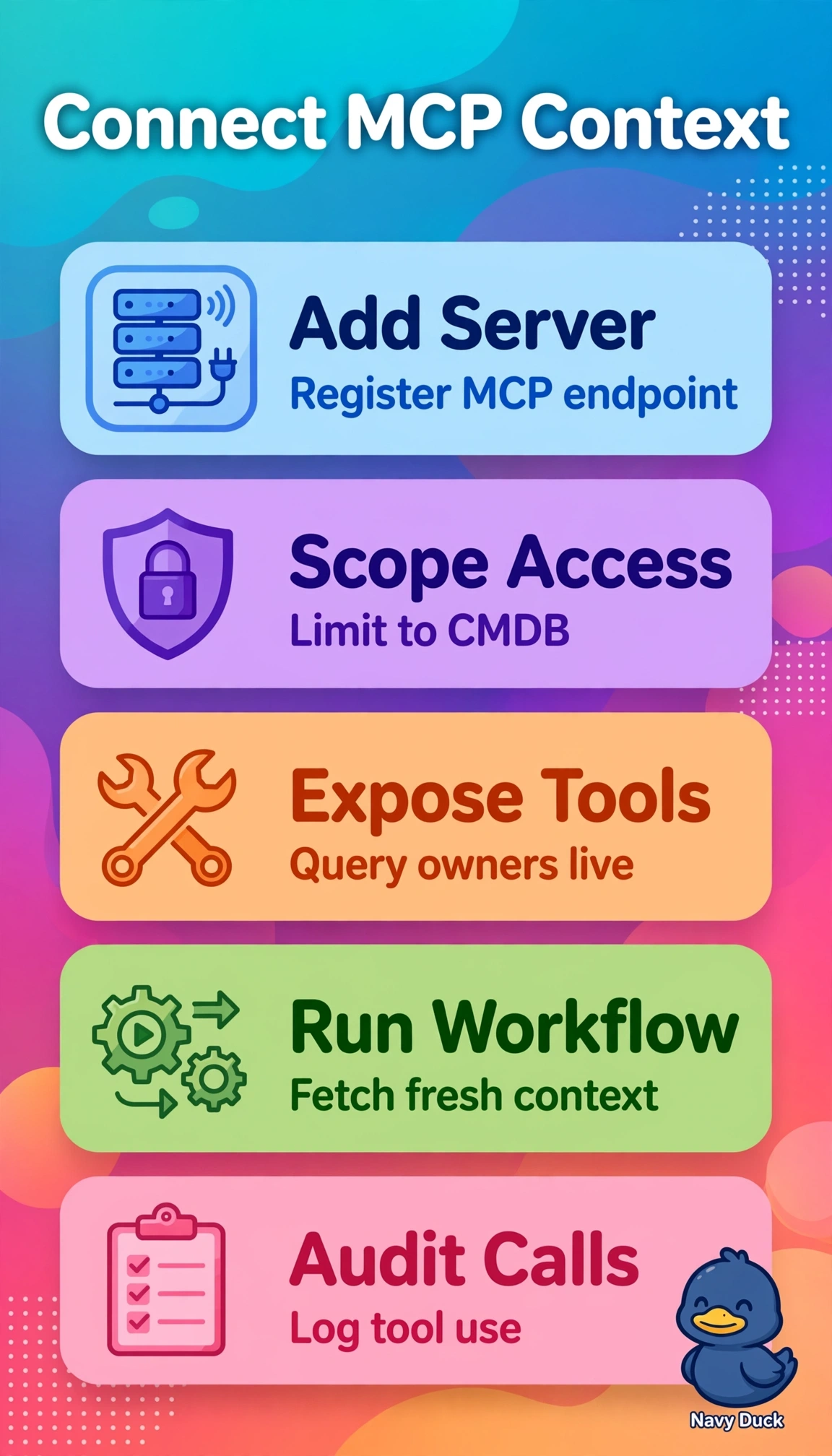
Short Explanation
Static snapshots go stale fast in incidents. Connecting live MCP tools feeds your agent fresh owner context on demand.
Full Explanation
The correct response works because registering the MCP server as a constrained tool source gives the agent live, least-privilege function calls to both CMDB and on-call APIs at inference time, which directly fixes hallucinated owners by grounding the summary in authoritative current state rather than parametric memory while preserving security boundaries and auditability. The periodic sync caching approach fails on freshness by concept because scheduled ETL into a cache reintroduces staleness and ownership drift, so reassignments or failover changes between syncs will still produce incorrect owners despite using the sanctioned MCP path. The approval-gated live query approach fails on workflow integration by concept because deferring tool use until after human review means the initial draft that most needs grounding is still generated without context, adding latency without improving autonomy or draft quality. The inventory-only live query approach fails on completeness by concept because service-to-owner resolution requires joining asset records with the current roster, so correct service identification can still map to the wrong human when shift, escalation, or secondary on-call data is absent. For exam strategy, distinguish live tool invocation during the run from design-time import, scheduled sync, or human-in-the-loop retrieval, as stems emphasizing hallucinates, live access, and least-privilege tools point to runtime scoped tool use. As a practical check, verify tool traces show scoped MCP calls for both CMDB lookup and roster lookup on each incident run with denied permissions for out-of-scope methods and latency fallbacks that escalate rather than invent an owner.