
A logistics startup builds an agentic workflow to label incoming issues, assign owners by region, and post a welcome comment using shared team terminology. Labels must stay consistent across repos. Which approach best creates effective agentic workflow instructions?
Select an answer to reveal the explanation.
Short Explanation
You're writing a clear playbook the whole crew can follow. Scoped instructions work like a recipe card, exact ingredients and steps keep every batch tasting the same.
Full Explanation
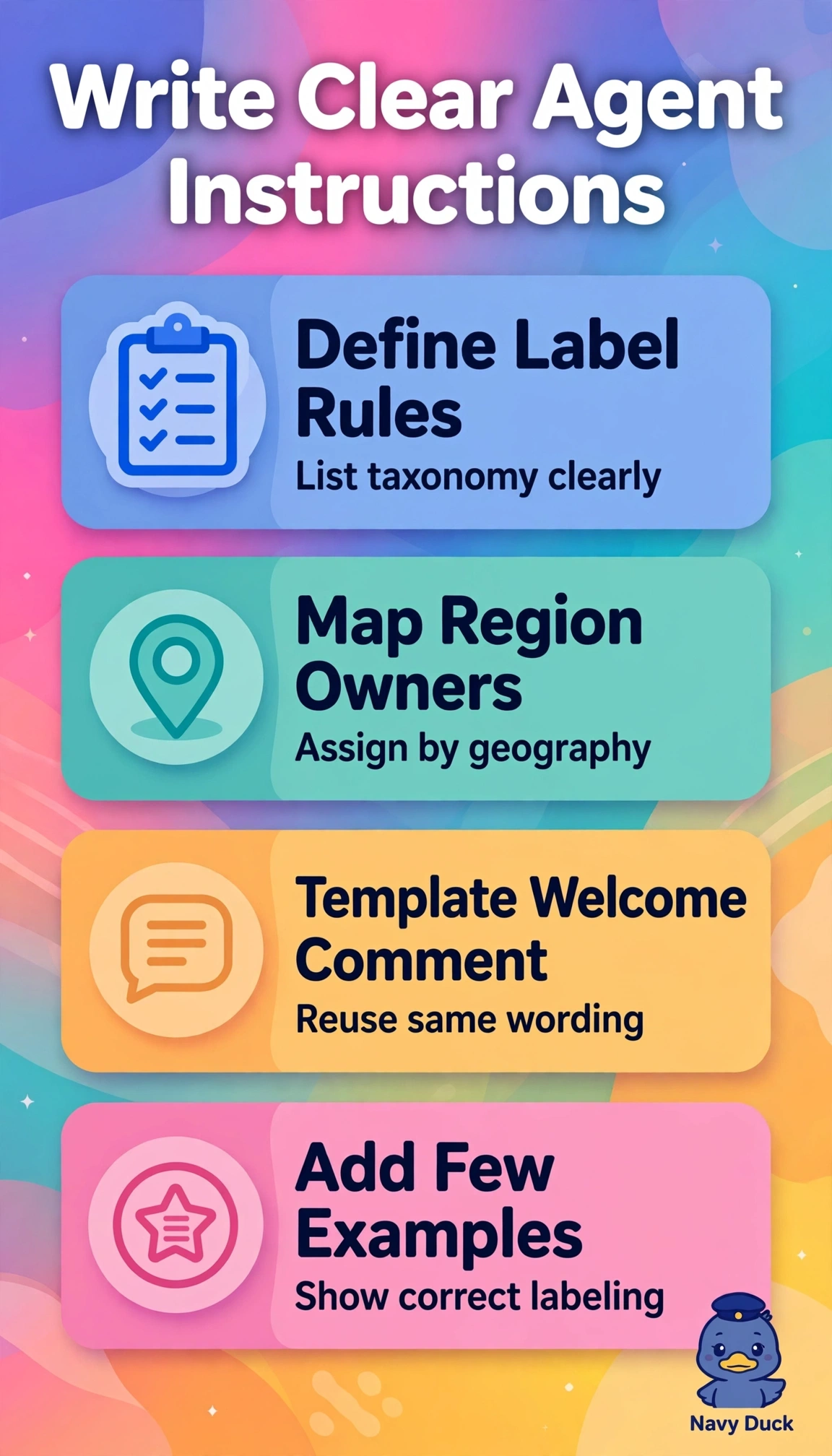
The correct approach works because scoped instructions maintain a single consistent labeling taxonomy across repositories while providing guidance for all three tasks with examples that anchor agent behavior. Labeling rules prevent drift, the region mapping supplies logic for assigning owners by geography, and the comment template turns shared team terminology into a repeatable welcome message. The detailed per-repo variant fails on scope because separate instructions per repository allow definitions to diverge and violate the requirement that labels stay consistent across repos despite covering tasks locally. The scoped variant with labeling rules, terminology glossary, and comment template fails on routing because a glossary documents vocabulary but does not define who owns which region, so the agent cannot assign owners. The scoped variant with labeling rules, region mapping, and terminology glossary fails on execution because without a template the agent has vocabulary but no structured workflow to post the welcome comment reliably. As an exam caveat, watch for distractors that replace a procedural artifact like a mapping or template with a descriptive artifact like a glossary, since keyword overlap makes them feel complete. As a practical check, test with synthetic issues from different regions in two repos and verify identical labels, correct assignees, and correctly phrased comments.