
A business analyst at a logistics company repeats the same compliance checklist for every shipment review and wants a reusable custom skill that agents can load with Vault policies and Jira formatting. The skill must stay portable across agents and workflows. Which approach should the analyst use to create a custom skill for consistent reuse?
Select an answer to reveal the explanation.
Short Explanation
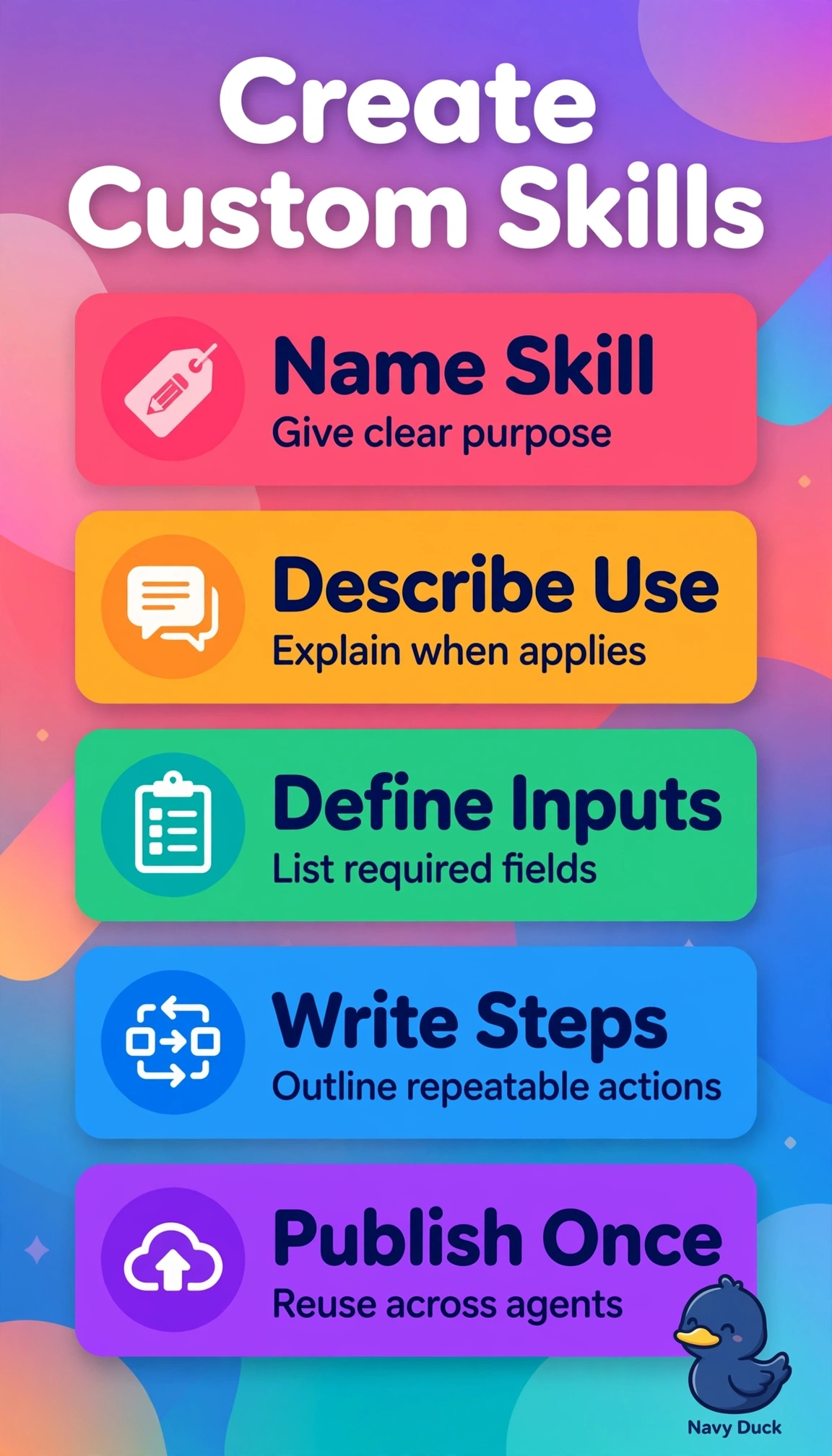
You’re building a reusable playbook, not a sticky note. Packaging lets any agent pull your checklist in with the right inputs every time.
Full Explanation
The correct response is right because a named, described skill with defined inputs and procedural steps creates a self-contained capability that any authorized agent can discover and invoke on demand across different workflows while still applying Vault policies and Jira formatting consistently, which directly satisfies portability and reuse. The automated workflow approach fails on portability by concept because it binds the Vault lookups and Jira updates to a fixed trigger and sequence, making it excellent for consistent execution but not a loadable skill that travels across agents. The versioned knowledge article approach fails on executability by concept because articles provide searchable reference and examples, not parameterized inputs and invocable steps, so agents may read the guidance but cannot load it as a reusable action. The embedded agent instructions approach fails on scope by concept because hard-coding Vault and Jira rules into a single agent improves that agent's consistency but prevents sharing and discovery by other agents and workflows. An exam caveat is to distinguish creation mechanism from content storage, since many stems mention Vault and Jira to test whether you choose a portable action versus a document or a single-agent customization. A practical check before release is to invoke the skill from two different agents in separate workflows and confirm both enforce the same Vault policy and produce identical Jira formatting without duplicating configuration.