
A retail operations team wants an agent to triage 500 daily vendor emails: classify intent, then send invoices to a finance agent, delays to a logistics agent, and complaints to a support agent. Each path needs different tools and prompts. Which agentic design pattern best aligns this classified routing workflow with reusable specialized agents?
Select an answer to reveal the explanation.
Short Explanation
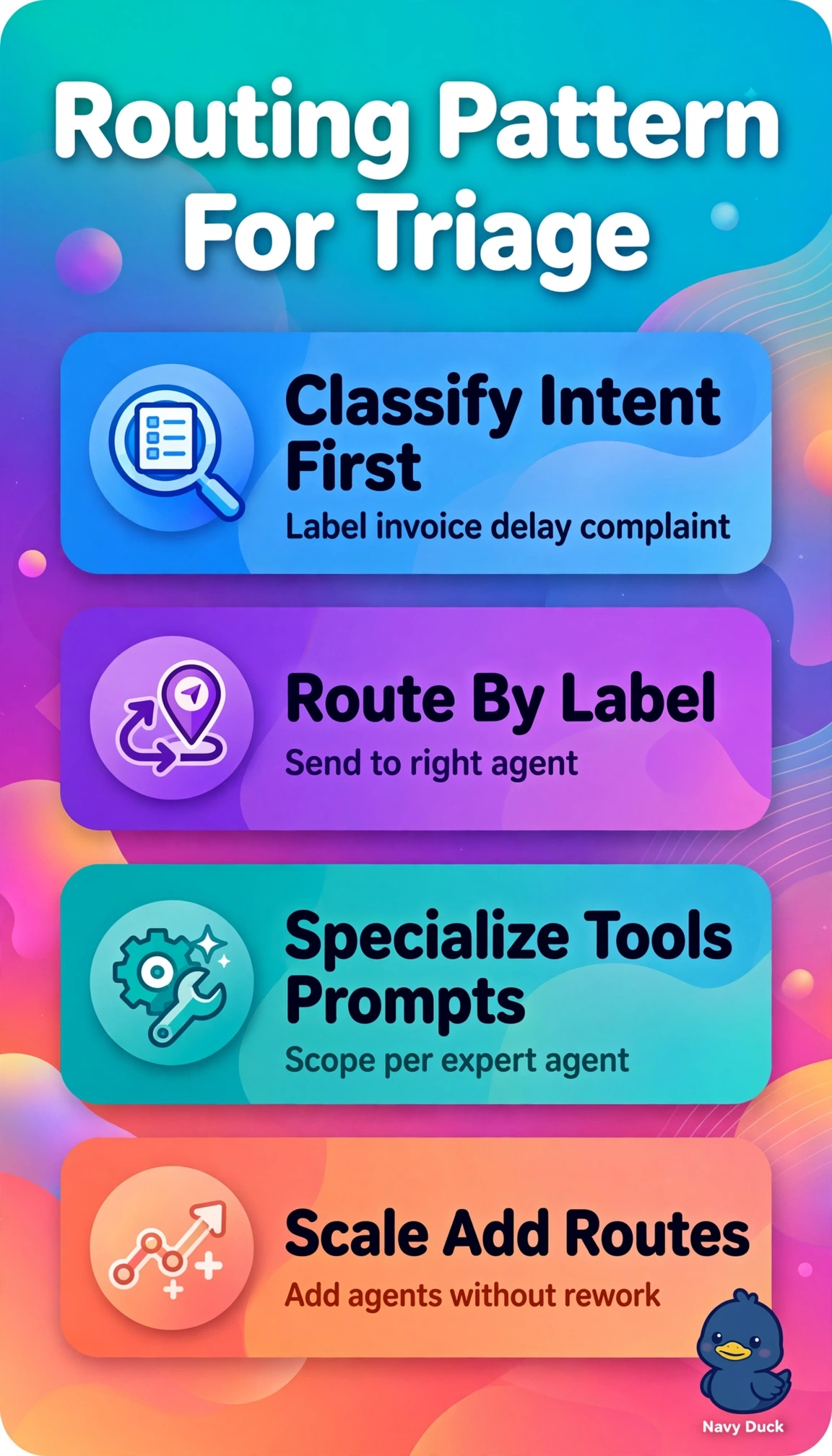
Sorting mail before delivering it saves a lot of wasted footsteps. That routing hub with specialist carriers keeps tools clean and lets you add new lanes without rewiring everything.
Full Explanation
The routing pattern is correct because a central classifier makes one exclusive intent decision and delegates each vendor email to only the finance, logistics, or support specialist that owns the distinct prompt and tools for that intent, preserving separation of concerns, enabling reuse, and scaling to 500 daily messages without cross-path coupling. The chaining alternative fails conceptually because it requires ordered sequential steps where one output becomes the next input, so an invoice would still flow through logistics and support handling instead of branching exclusively, increasing latency and compounding errors. The parallelization alternative fails conceptually because it invokes all specialists concurrently on the same email for speed or aggregated results, which suits divisible tasks but violates single-path routing, wastes API and tool calls, and can create conflicting side effects. The evaluator-optimizer alternative fails conceptually because it iterates a generator and evaluator to refine the same routing decision or draft for quality, which improves accuracy but never provides exclusive handoff to independent specialists with different capabilities. Exam caveat is to not choose a pattern merely because a classifier is mentioned, but to test whether the workflow needs exclusive branch, sequence, concurrency, or iterative refinement. Practical check is to trace production logs to verify each email ID triggers exactly one specialist with its own tools and that each specialist remains independently callable from other workflows and monitor misrouted cases to retrain the classifier threshold.