
A technical project manager has an agent drafting release notes that sometimes omit breaking changes. The team wants the agent to check its own draft before posting. Which design best configures self-critique loops for this agentic workflow?
Select an answer to reveal the explanation.
Short Explanation
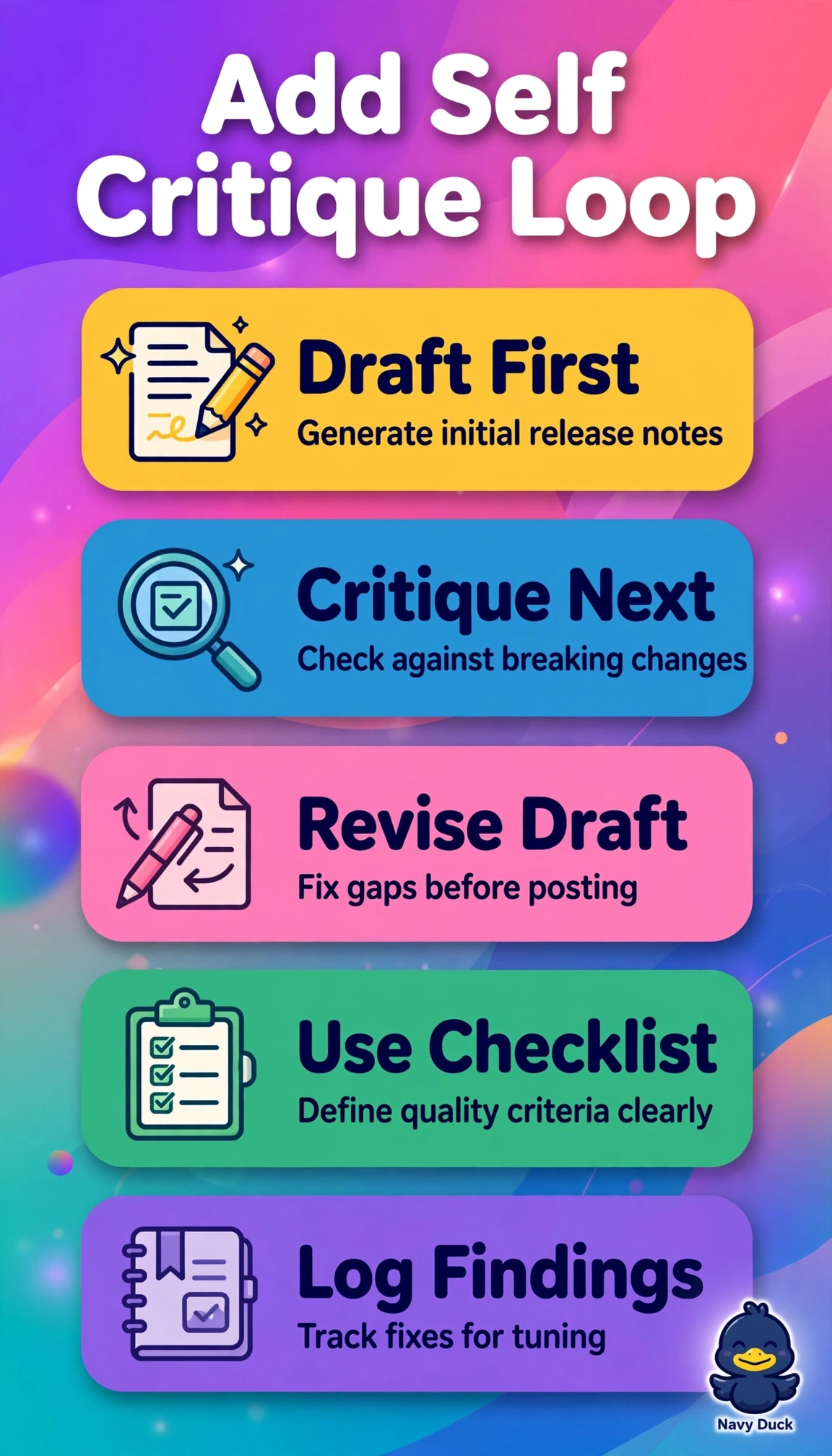
You wouldn't send a big launch email without proofreading it one more time, right? You'll get safer notes when you have your agent do a second pass with a breaking-change checklist and fix gaps using reflection.
Full Explanation
The correct design is effective because it implements a genuine self-critique loop with separation of concerns: generation followed by a distinct evaluation pass that uses an explicit checklist for breaking changes and closes the loop by revising the draft before posting, which directly targets the observed omission failure mode. The human-approval workflow fails by concept of agency allocation because although it checks breaking changes before posting, it substitutes human oversight for agentic self-critique and does not teach the workflow to detect and fix its own drafts. The score-only self-review fails by concept of incomplete loop closure because it adds evaluation before posting but omits the revision action, so detected omissions would remain in the published notes. The embedded-prompt checklist fails by concept of single-pass generation because it improves initial instructions yet provides no independent verification of the finished artifact, leaving no mechanism to catch errors the first pass still makes. For the exam, do not confuse any pre-posting quality help such as better prompting, human review, or scoring with a full critique-and-revise loop unless all three elements of separate check, targeted criteria, and revision are present. As a practical check, verify the pipeline logs show a second model call that reads the draft, outputs a checklist verdict on breaking changes, and writes an updated draft when needed before any post action executes.