
A support team’s agentic workflow drafts answers but hallucinates order status because it lacks live data from Zendesk and Postgres. Agents need read-only, scoped access without hardcoding credentials. Which MCP approach should connect agentic workflows to improve context?
Select an answer to reveal the explanation.
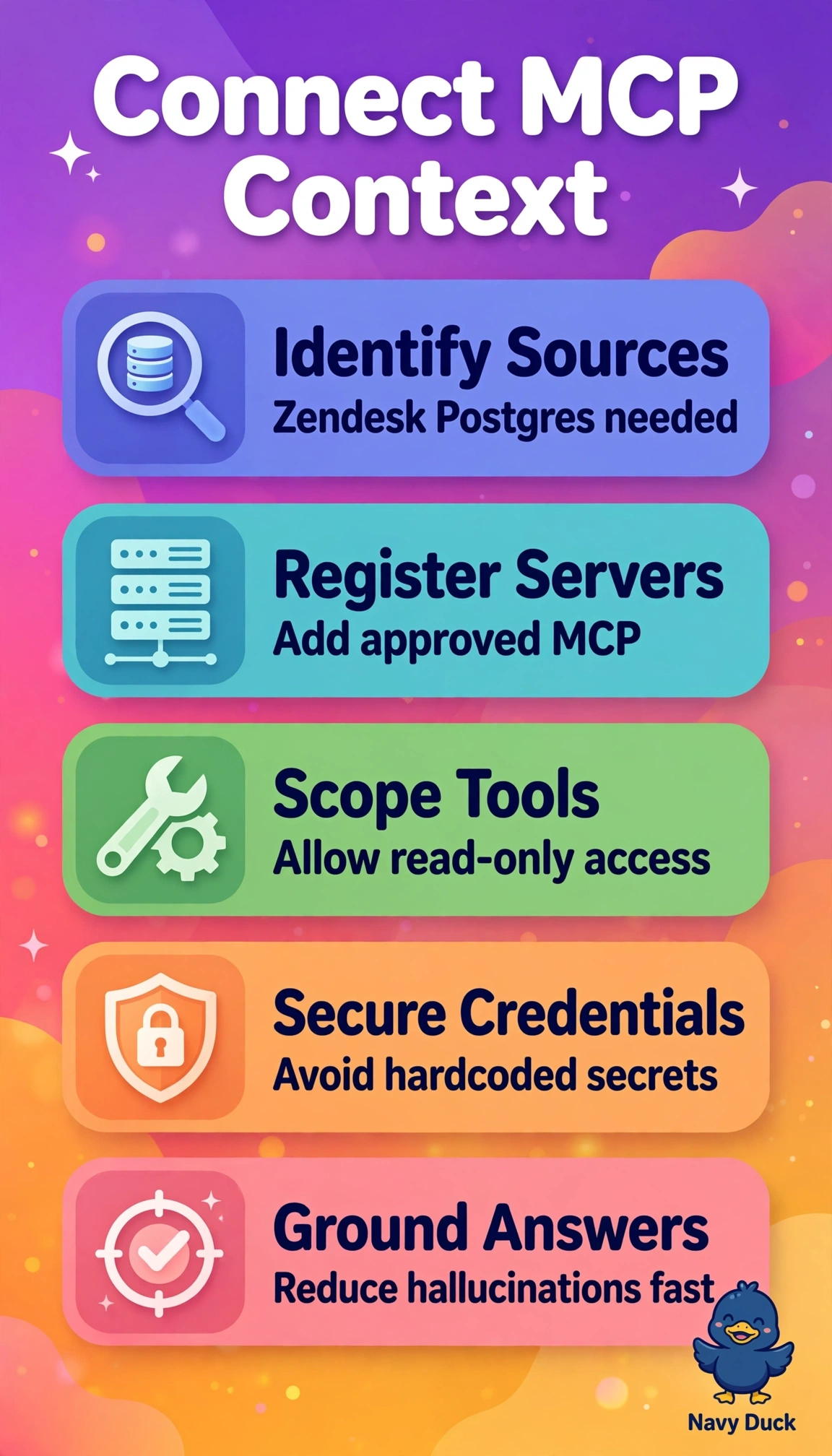
Short Explanation
You wouldn't hand over master keys for a lookup, and scoped MCP avoids that. Approved servers give live context with safe, limited access.
Full Explanation
The correct approach succeeds because scoped MCP servers expose live Zendesk and Postgres records through narrow approved read-only tools with server-managed authentication, giving agents fresh context for accurate drafts while enforcing least privilege and keeping secrets out of prompts and code. Indexed snapshots with vaulted access are attractive because caching and vector search are standard for speed, yet the core concept fails on freshness since prebuilt summaries cannot reflect new tickets or order changes, so hallucination persists despite good security. Full write automation is attractive because autonomous update is a valid pattern for closure, yet the core concept fails on authorization since the task requires read-only drafting and broad write tools create corruption and compliance risk. Shared static tokens are attractive because they simplify integration, yet the core concept fails on identity lifecycle since long-lived shared secrets lack per-agent scoping, rotation, and audit compared to managed OAuth or vault issuance. The exam caveat is to demand liveness, read-only scope, and managed credentials together and distrust any answer meeting only two, and the practical check is to list the tool manifest to confirm only read and search methods, query a just-updated order to prove liveness, and test that revoking one agent leaves others unaffected.