
A program manager at a 800-employee services company designs an agent to triage internal software access requests from intake to provisioning. Security requires auto-provisioning only low-risk requests, holding ambiguous cases, and escalating high-risk or low-confidence decisions with reasons logged. Which decision-making criteria best guide the agent's approve, hold, and escalate actions?
Select an answer to reveal the explanation.
Short Explanation
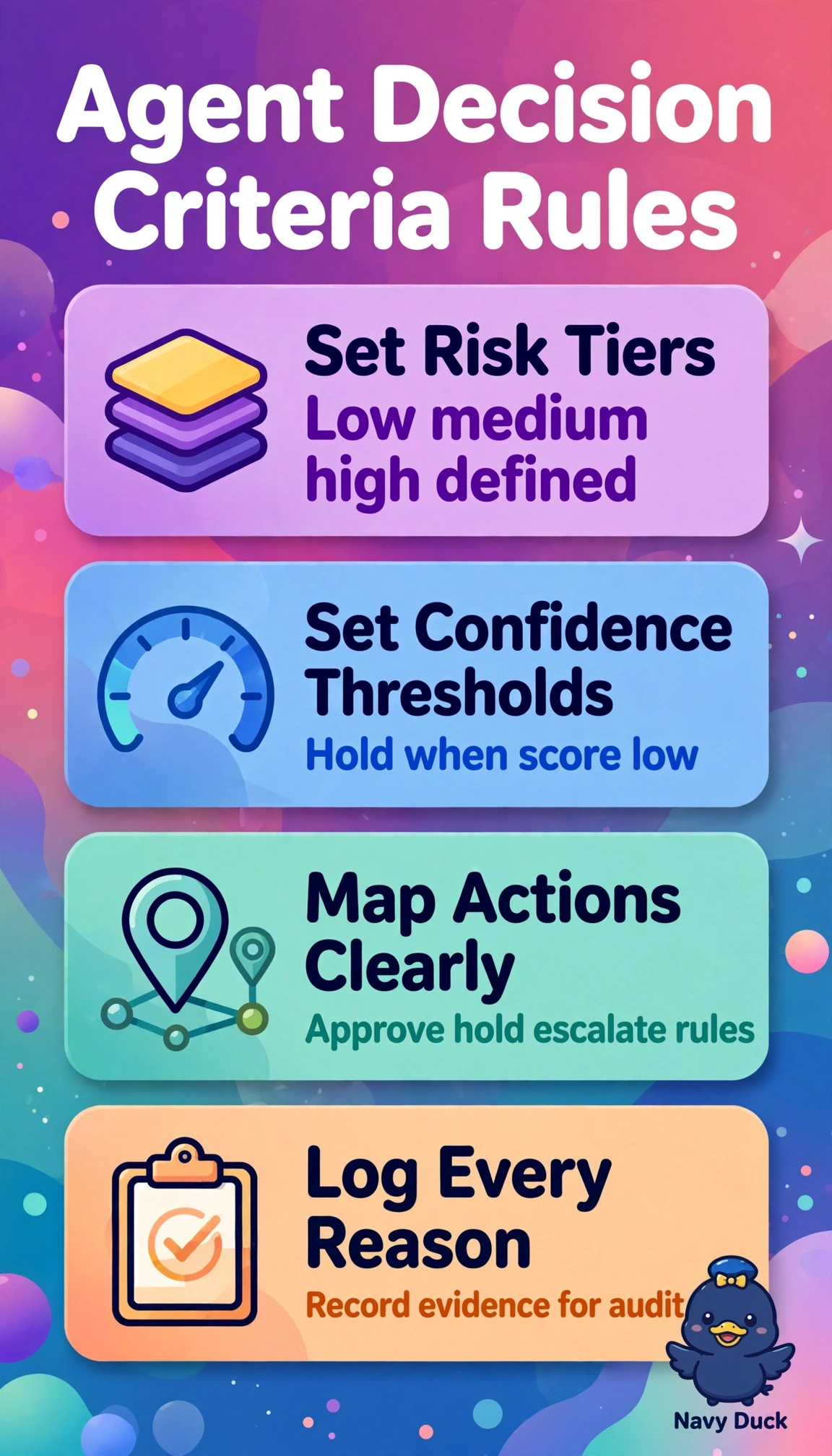
You'll want your agent to sort requests by risk and confidence, so you've got clear rules for when it can go ahead or must pause. Those thresholds work like traffic lights, giving you a clean go, yield, or stop with the reason written down every time.
Full Explanation
The correct approach is right because it jointly enforces all three security constraints for triage to provisioning: risk tiers restrict auto-provisioning to low-risk requests only, confidence thresholds create a principled mechanism to hold ambiguous cases rather than force an approve or deny, and escalation rules route high-risk or low-confidence decisions to humans while logged reasons provide auditability for every outcome. The risk-only approach fails by concept because risk classification alone cannot handle uncertainty, so a low-risk label with low model confidence would still be auto-approved instead of held or escalated as required. The confidence-only approach fails by concept because decision certainty is not the same as access safety, so a high-confidence prediction for a high-risk privileged access request could be auto-provisioned in violation of the low-risk-only rule. The workflow without audit logging fails by concept because even with correct approve, hold, and escalate routing, the absence of required reasons breaks traceability, incident review, and proof of policy compliance. As an exam caveat, do not select a partially correct governance model when the stem explicitly conjoins risk, confidence, escalation, and logging with and-language, and be wary of absolutes like regardless or without that quietly drop one conjunct. As a practical check, test the deployed agent with borderline cases such as missing manager approval, unusual privilege scope, or conflicting identity signals and verify that it holds or escalates with a stored reason instead of auto-provisioning.