
A business operations analyst must automate monthly vendor invoice reminders across finance and procurement. The agent needs a consistent trigger on the first Monday, read-only invoice access, specific reminder steps, and an audit trail. Which approach to creating agentic workflow files best delivers a maintainable automation?
Select an answer to reveal the explanation.
Short Explanation
Great automation reads like a good checklist. Trigger plus least-privilege scope plus steps means anyone can audit it, and declarative-file is your source of truth.
Full Explanation
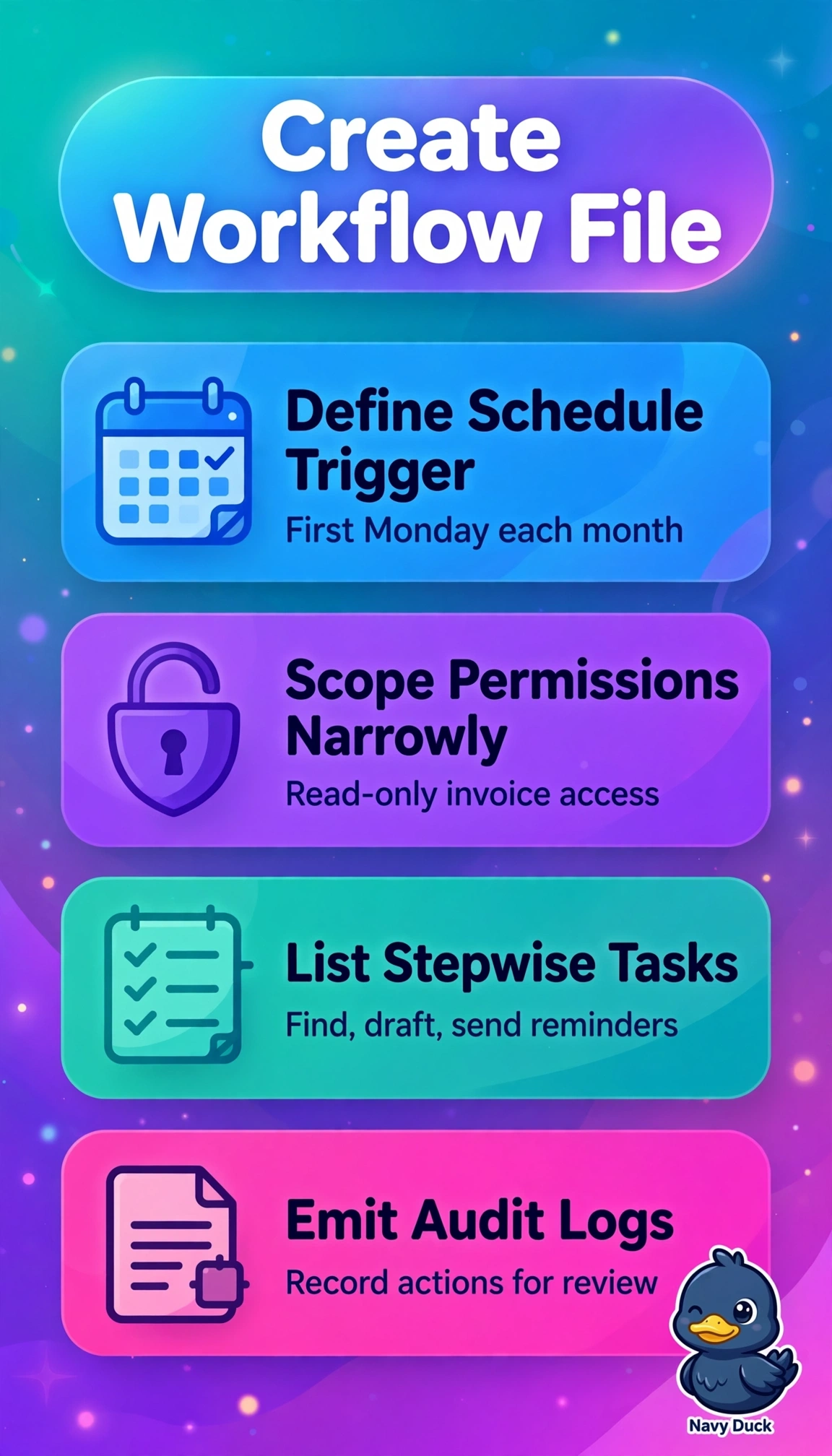
The versioned workflow file succeeds because it encodes all four requirements in one reviewable artifact, with a first-Monday schedule trigger ensuring consistent initiation, scoped read-only invoice permissions enforcing least privilege across finance and procurement, explicit stepwise tasks ensuring deterministic reminders, and logging outputs providing an audit trail, while versioning enables change control for maintainability. A well-structured manually started file fails on automation consistency because reliance on human initiation reintroduces missed or late runs and undermines the first-Monday requirement despite good permissions, steps, and logging. A scheduled versioned file reusing an existing shared finance user role fails on permission scoping because broad reusable credentials violate least privilege, expand blast radius, and complicate attribution compared to narrow read-only access. A scheduled scoped file without persistent logs fails on observability because without durable outputs there is no evidence for troubleshooting or compliance review. The exam caveat is that plausible shortcuts satisfying three of four pillars remain incorrect when the stem explicitly requires trigger, scope, steps, and audit, so identify the missing pillar. As a practical check, verify the schedule expression, permissions block, task list, and retained run log in version control.