
An operations lead is building an automation that labels incoming GitHub issues, checks inventory via an internal API, and posts a summary to Slack only when stock is low. Early tests either spam Slack or fail to call the API securely. Which tool selection and configuration should the lead implement to make the automation behave correctly?
Select an answer to reveal the explanation.
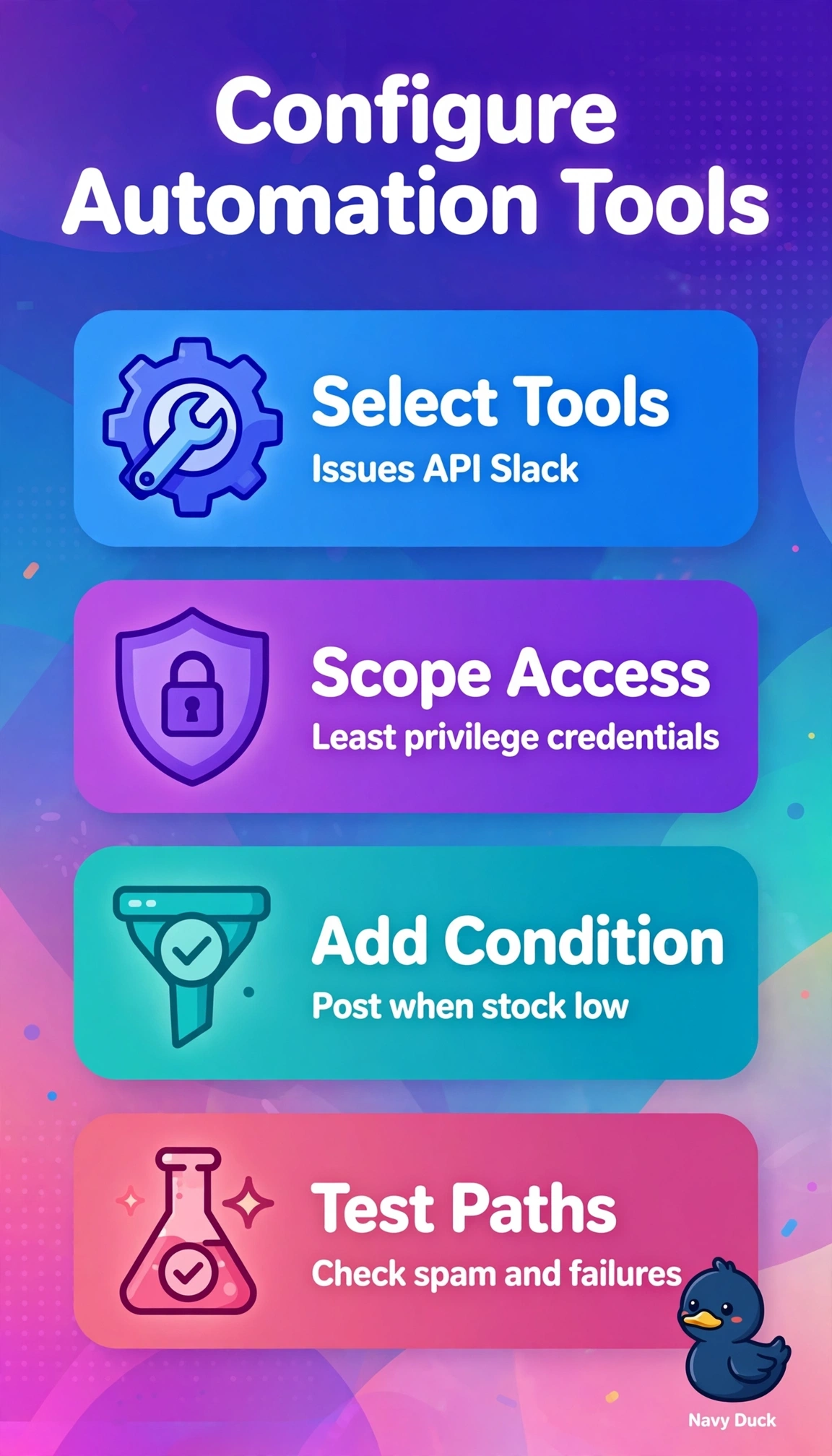
Short Explanation
You’re wiring helpers with rules, not open doors. Scoped tools plus a low-stock condition stop the spam. That combo brings secure, precise automation.
Full Explanation
The correct approach succeeds because it integrates all three required capabilities under least-privilege access and gated execution: GitHub issue tools provide labeling and context, the internal inventory API provides authoritative stock truth via scoped credentials, and Slack delivery is guarded by conditional logic so summaries appear only on low-stock conditions, which simultaneously resolves early spamming and insecure API calls. The always-post design is operationally sound for visibility but violates selective notification by emitting a message for every triaged issue, recreating alert fatigue and contradicting the only-when-low specification. The cached-data design preserves labeling and careful alerting yet breaks system-of-record integrity by substituting stale spreadsheet or cached values for the live internal API check, so reorder decisions may be based on outdated counts. The no-label design correctly secures inventory and Slack behavior but breaks intake triage by omitting classification of incoming issues, leaving downstream routing and reporting incomplete. An exam caveat is to treat qualifiers like only, scoped, and via internal API as decisive rather than background detail, since attractive answers often preserve workflow shape while dropping one constraint. A practical check is to run separate in-stock versus low-stock issues with scoped test credentials and verify no Slack message on normal stock, one accurate summary on low stock, fresh API logs per run, and a label applied to both issues.