
A program manager at a 350-employee retailer wants an agent to support new store openings coordinated across facilities, hiring, and merchandising teams. Leadership needs clear owners, defined inputs and outputs, and visible handoffs to avoid delays during the 90-day timeline. Which decomposition best breaks this store-opening use case into agent-ready processes and tasks?
Select an answer to reveal the explanation.
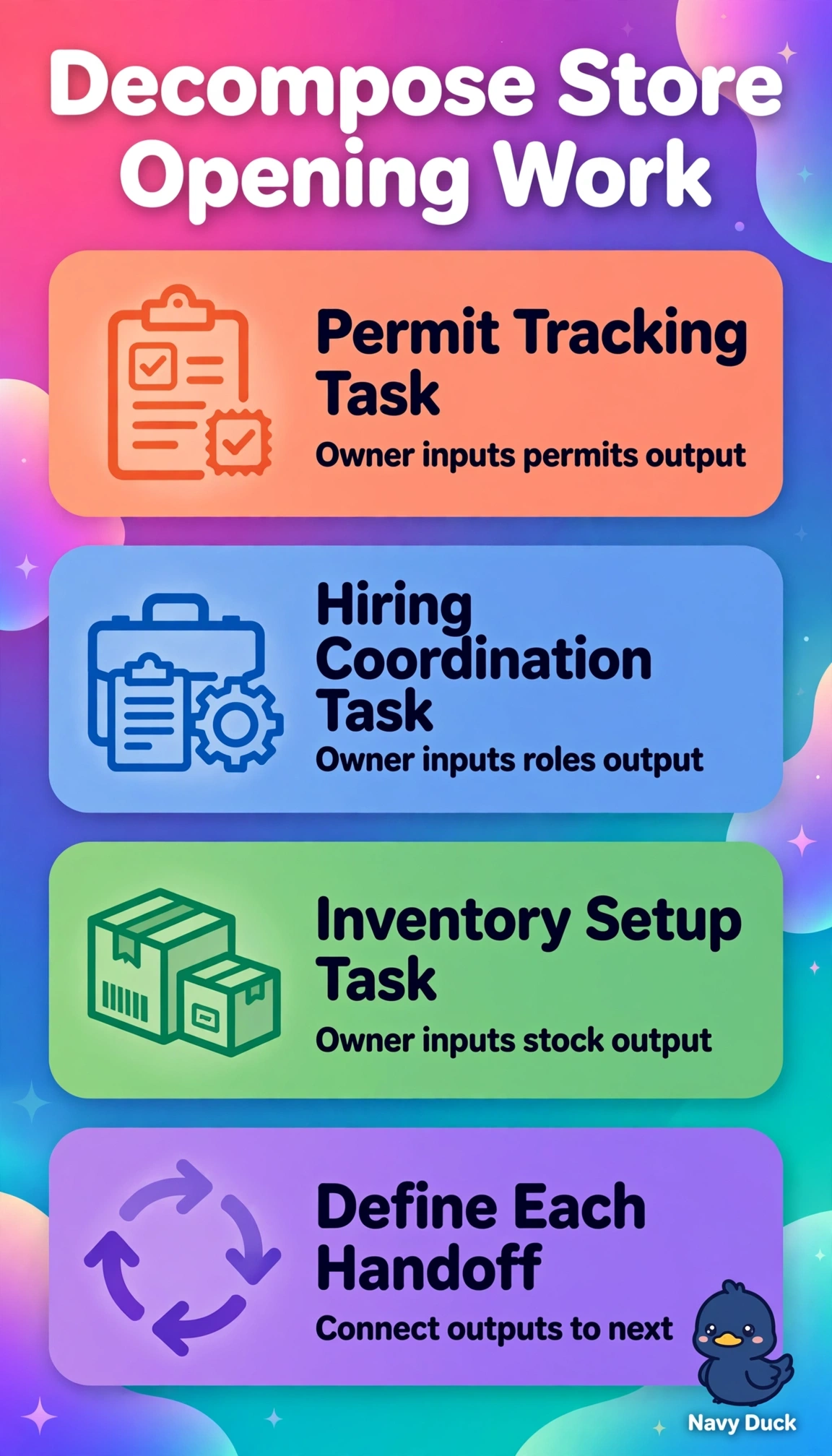
Short Explanation
You make an agent useful by turning a big goal into small ownable jobs. That kind of decomposition is like a recipe that names the cook, ingredients, and handoff for each dish.
Full Explanation
The correct response works because it converts a cross-functional 90-day store opening into discrete agent-ready units where each process names an accountable owner and specifies what goes in, what comes out, and where responsibility transfers next, which directly prevents the queueing and ambiguity that cause delays across facilities, hiring, and merchandising. The workstream breakdown with milestones but no mapped handoffs fails on dependency management because ownership and timing without explicit transfer conditions leave agents unable to trigger, validate, or escalate the next step when permits, hires, or stock move between teams. The weekly-standup breakdown fails on interface contract design because owners, handoffs, and deadlines cannot drive reliable automation if required inputs, data formats, and expected outputs remain undefined for the agent to consume and produce. The repeatable-template breakdown fails on time-bounded orchestration because generic reusable documentation without anchoring tasks, buffers, and handoffs to the 90-day timeline cannot enforce sequencing or expose slippage during this opening. On the exam, beware highly professional answers that satisfy three of four leadership constraints and differ by only one omitted element, so match every stem noun to the choice before selecting. As a practical check, walk one real case end to end and confirm each task shows a single owner, a testable input and output, the receiving team and trigger for the handoff, and a due date that rolls up inside 90 days.