
A business analyst must let an agent draft vendor contract redlines from legal playbooks. Policy demands a human approves strategy before drafting, but the analyst wants hands-off drafting once the plan is approved to save time. Which agent work mode best balances oversight and efficiency?
Select an answer to reveal the explanation.
Short Explanation
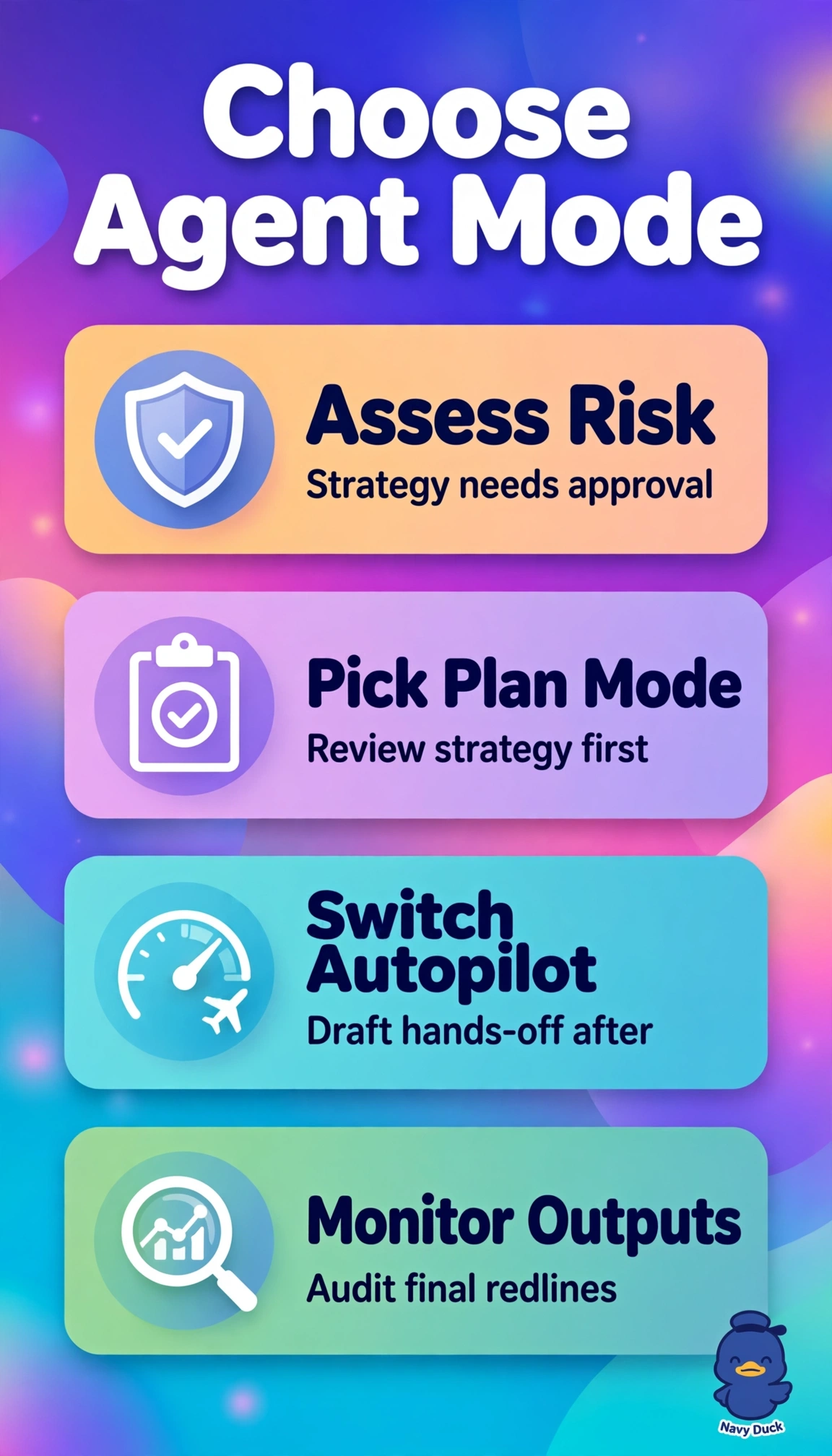
Matching control to risk is your superpower here. That pairing uses plan mode for the risky strategy gate, then lets autopilot handle routine drafting. It's like approving architectural blueprints before letting the crew build unsupervised.
Full Explanation
The correct pattern separates governance from execution by using plan mode to present the redline strategy for explicit human approval before any drafting begins, then switching to autopilot mode to execute hands-off drafting constrained to the legal playbooks, which satisfies the policy gate, preserves compliant grounding, and delivers the time savings the analyst seeks. By contrast, retaining interactive mode with per-clause confirmation after an approved plan preserves oversight but defeats the stated efficiency goal because the human remains in the loop for every drafting step rather than delegating execution after approval. Aligning through interactive discussion before hands-off autopilot drafting from playbooks is efficient and grounded, yet it fails the governance requirement because informal conversational alignment is not the formal plan approval that policy explicitly demands for strategy. Drafting hands-off from past precedents after plan approval is also efficient and properly authorized at the strategy level, yet it fails the grounding requirement because vendor precedents are not the authorized playbooks and may introduce outdated or non-compliant language. Exam caveat: distinguish formal plan approval from general human-in-the-loop interaction, as only an explicit approved plan artifact satisfies a policy gate before autonomous execution. Practical check: verify the run log shows an approved plan version, autopilot execution without per-step prompts, and citations to specific playbook sections for each proposed redline.