
A regional clinic network proposes an agentic workflow to handle 1,500 weekly patient rescheduling messages by reading requests, checking scheduling policy, and updating the calendar. Wait times are long, staff overtime is high, and errors risk missed care. Which assessment of workflow impact and business value best justifies the investment decision?
Select an answer to reveal the explanation.
Short Explanation
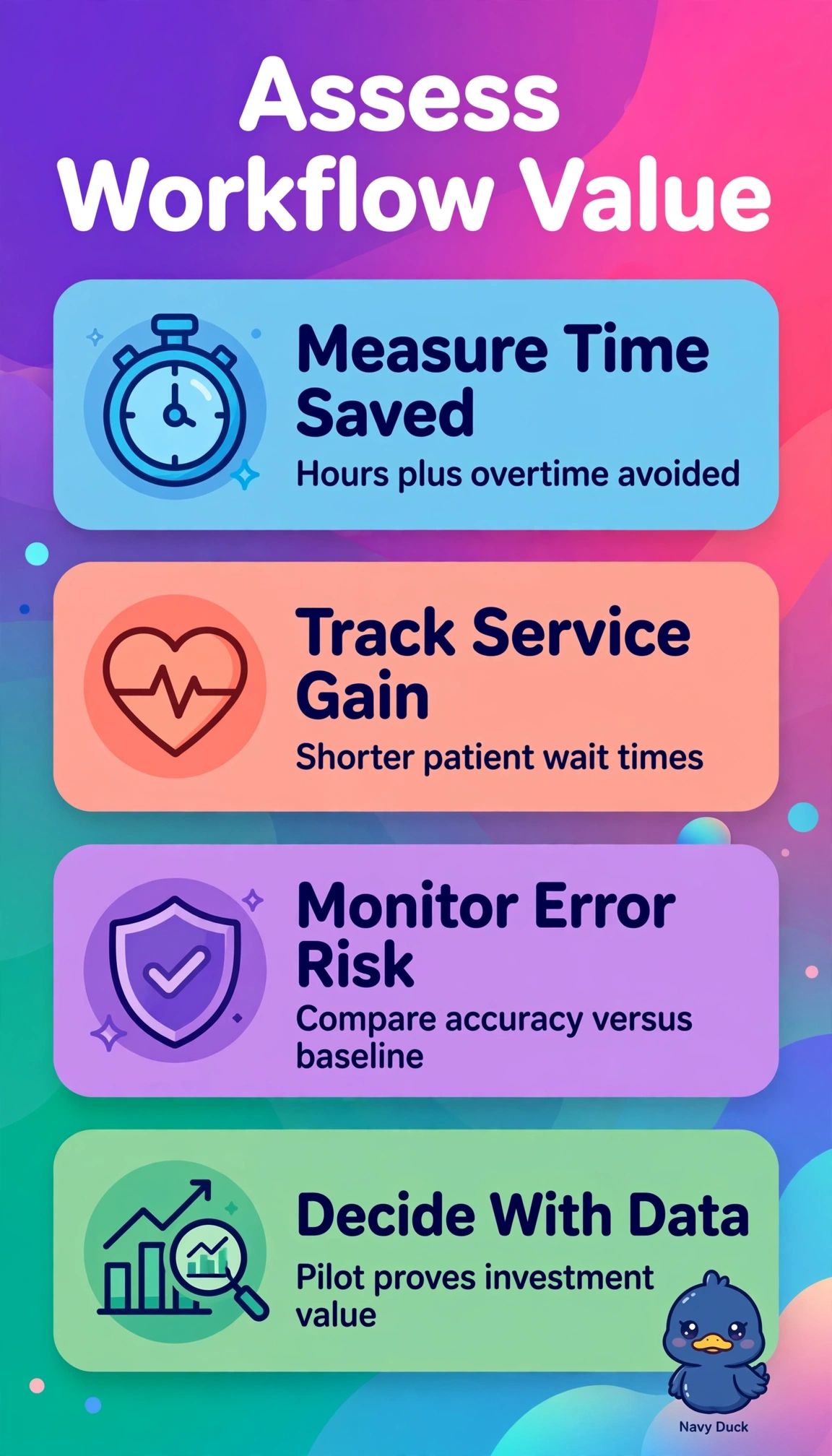
You’re not just counting messages; you’re showing what they cost your team and your patients. Like checking your receipt before and after using a coupon, a pilot baseline helps prove you’ve saved hours, avoided overtime, and shortened waits.
Full Explanation
The assessment that compares hours saved, overtime avoided, wait-time reduction, and error risk against a pilot baseline best supports an investment decision. It covers every stated business concern and provides a credible comparison to help attribute changes to the workflow rather than shifts in message volume or seasonal variation. Measuring throughput alongside hours, overtime, and wait-time changes against a baseline is useful, but it leaves scheduling error risk unmeasured, so the potential cost of missed care is not included. Quantifying hours, waits, and error risk while excluding overtime is incomplete because overtime is an explicit business pain; omitting it can understate return on investment and mislead staffing decisions. Reviewing hours, overtime, waits, and errors only after launch lacks a pre-pilot baseline, so even measured gains cannot establish the workflow’s incremental benefit. An exam caveat: avoid a measure that is strong operationally but narrow; the best assessment combines efficiency, cost, patient experience, and risk with a comparison, rather than relying on volume or satisfaction alone. For a practical check, record pre-pilot overtime hours, average rescheduling wait time, and error or near-miss rates for the same clinics, then measure them the same way during the pilot to calculate net value.