
A program manager at a 40-person SaaS firm wants an agent to triage new bug reports by reproducing steps, labeling severity, and assigning the owning team, with audit logs for compliance. Past runs skipped steps and assigned randomly. Which agentic workflow instruction set best creates reliable behavior?
Select an answer to reveal the explanation.
Short Explanation
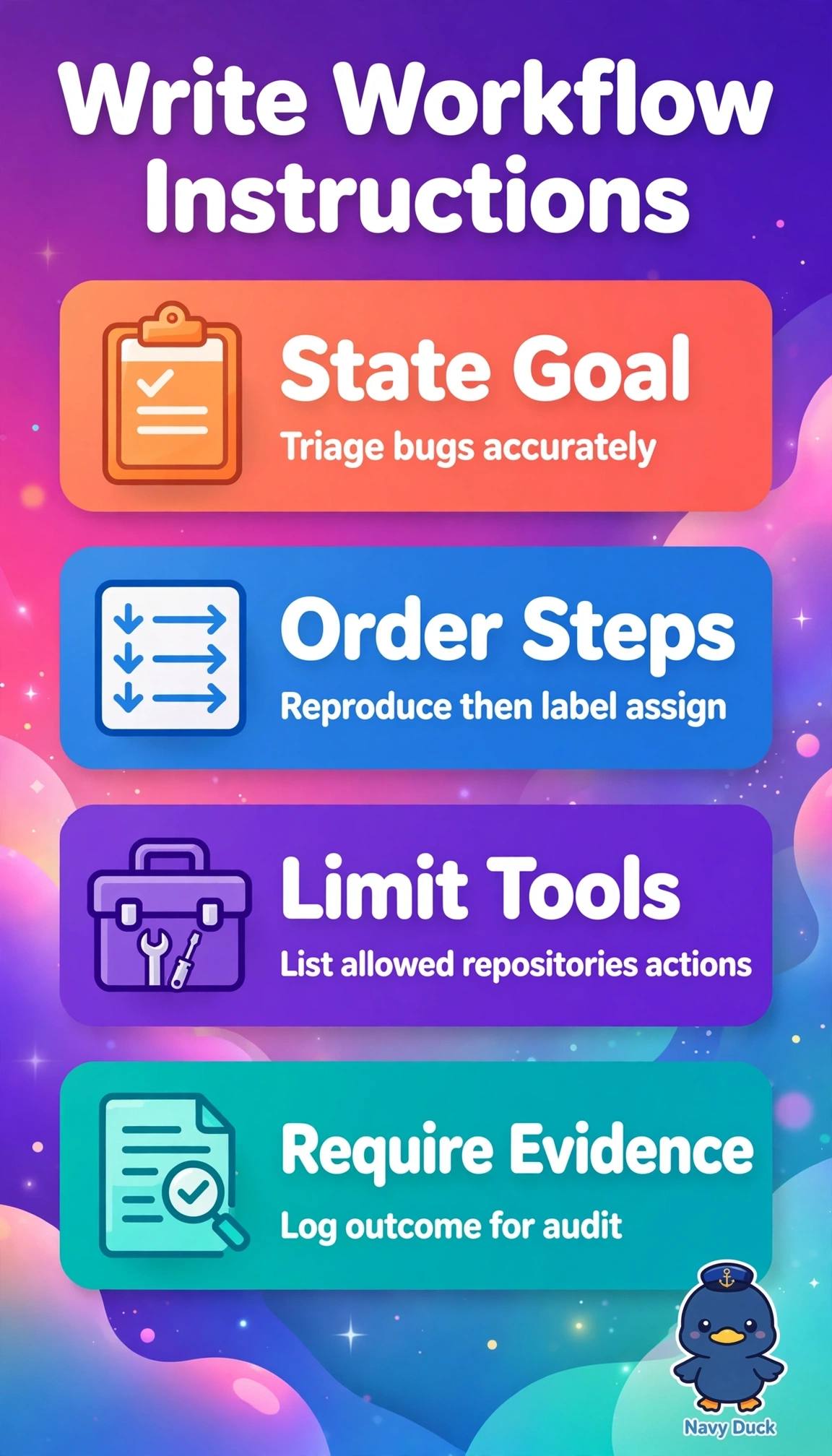
You'll get steadier results when you spell out your goal, order the reproduce-label-assign steps, name the tools, and demand a log. That's like handing your sous-chef a recipe card with steps, tools, and a photo to prove the dish.
Full Explanation
The correct instruction set succeeds because it binds a clear triage goal to an ordered reproduce-label-assign sequence, constrains execution to listed tools, and mandates a logged outcome, which together prevent skipped steps, random assignment, and missing compliance evidence. The notify variant fails on ownership because notifying a channel after reproduction and labeling does not route accountability to a specific owning team, so tickets can stall despite looking complete, directly repeating the random-assignment failure. The dashboard-update variant fails on auditability because a summarized display is mutable and lossy, whereas compliance requires an immutable logged outcome linking inputs, tool calls, and decisions for later review. The suggest-tools variant fails on control because encouraging helpful tools leaves tool selection open-ended, increasing variance and risk of unapproved reproduction methods, while an explicit allowlist enforces reliable behavior. As an exam caveat, beware attractive near-synonyms that change the operative concept, since test writers use notify for assign or summary for log to reward precise reading of required workflow elements. As a practical check before deployment, run synthetic bug reports and inspect the audit log to confirm reproduce then label then assign occurred with only allowed tools and that each record identifies severity and owner.