
A procurement supervisor pilots an agentic workflow that creates purchase orders from approved requisitions for a 500-person manufacturer. Finance requires quantities to match requisitions, vendors to be on the approved list, and totals to stay within budget, while operations wants faster cycle times. Which supervision practice best ensures that agentic workflows meet requirements?
Select an answer to reveal the explanation.
Short Explanation
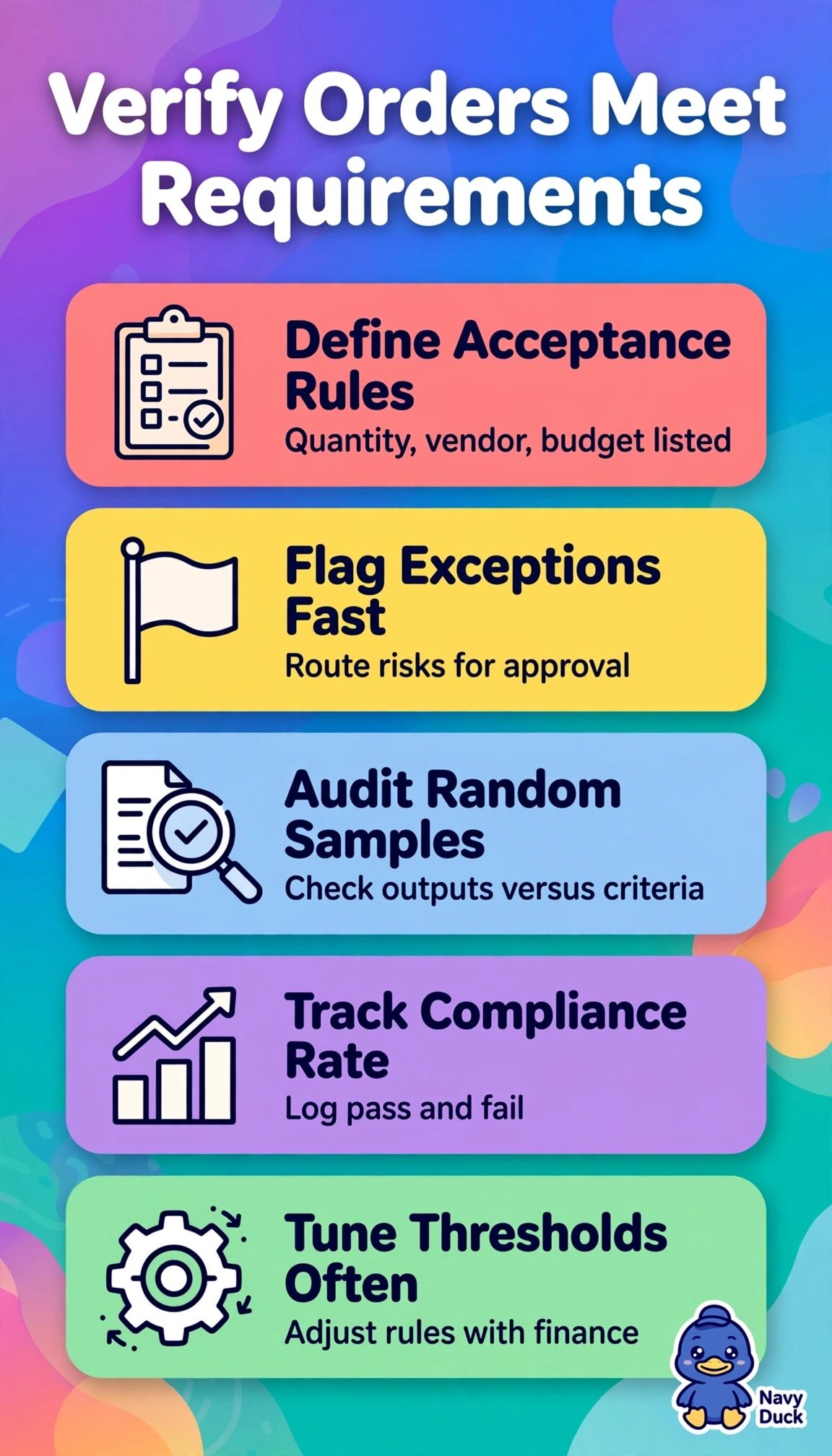
Faster orders mean nothing if they break finance rules, so you’ve got to check the receipts. Sampling outputs against criteria plus human approval keeps speed and compliance in balance.
Full Explanation
The correct practice is right because it balances both stakeholder demands through exception-based oversight: routing only flagged orders for human approval preserves operations faster cycle times instead of bottlenecking every transaction, while systematically auditing sampled outputs against all three finance constraints of quantity match, approved vendor list, and budget limit ensures agentic drift is detected without reviewing everything. Requiring manual supervisor approval on every order verifying all three rules fails by concept of proportionality and scalability, as universal human gating satisfies finance but directly violates the operations requirement for faster cycle times and defeats the purpose of piloting an agent for a 500-person manufacturer. Routing flagged orders for human approval and auditing only quantity accuracy and budget limits fails by concept of completeness of controls, as it implements proper human-in-the-loop and sampling discipline yet omits the approved vendor status check and would allow off-list purchases to pass. Auditing sampled outputs for all three finance rules while tracking cycle improvements fails by concept of preventive versus detective control, as retrospective sampling and metrics detect issues after creation but provide no in-flight intervention for high-risk flagged orders before release. As an exam caveat, beware attractive answers that list two of three finance checks plus efficiency language because partial coverage is still noncompliant when the stem explicitly enumerates quantity, vendor, and budget together. As a practical check, confirm exception thresholds are defined, the approved vendor master is system-enforced, and audit samples are stratified and documented with remediation for mismatches.