
A retail operations director spends 15 hours weekly manually copying Zendesk trends into GitHub issues, chasing owners for status, and compiling Friday status decks. Volume is high, rules are clear, and delays cause stockouts. Which criterion should the director use to identify use cases that can be optimized by agentic workflows or automations?
Select an answer to reveal the explanation.
Short Explanation
You’re hunting for boring repetition that hurts when it’s late. Repeatability plus clear rules screams automate me first. Save human judgment for negotiations and reviews.
Full Explanation
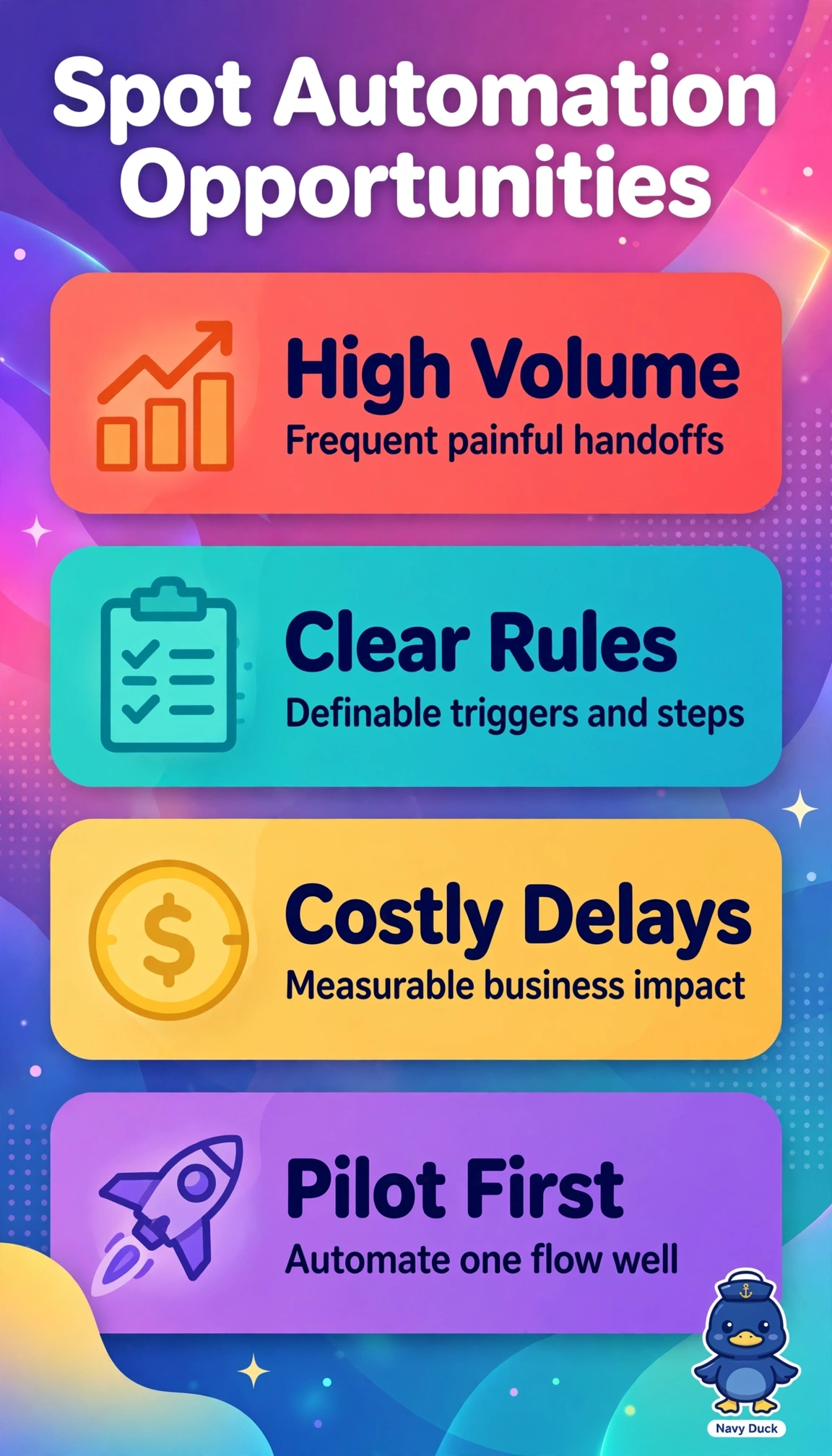
The correct criterion works because it combines all four signals in the scenario: high volume across 15 hours weekly justifies investment, rule-based work allows reliable delegation, cross-tool handoffs from Zendesk trends to GitHub issues to Friday decks remove copy-paste latency and chasing, and clear triggers plus measurable delay costs tied to stockouts let the director sequence by business risk. The hours-saved-per-week criterion fails by concept because effort-based prioritization optimizes for convenience rather than urgency, so tidy but low-risk tasks could rank above stockout-driving delays. The continuous-monitoring criterion fails by concept because observation without defined starting events creates noisy runs and unclear ownership, whereas agentic workflows need explicit triggers such as a trend threshold, owner non-response, or reporting cutoff to act deterministically and auditably. The Zendesk-only tagging criterion fails by concept because single-system cleanup improves categorization but leaves the end-to-end copying, follow-up, and deck compilation untouched, so total lead time does not fall. As an exam caveat, do not select a plausible best practice that satisfies three cues but drops the fourth; identification questions reward the full conjunction of volume, rules, handoffs with triggers, and costed delay. As a practical check, map one week of tickets to trigger, handoff, rule, and stockout cost before building, then automate the highest-cost handoff first and measure delay reduction.