
An operations lead wants an automation that labels new backlog issues as triage-needed, and re-labels issues idle for 14 days as stale for a 200-issue backlog. Manual labeling misses items and runs at odd times. Which choice best selects and configures triggers for this automation?
Select an answer to reveal the explanation.
Short Explanation
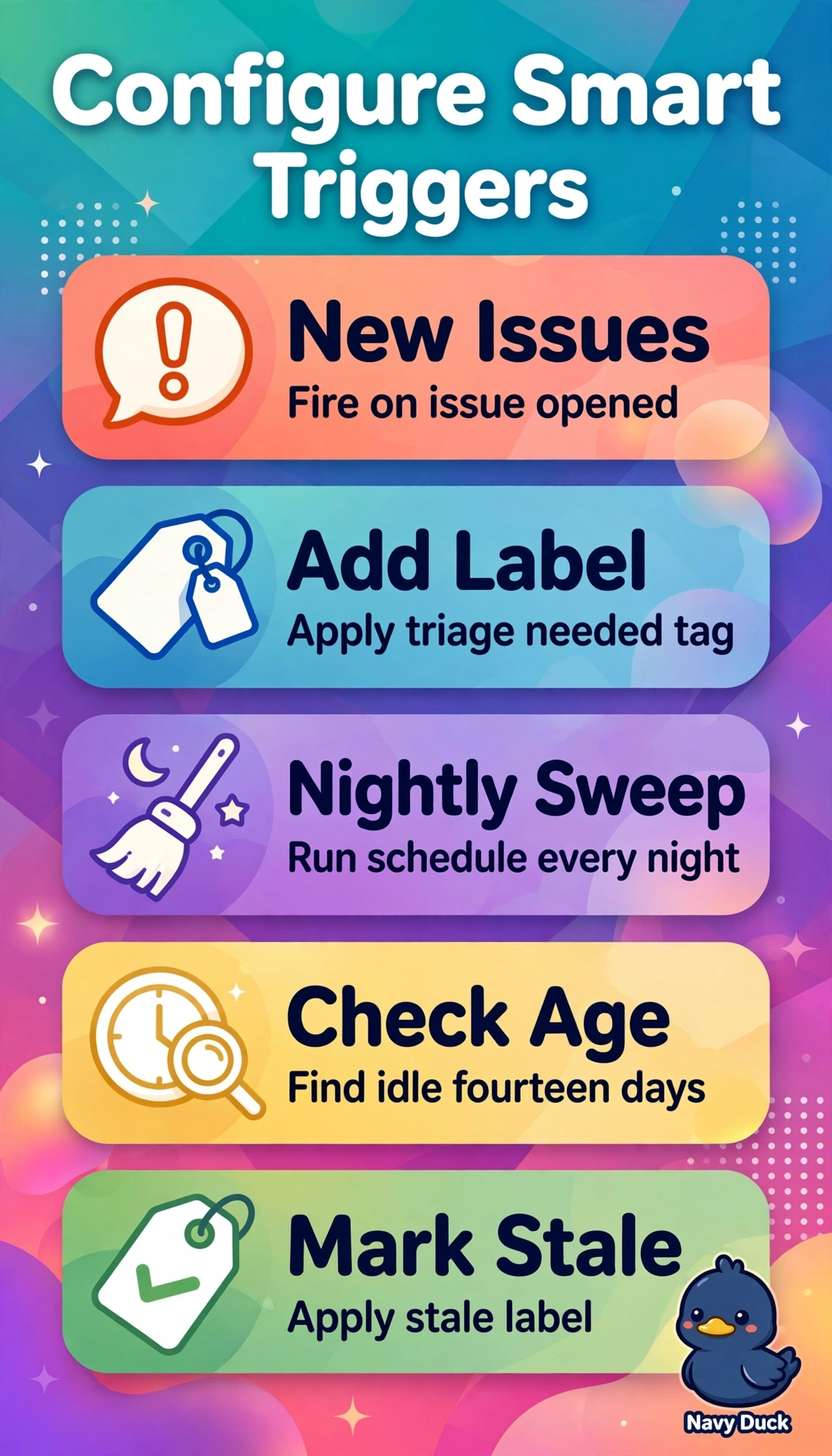
Right moments make automation feel magic. You're pairing each job with its natural trigger, like setting one alarm for arrivals and another for bedtime.
Full Explanation
The correct pairing matches event-driven creation to time-based aging because issue-opened fires immediately when a backlog item is created so triage-needed labeling is complete without polling delay, while a nightly schedule query can filter updated-at older than 14 days across the full 200-issue backlog to apply stale at a predictable time, fixing missed items and inconsistent manual timing. Batching both tasks into a single nightly schedule is a common efficiency pattern but it fails immediacy for new arrivals by delaying triage labeling until the next run. Relying on an issue-updated event for stale detection is widely used for activity-driven work but it confuses activity with inactivity because stale requires absence of activity for a duration, so items that sit idle would never trigger evaluation. Limiting the nightly scan to labeled issues only is a valid tactic to save API calls but it fails coverage here because unlabeled or imported idle items outside that subset would never be examined for the 14-day rule. As an exam caveat, distinguish creation events versus time conditions versus activity events, since prompts pairing new plus idle-for-N-days almost always expect an event trigger plus a scheduled query rather than two events or two schedules alone. As a practical check, verify the scheduled query filters on updated_at with pagination and test that a fresh issue is labeled within seconds and a 14-day idle fixture is marked stale overnight.