
A business analyst must automate triaging 500 weekly support tickets requiring classification, knowledge lookup, and human approval for refunds. Accuracy and auditability matter more than speed. Which choice best aligns the agentic workflow with common design patterns?
Select an answer to reveal the explanation.
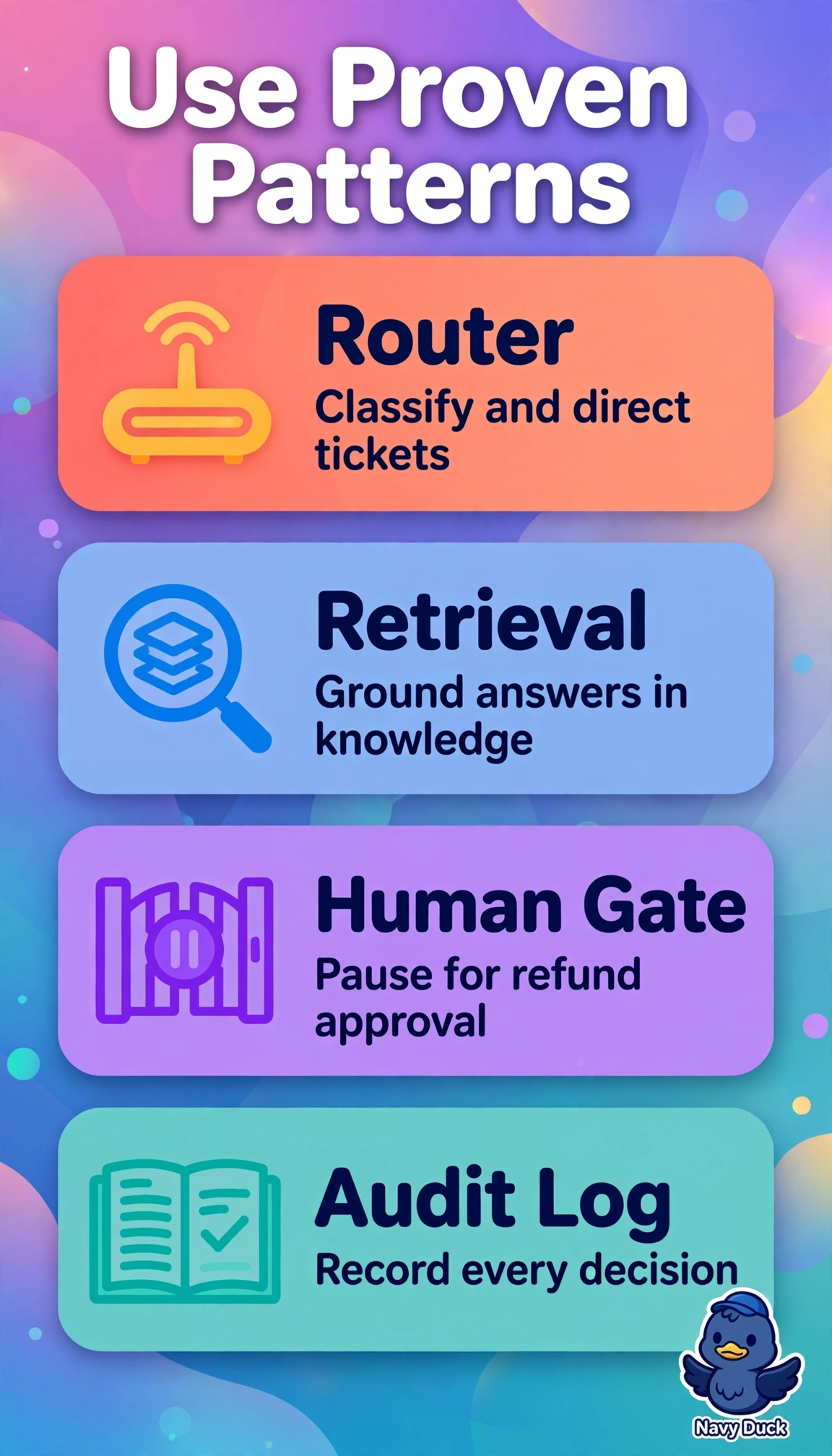
Short Explanation
You'll get your 500 tickets sorted and matched to answers automatically, yet you're still in charge when refunds pop up — like a bakery conveyor that pauses for your final icing check. That human-in-the-loop setup keeps you fast, accurate, and audit-ready.
Full Explanation
The correct design is right because triaging diverse tickets requires classification plus routing to appropriate handling, grounding responses with retrieval for accuracy, and a human approval gate before refunds for auditability when accuracy outweighs speed. The reflection variant fails by concept because self-critique with logged revisions improves draft quality and traceability but cannot replace explicit human authorization, so auto-issuing refunds violates financial control and the stated approval need. The fine-tuned-memory variant fails by concept because answering from internalized weights replaces live knowledge lookup with static memory that can drift and lacks citations, undermining accuracy and auditability despite correct routing and approval. The sequential-chain variant fails by concept because fixed-order retrieval with approval omits classification and routing, leaving no way to triage heterogeneous tickets at 500 per week into correct paths. Exam caveat is that audit logs and reflection history do not equal approval, so choose explicit human gates for high-stakes actions even when logging looks auditable. Practical check is to map every requirement to a mechanism and verify no refund executes without recorded human sign-off with retriever sources attached.