
A support operations lead owns a triage agent that failed overnight on malformed tickets, blocking the queue. She has error logs, a few bad ticket examples, and permission to retry. Which interaction should she use to resolve failures in the agentic workflow?
Select an answer to reveal the explanation.
Short Explanation
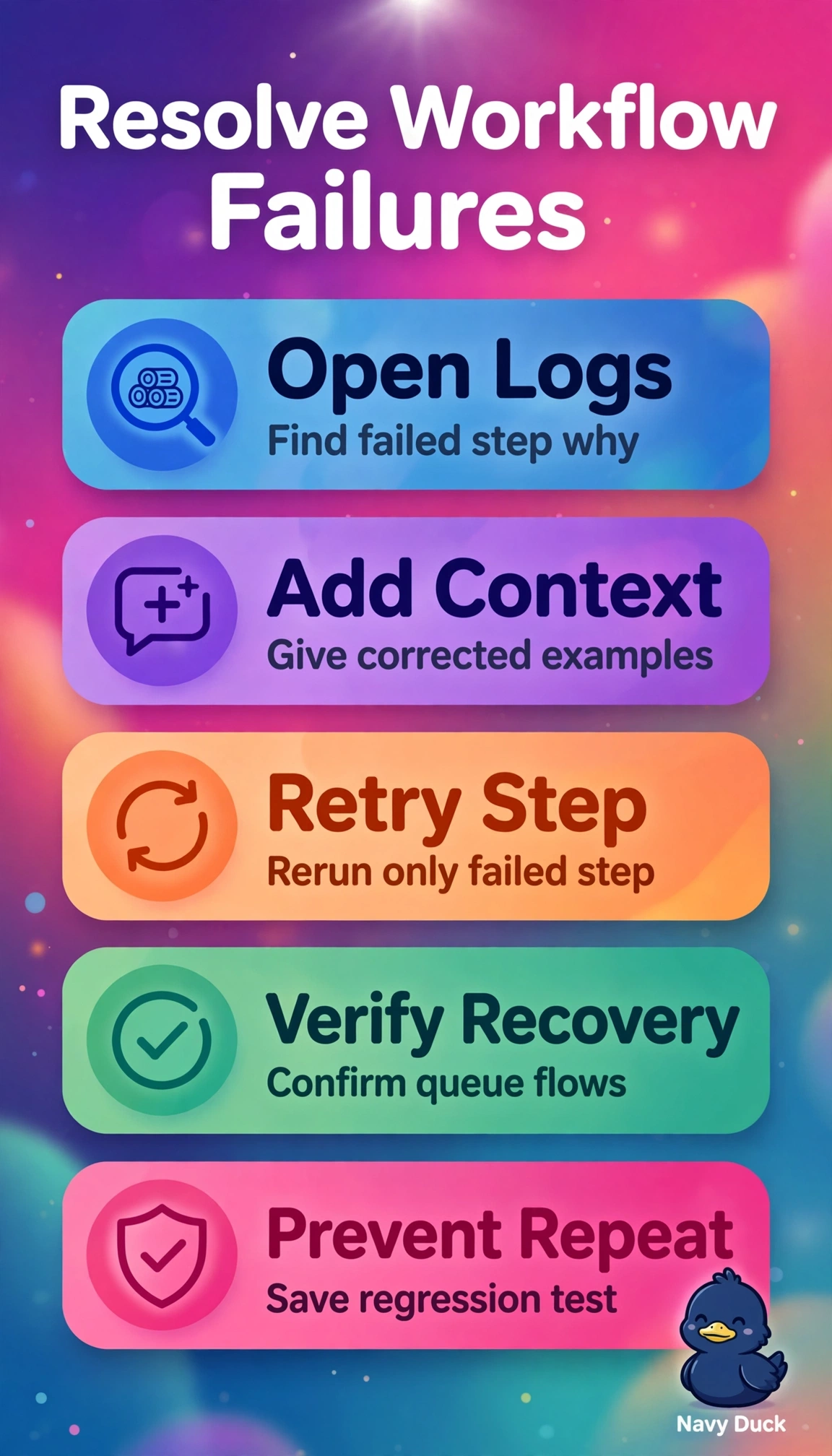
Failures are clues, not dead ends. Targeted retry-with-context helps you fix the exact step and prove the queue flows again.
Full Explanation
The correct interaction succeeds because it follows the closed-loop recovery pattern for agentic workflows: diagnose the precise failure from step-level logs rather than guessing, supply corrected examples to steer handling of malformed tickets, then resume execution at the failed step to preserve completed work and confirm the queue unblocks. The alternative that reviews logs but restarts the entire workflow from the beginning fails on scope and efficiency, since re-executing successful steps wastes time and can duplicate side effects like ticket updates while still leaving the model without guidance on malformed inputs. The alternative that inspects logs and immediately retries the failed step fails on adaptation, because without added examples the same malformed pattern is likely to trigger the identical error and cause another block. The alternative that adds examples and retries the failed step without inspecting logs fails on diagnosis, because guidance applied blindly may not address the true root cause recorded in the error details. As an exam caveat, distinguish resuming a failed run from starting a new run and distinguish adding guidance from merely rerunning with identical inputs, since wording about step versus workflow scope often determines correctness. As a practical check, confirm the failed step status changes to succeeded, validate the next few triaged tickets for correct parsing, and monitor queue throughput before closing the incident.