
A product manager is building an automation that drafts customer release notes from merged pull requests for a fintech app. It must use concise tone, cite the PR source, and use a cost-effective model for high volume. Which prompt and model setup should the manager choose to configure prompts and models for an automation?
Select an answer to reveal the explanation.
Short Explanation
You're tuning both recipe and oven for bulk baking. A focused prompt plus an efficient model keeps quality high and costs steady at scale.
Full Explanation
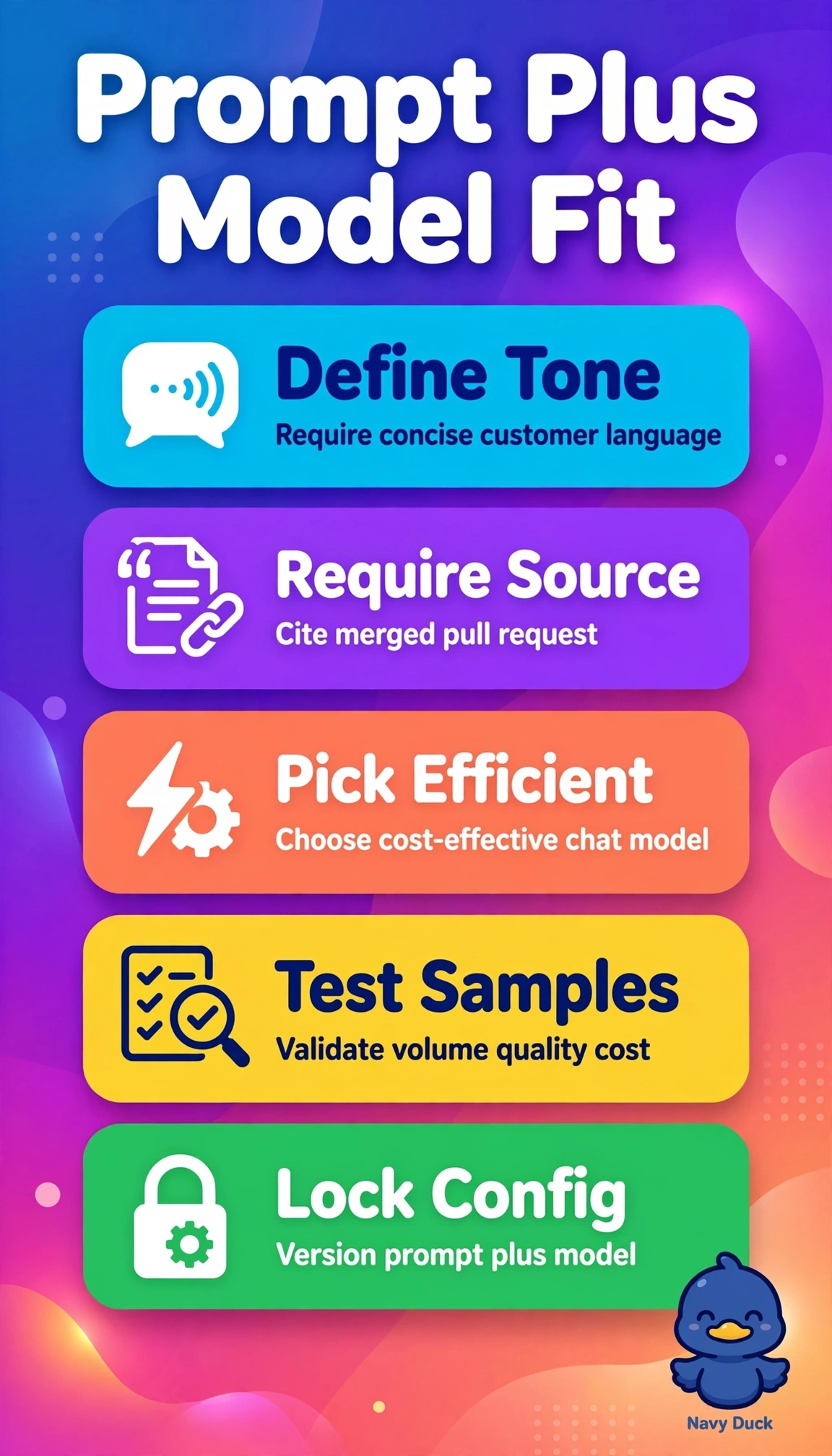
The correct setup satisfies all three constraints together: a dedicated release-note prompt enforces concise tone for customers, explicit citation rules preserve traceability to each merged pull request for trust and audit, and an efficient chat model controls cost and latency at high volume without sacrificing routine quality. A detailed thorough prompt with citations on an efficient model suits internal changelogs and compliance review, but it fails the conciseness requirement by generating longer notes that need extra trimming. A concise prompt without citation rules on an efficient model suits high-throughput drafting where provenance lives elsewhere, but it fails the traceability requirement essential for fintech verification. A concise cited prompt on a premium reasoning model suits complex inference over difficult code, but it fails the cost-effectiveness requirement since routine drafting cannot justify premium price and latency. Exam caveat: match model tier to task complexity and volume rather than assuming the most capable model is best. Practical check: pilot on representative PRs to verify brevity, confirm every claim links to the right PR, and measure cost and latency per thousand notes before rollout.