
You are a business analyst at a 500-person manufacturer drowning in weekly supplier emails, spreadsheet reconciliations, and status meetings that follow the same steps. Leadership wants measurable time savings without replacing human judgment on exceptions. Which criterion should you use to identify use cases that can be optimized by agentic workflows or automations?
Select an answer to reveal the explanation.
Short Explanation
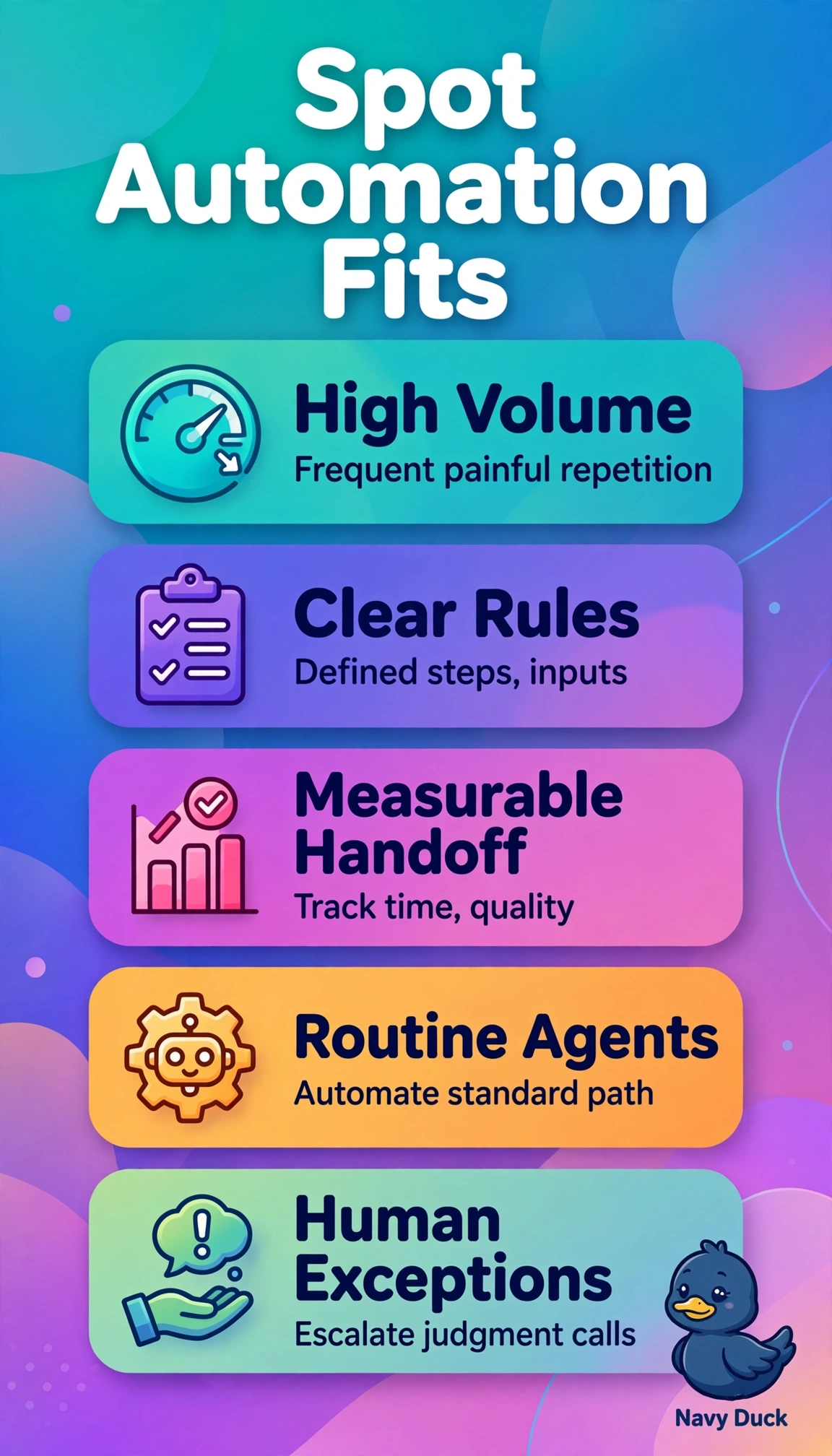
You'll save the most time when you point automation at your busiest, rule-based routines with clear, measurable handoffs. Repeatability is your filter here, like paving your busiest footpath first so routine work flows through while you still catch the exceptions.
Full Explanation
The correct criterion fits the manufacturer because weekly emails, reconciliations, and status meetings are high-volume and repeatable with the same steps, so clear rules and measurable handoffs let you baseline cycle time and handoff errors and prove time savings, while having agents do routine work and escalate exceptions preserves human judgment exactly as leadership required. The fully autonomous reconciliation approach fails on governance by removing human review and letting agents close shortages alone, which is a valid straight-through automation pattern elsewhere but violates the explicit requirement to keep judgment on exceptions and creates audit and safety risk. The satisfaction-oriented email drafting approach fails on value measurement because improving stakeholder satisfaction is a legitimate collaboration goal but does not satisfy the demand for measurable time savings and would be hard to quantify as hours saved. The negotiation-support approach fails on suitability because complex low-volume negotiations benefit from agent-assisted analysis yet lack the volume, repeatability, and rule clarity needed for workflow optimization ROI. For the exam, distinguish between preserving versus replacing judgment and between measurable efficiency versus qualitative improvement language, since attractive distractors often keep four of five constraints. As a practical check, verify volume per week, rule clarity, exception rate, and time per handoff before automating, then pilot routine-path automation with explicit escalation thresholds and track hours saved and escalation accuracy.