
A finance operations team wants an agent to auto-approve software purchases under a threshold, route larger requests to managers, and flag unusual vendors for review. They need consistent, auditable decisions without ad-hoc judgment. Which specification best defines decision-making criteria for the agent?
Select an answer to reveal the explanation.
Short Explanation
You're giving the agent clear guardrails it can actually follow. Explicit criteria act like posted speed limits with detour signs, not vibes. Thresholds plus escalation keep every decision consistent and auditable.
Full Explanation
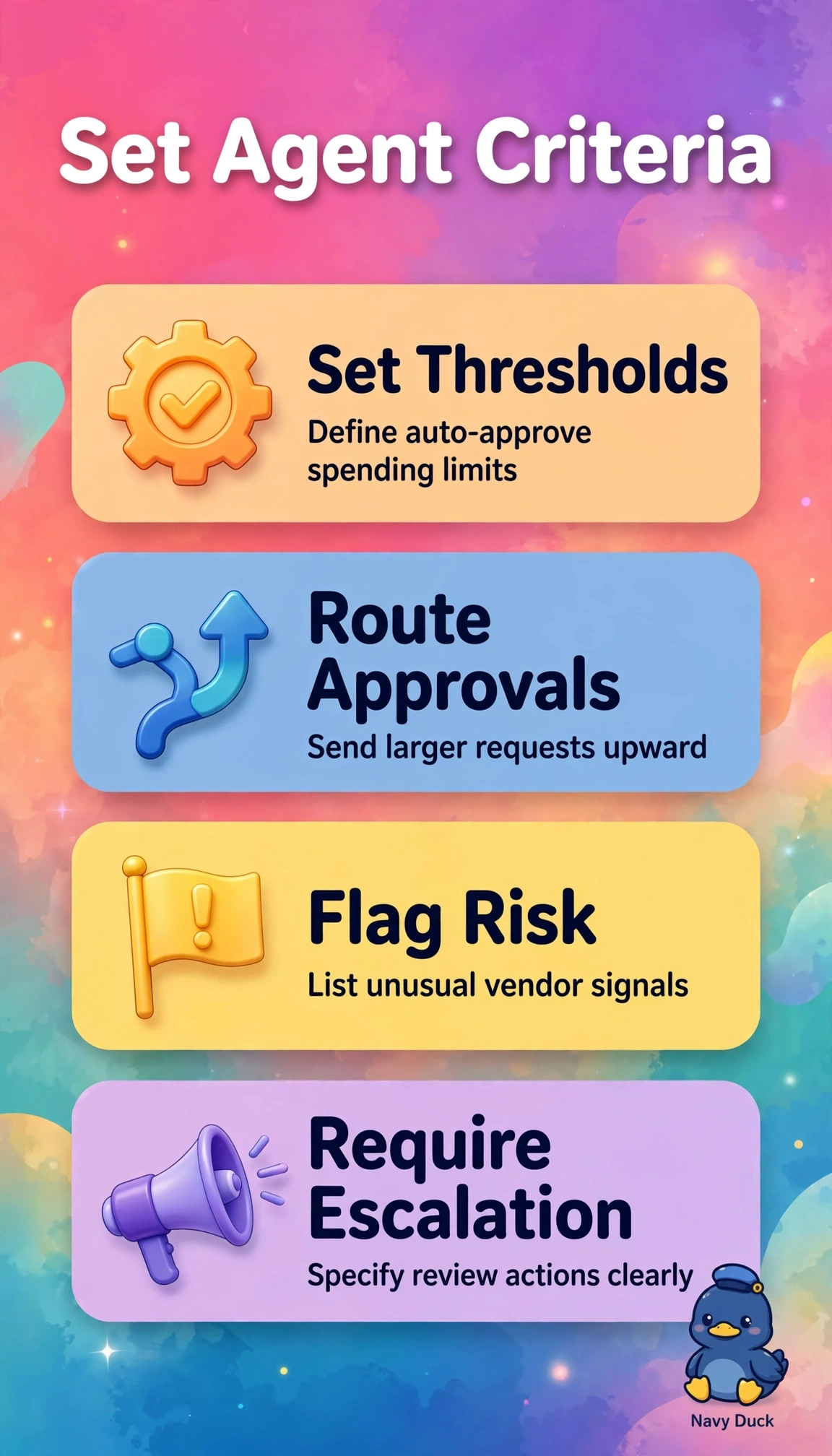
The correct specification is right because it directly operationalizes all three business rules into deterministic, verifiable criteria: quantitative spending thresholds determine auto-approval versus manager routing, predefined vendor risk rules trigger review, and required escalation actions remove discretion while creating an audit trail that finance auditors can test for consistency. The version-controlled thresholds and routing distractor fails on completeness because despite strong governance and logging, deferring vendor assessment leaves the unusual-vendor requirement unaddressed, so risky suppliers could auto-approve under the threshold. The streamlined-decision distractor fails on auditability because explicit rules alone do not satisfy the stated need for auditable decisions if logs are not mandated, leaving no evidence to prove which rule fired. The adaptive learning distractor fails on consistency and predictability because continuously tuned thresholds and scores, while common in modern procurement analytics, replace explicit, stable criteria with opaque drift that auditors cannot replicate. An exam caveat is to distinguish popular efficient or intelligent designs from what the stem actually requires, choosing completeness and auditability over sophistication when those are explicitly demanded. A practical check is to trace three sample requests, one under threshold, one over threshold, and one with an unusual vendor, through the specification and confirm each yields a single expected outcome with a logged rule citation and escalation owner.