
A business analyst must add a support-triage agent to a monorepo that already has checkout and billing automations without causing naming conflicts. Which setup best configures the folder structure for an agentic workflow to stay organized?
Select an answer to reveal the explanation.
Short Explanation
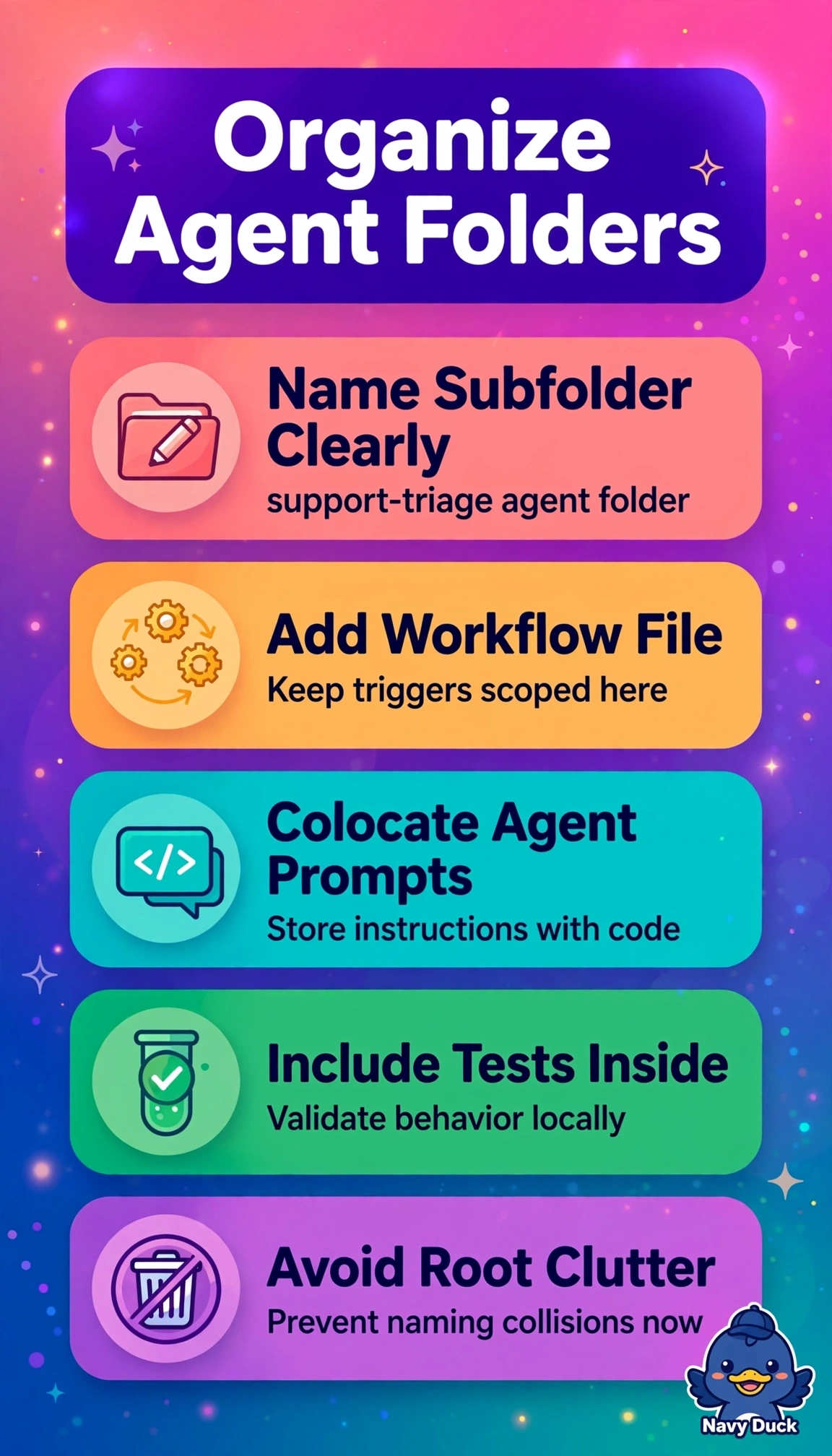
Good fences keep good agents from tripping each other. A dedicated folder is your toolbox-drawer, triage tools stay together without tangling checkout gear daily.
Full Explanation
The correct setup isolates the new capability in its own clearly named directory containing its workflow definition, prompts, and tests, which preserves monorepo organization and prevents filename collisions with checkout and billing automations while keeping related artifacts discoverable and independently evolvable. A versioned shared library for common prompts and utilities is a sound reuse pattern, but it fails on isolation because it provides cross-cutting helpers rather than a dedicated home for the triage workflow itself, so triage-specific logic would still lack clear ownership. Storing prompts and tests in a named subfolder while leaving the workflow file at the repository root improves partial organization yet fails on conflict avoidance, since root-level workflow filenames are the most likely to collide as checkout, billing, and triage triggers accumulate. Adding triage steps inside the billing automation folder sensibly reuses validated assets, but it fails on bounded context by coupling an unrelated support concern to billing ownership, versioning, and access, which risks unintended side effects and future naming clashes. Exam caveat: choose colocation and separation by business capability over tempting reuse when the stem emphasizes avoiding conflicts in a shared monorepo. Practical check: list the new folder alongside checkout and billing directories and confirm unique workflow, prompt, and test filenames with no root duplicates before merging.