
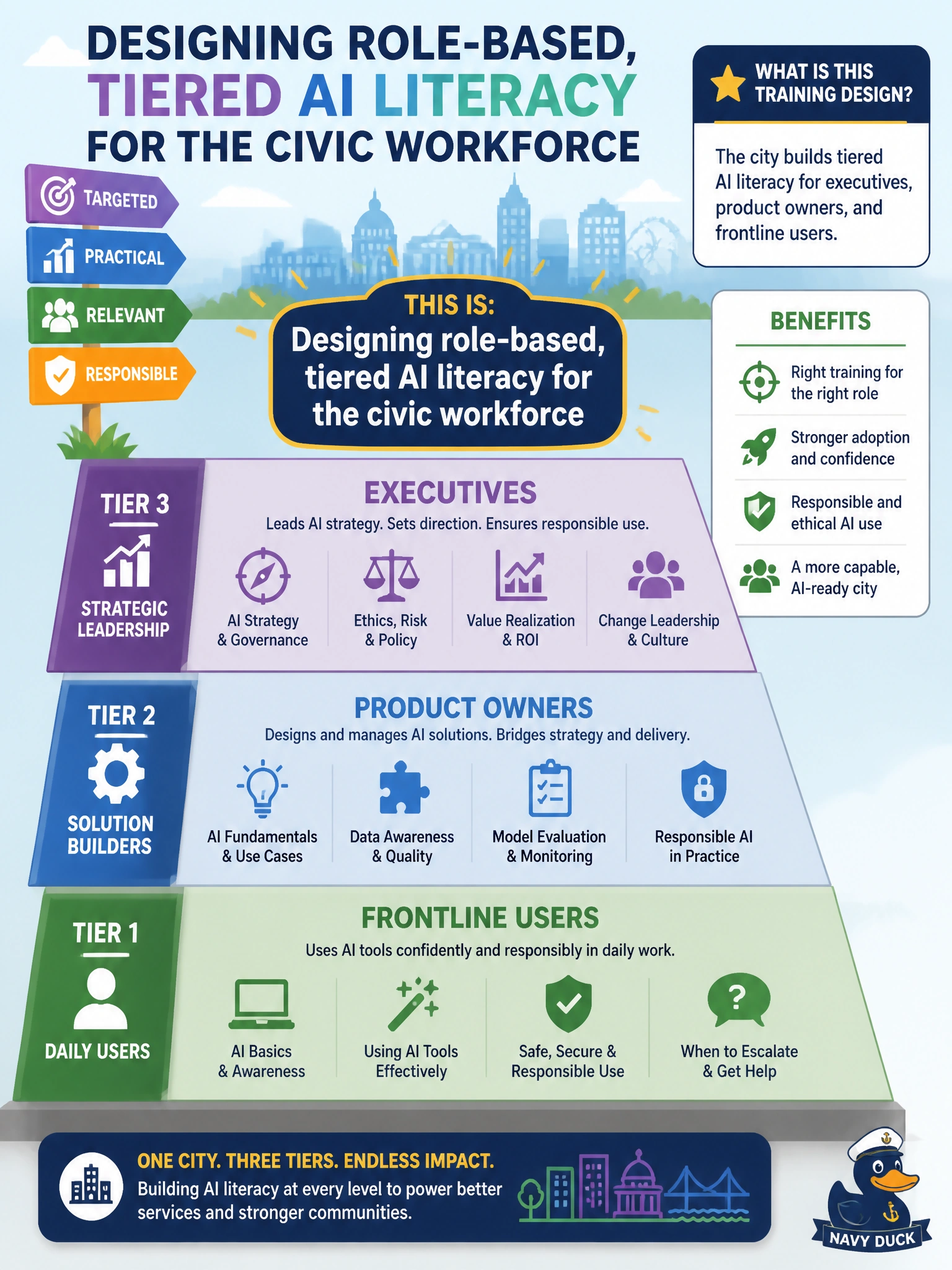
The city builds tiered AI literacy for executives, product owners, and frontline users. What training design is this?
Select an answer to reveal the explanation.
Short Explanation
Bosses, product owners, and counter staff don’t need the same textbook. Tier the literacy so each seat gets the skills that fit the job.
Full Explanation
One-size literacy wastes time and leaves critical seats underprepared. Building tiered AI literacy for executives, product owners, and frontline users is role-based training design for the civic workforce. Executives need risk, sponsorship, and decision-rights fluency; product owners need evaluation, data boundaries, and lifecycle controls; frontline users need approved-use patterns, escalation, and privacy hygiene. Tiering works because job-to-be-done and failure modes differ; identical deep engineering courses for every role create dropout and still miss executive governance skills.
Giving every role the identical deep engineering course regardless of job fails by concept: irrelevant depth reduces completion and transfer. Training only executives and leaving frontline users untrained fails where resident harm actually occurs—at the point of use. Skipping literacy tiers because a single vendor webinar covers everyone fails coverage and specificity; webinars rarely encode municipal role duties.
Exam caveat: 'everyone gets the same AI course' sounds fair but is poor instructional design. Prefer role-based tiers. Operational check: publish a literacy matrix by role, map curricula to that matrix, and verify completion plus observed Ability for each tier before expanding high-risk uses.