
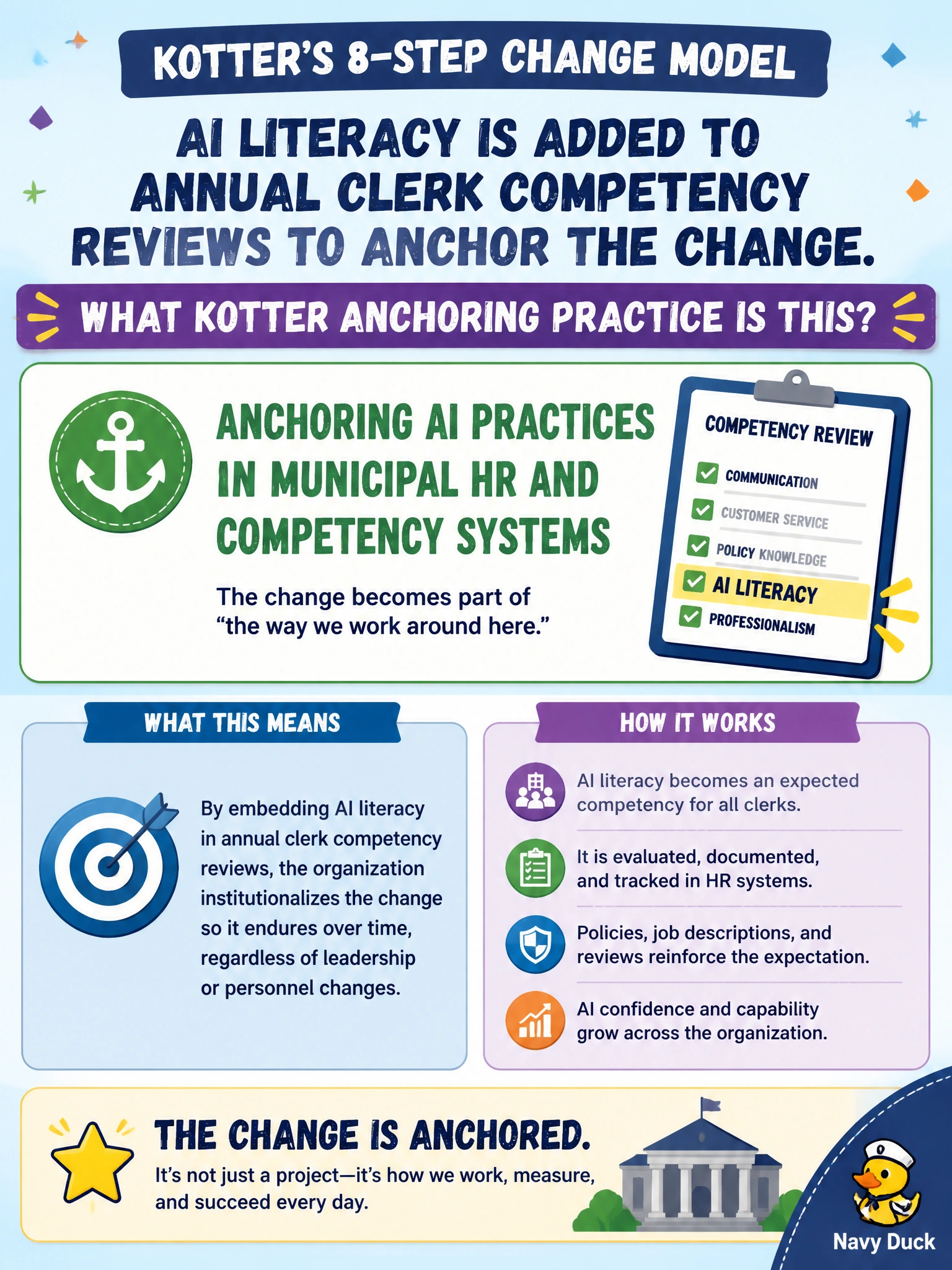
AI literacy is added to annual clerk competency reviews to anchor the change. What Kotter anchoring practice is this?
Select an answer to reveal the explanation.
Short Explanation
When you add AI literacy to annual clerk reviews, you make the change part of how your municipality works. That anchoring helps the practice last beyond the pilot and its kickoff party.
Full Explanation
Kotter’s anchoring step hardwires new behaviors into formal systems so they can survive shifts in leadership attention. Adding AI literacy to annual clerk competency reviews anchors AI practices in municipal HR and competency systems. Performance and competency processes signal what your organization truly values: when AI-safe practice is included in a review, supervisors can coach it, staff can prepare for it, and the behavior can persist after the pilot and its kickoff pizza party end. Leaving AI literacy outside all performance and competency processes fails because behaviors without reinforcement can regress to pre-change norms. Anchoring change only in a one-time kickoff pizza party fails because an event is not an ongoing system. Removing AI expectations from clerk reviews after the pilot ends fails because it deliberately disconnects the reinforcing mechanism when consistent practice still matters. Exam caveat: cultural posters are not anchors; HR and competency integration is. Practical check: update competency frameworks and review templates with specific AI literacy behaviors, train supervisors to assess them, and audit a sample of reviews for evidence that AI expectations were actually discussed.