
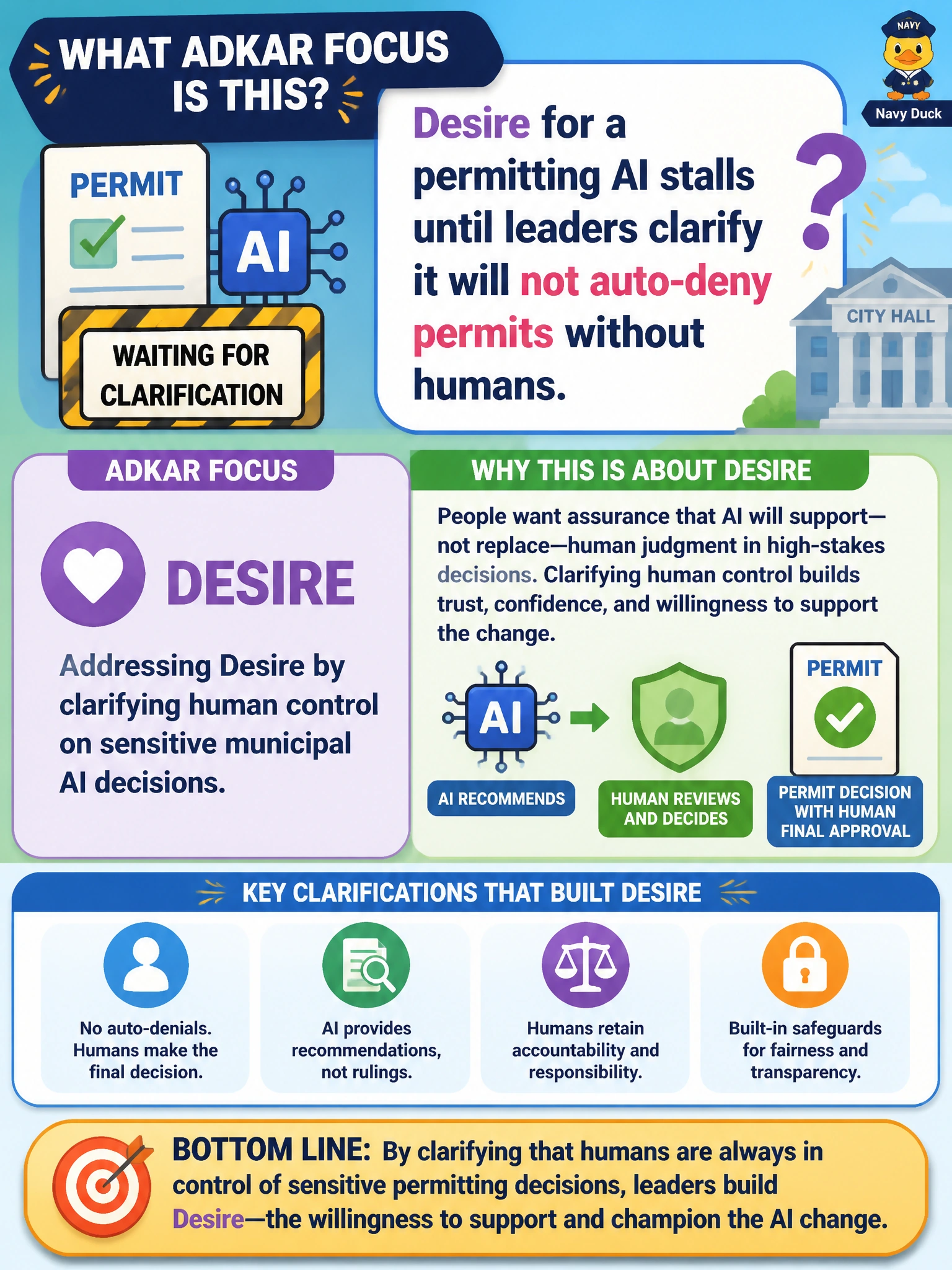
Desire for a permitting AI stalls until leaders clarify it will not auto-deny permits without humans. What ADKAR focus is this?
Select an answer to reveal the explanation.
Short Explanation
Nobody wants an AI that rubber-stamps denials alone. Clear the fear—humans stay in the loop—and Desire starts to thaw.
Full Explanation
Desire collapses when staff believe AI will remove human judgment on consequential civic decisions. In permitting, auto-denial without humans raises fairness, due-process, and accountability fears. Clarifying that the system will not auto-deny permits without human review directly addresses Desire by restoring a credible picture of human control on sensitive municipal AI decisions. That works because Desire is motivational: people support tools that augment their professional duty and resist tools that appear to abdicate public authority to opaque automation.
Raising Desire by promising fully automated denials with no human review fails by concept: that promise intensifies fear and ethical objection rather than motivation. Ignoring Desire and shipping auto-deny features to force acceptance fails change psychology and often triggers labor, legal, and political backlash. Confusing Desire with Awareness by only sending a tool brochure fails because brochures build Awareness at best; they do not resolve the motivational threat about unsupervised denials.
Exam caveat: ADKAR Desire items hinge on WIIFM and risk-to-me; for municipal permitting, human-in-the-loop assurances are the Desire lever. Operational check: publish decision-rights language (AI recommends, humans decide on denials), demonstrate the human review step in demos, and measure Desire/sentiment before expanding automation depth.