
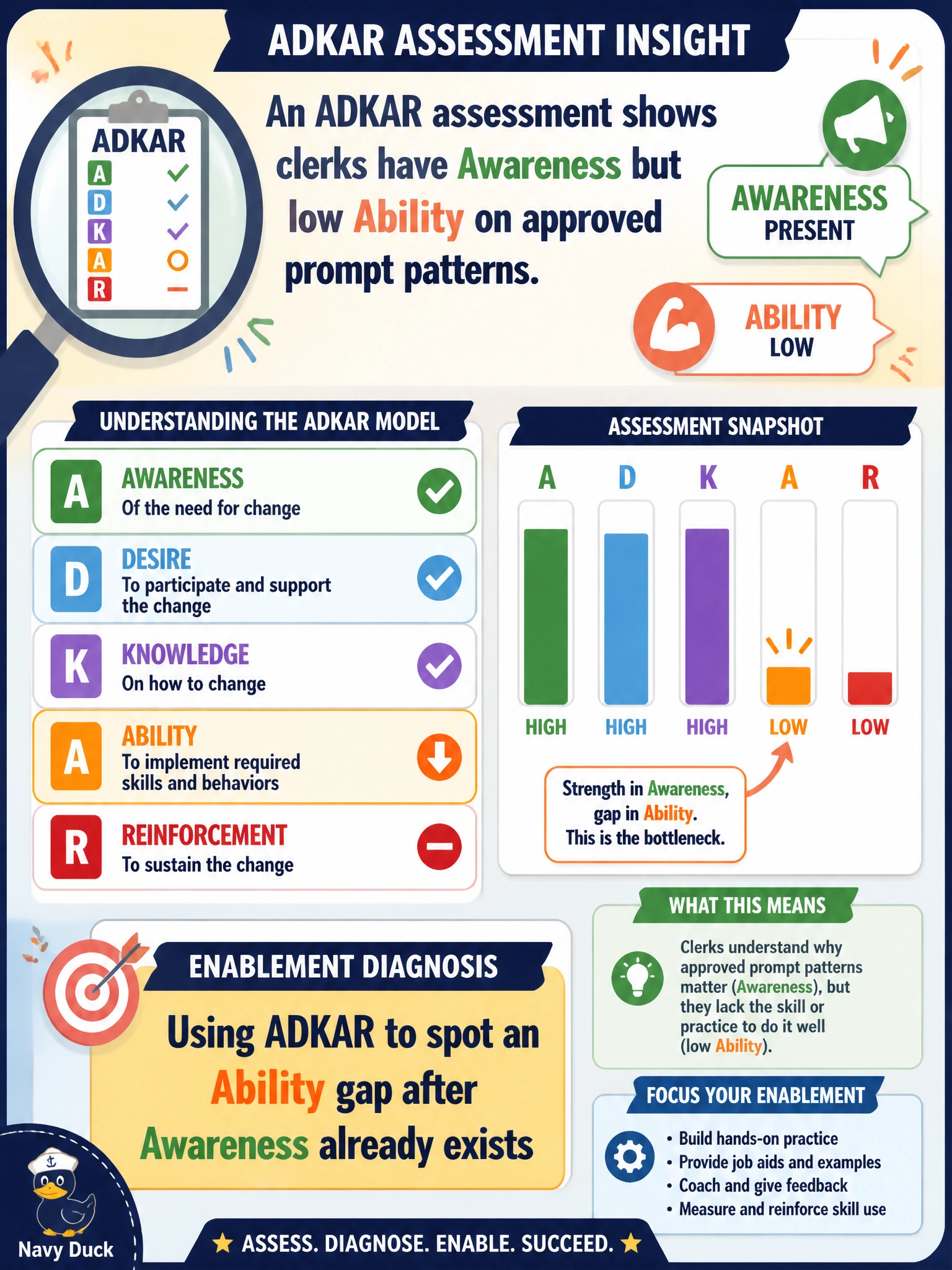
An ADKAR assessment shows clerks have Awareness but low Ability on approved prompt patterns. What enablement diagnosis is this?
Select an answer to reveal the explanation.
Short Explanation
They know the tool exists—that’s Awareness. They still can’t drive the prompt patterns—that’s Ability. ADKAR separates ‘heard of it’ from ‘can do it.’
Full Explanation
ADKAR separates stages of individual change so enablement matches the real gap. An assessment showing clerks have Awareness but low Ability on approved prompt patterns diagnoses an Ability gap after Awareness already exists. That diagnosis works because knowing a municipal GenAI tool is approved is not the same as being able to apply retrieval-grounded prompts, refuse forbidden data classes, and escalate uncertain outputs. Training and practice—not another awareness email—are the appropriate response.
Assuming Awareness automatically creates Ability with no skill practice fails by concept: ADKAR treats Ability as a distinct stage requiring coaching and repetition. Skipping ADKAR and blaming clerks without diagnosing the gap fails because blame without diagnosis wastes change energy and misallocates interventions. Focusing only on Desire while ignoring that clerks cannot yet perform fails stage logic—even motivated staff cannot execute patterns they have not practiced.
Exam caveat: when a stem states Awareness is present and performance is weak, prefer Ability (or Knowledge→Ability) interventions over more Awareness campaigns. Keep clerk/municipal framing. Operational check: run short observed practice on approved prompt patterns, coach to proficiency criteria, and re-assess Ability before declaring the change complete.