
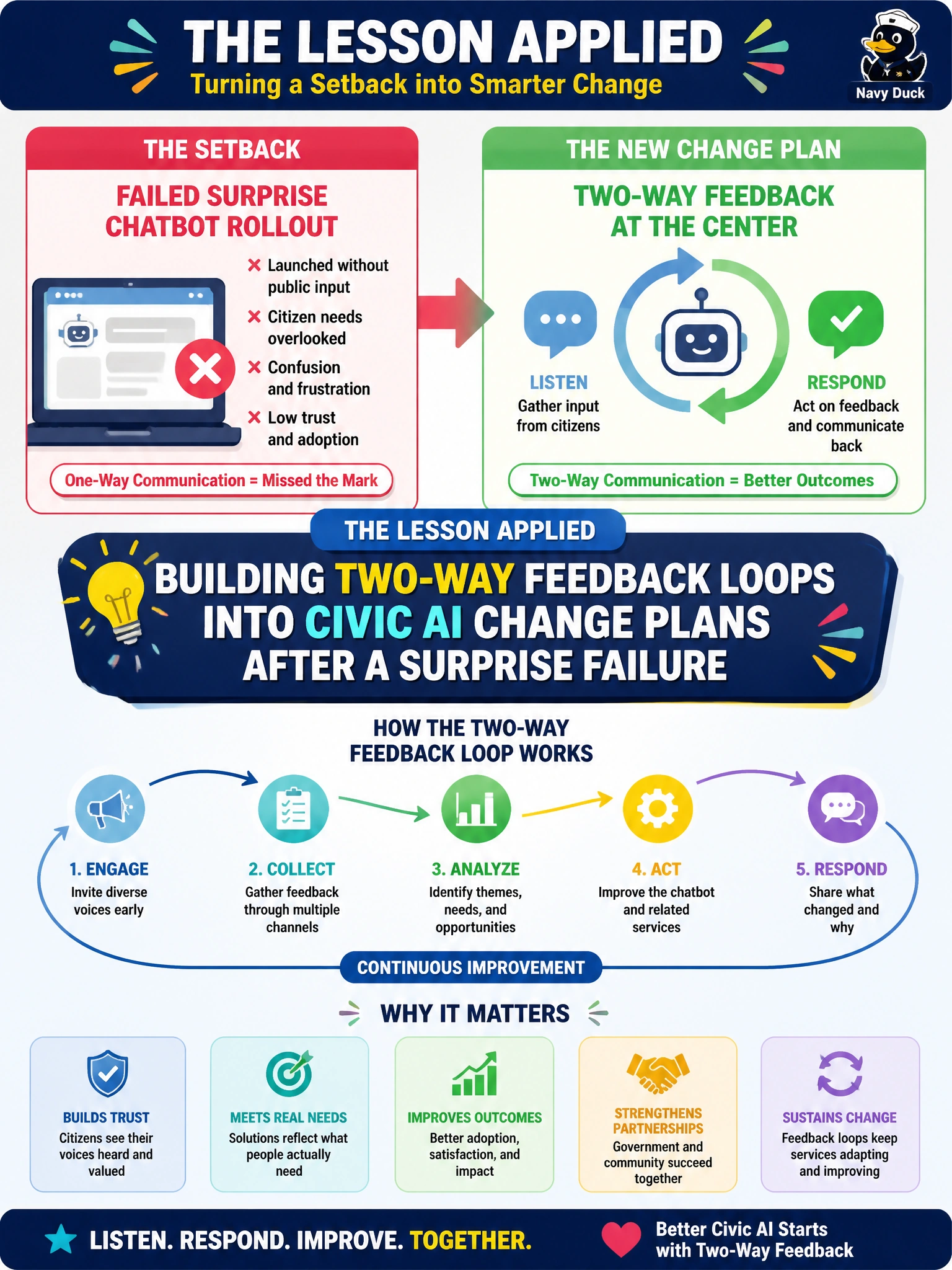
After a failed surprise chatbot rollout, the new change plan emphasizes two-way feedback channels. What lesson is being applied?
Select an answer to reveal the explanation.
Short Explanation
Surprise chatbots teach expensive lessons. This time, open the suggestion box both ways—listen, adjust, then roll—so the next launch isn’t another ghost town.
Full Explanation
Failed surprise rollouts teach that municipal change needs listening infrastructure. After a chatbot launches without warning and collapses adoption or trust, rebuilding the change plan around two-way feedback channels applies the lesson: staff and residents must be able to report defects, confusing answers, workload spikes, and policy conflicts—and the program must respond with visible adjustments. That works because AI systems drift and civic contexts vary by neighborhood, language, and case type; feedback loops convert lived experience into backlog and risk controls.
Doubling down on surprise launches with no feedback channels fails by concept: repeating the failure mode guarantees another rejection cycle. Treating staff feedback as noise that slows municipal AI programs fails because frontline signal is often the earliest indicator of unsafe or useless behavior. Closing all feedback channels once the chatbot is live fails the sustainment principle—production is when real resident interactions begin, so listening must continue.
Exam caveat: 'decisive launch' is not the same as 'unilateral surprise.' Responsible civic change pairs sponsorship with feedback. Operational check: stand up named intake (office hours, form, champion channel), publish response SLAs, show changelog items sourced from feedback, and compare post-relaunch adoption and complaint rates against the surprise-launch baseline.