
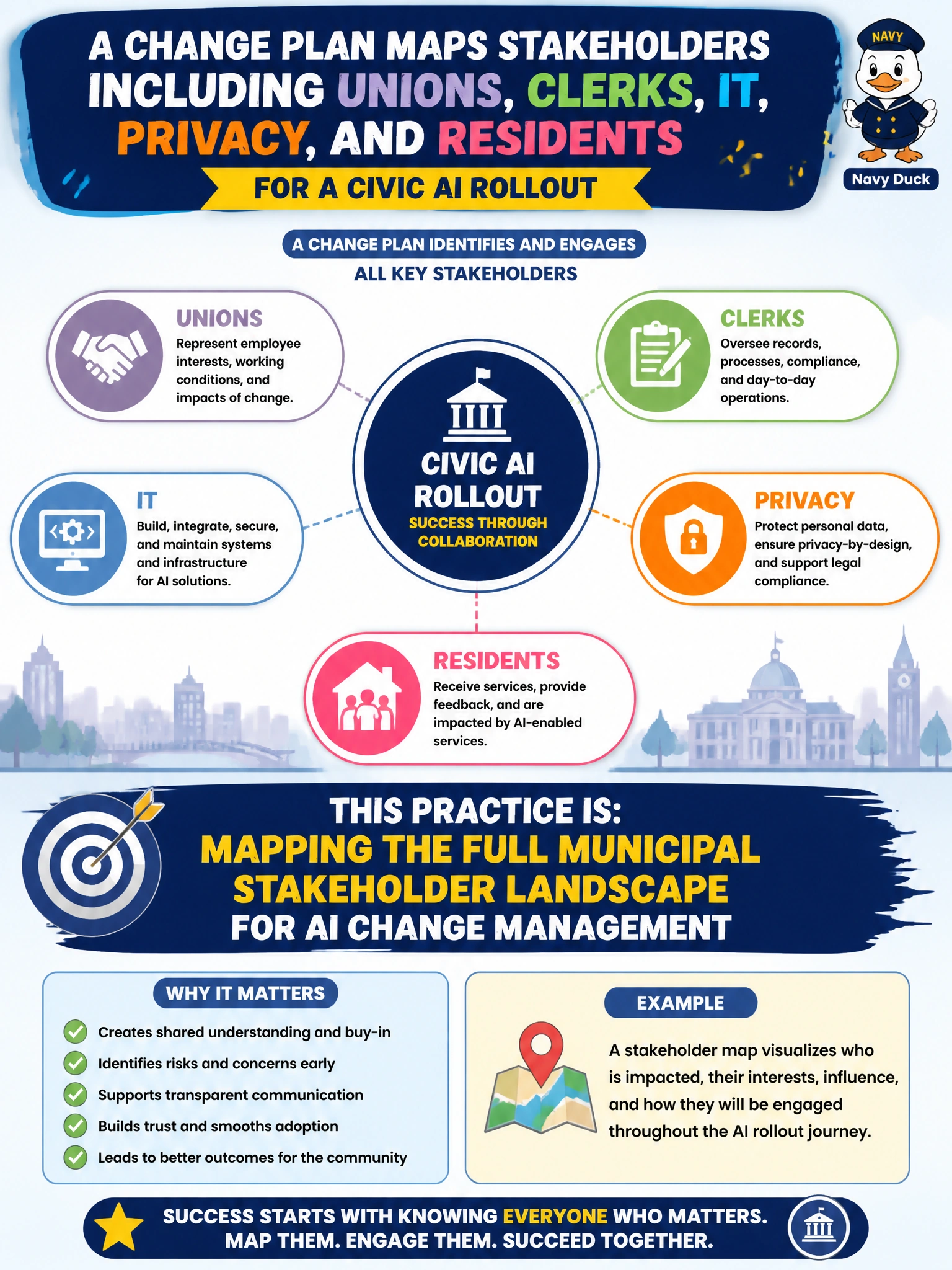
A change plan maps stakeholders including unions, clerks, IT, privacy, and residents for a civic AI rollout. What practice is this?
Select an answer to reveal the explanation.
Short Explanation
Unions, clerks, IT, privacy, residents—if they’re in the blast radius, put them on the map. Stakeholder maps keep surprises from becoming walkouts.
Full Explanation
Civic AI rollouts touch a wider stakeholder system than typical IT upgrades. Mapping unions, clerks, IT, privacy, and residents in the change plan is the practice of mapping the full municipal stakeholder landscape before design hardens. That works because each group holds distinct interests and veto-like power: unions and labor relations shape job impact; clerks own workflow reality; IT owns platforms and security; privacy owns data-minimization and notices; residents experience fairness and service quality. Early mapping drives engagement sequencing, risk registers, and communications tailored to each group rather than a single generic blast.
Engaging only IT and skipping unions, clerks, privacy, and residents fails by concept: IT-only maps miss labor, frontline, legal-privacy, and public-trust failure modes that routinely stall municipal AI. Treating stakeholder mapping as optional after go-live fails because late discovery of opposition or privacy gaps is far costlier than pre-launch engagement. Limiting the map to vendors because internal voices slow projects fails the accountability test—vendors do not represent municipal duties to workers or residents.
Exam caveat: 'move fast with vendors' distractors are common; CAIPM-aligned change management still requires full civic stakeholder coverage. Operational check: produce a stakeholder map with influence/interest and engagement owners, confirm union and privacy touchpoints are scheduled before pilot expansion, and track whether mapped groups actually received two-way engagement rather than one-way notification.