
A streaming service can label past accounts as fraud or legitimate. Another team has only ordinary viewing logs, with no fraud labels, and wants to flag sessions that look unusual. Which statement separates those two jobs?
Select an answer to reveal the explanation.
Short Explanation
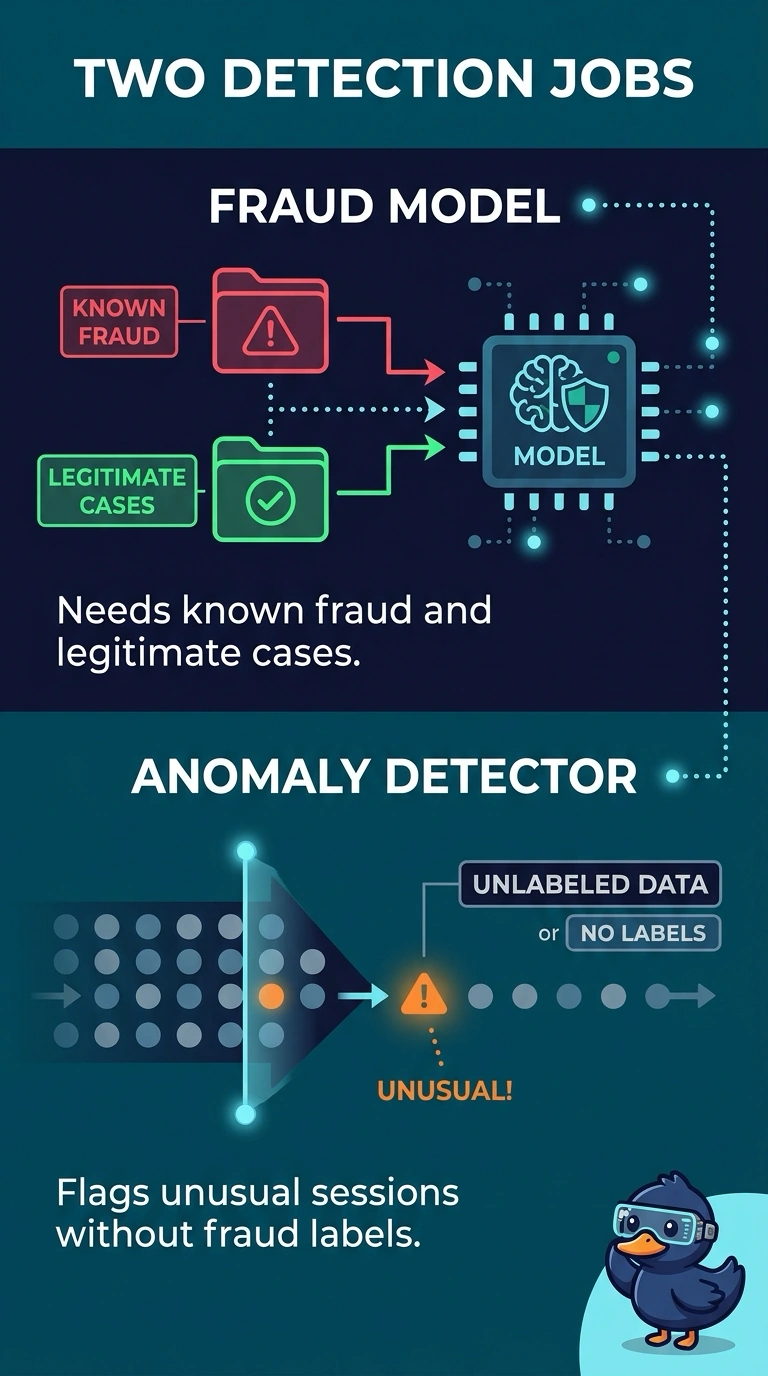
A detective with a mug book is doing a different job than a guard who only knows what a normal day looks like. You train the fraud model on known fraud and legitimate accounts, and you flag odd sessions without those labels when no fraud catalog exists. Do not swap which job needs the labeled cases.
Full Explanation
A fraud model that learns from known cases is supervised: each past account used for training carries a fraud or legitimate label, and the model estimates that class. An anomaly detector aimed at unusual sessions, with only ordinary logs and no fraud labels, scores how far a session sits from the usual pattern and does not need a catalog of confirmed fraud. Swapping those requirements gives the labels to the anomaly job and withholds them from the fraud model, which reverses the setup the service actually has. Treating both jobs as reward-driven policy updates invents a reinforcement signal the teams did not describe. Requiring a fraud or legitimate label on every past session before either score can exist would block the team that has only ordinary logs. Exam caveat: some detectors are fit on normal examples only, but that is still not the same as training on confirmed fraud cases. Operational check: inspect the training table for each job and confirm the fraud model has a fraud label column while the unusual-session job does not.