
A benefits agency has a year of ordinary claim records and no catalog of known fraud types. Investigators want each new claim scored higher when it sits far from that ordinary pattern. Which method produces that score?
Select an answer to reveal the explanation.
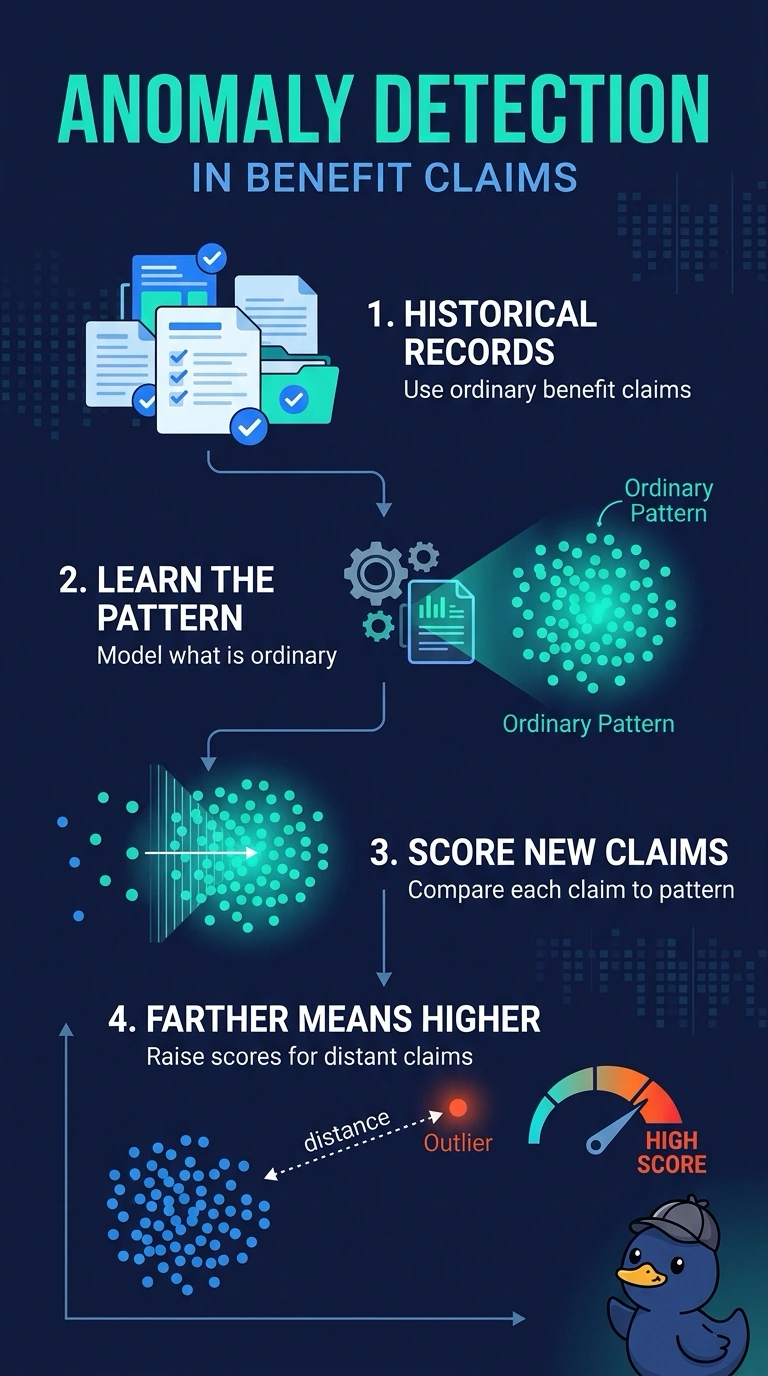
Short Explanation
A smoke alarm sounds when the room stops looking like an ordinary day. You want anomaly detection, a score that rises when a claim sits far from the usual pattern. A fraud classifier that demands labeled fraud cases cannot start from this catalog-free file.
Full Explanation
Anomaly detection scores how unusual a point is relative to the pattern in the historical records. With a year of ordinary claims and no catalog of fraud types, the agency can still score a new claim higher when it sits far from that ordinary pattern, which is the anomaly score investigators asked for. Supervised fraud classification needs past claims labeled fraud or legitimate, and those labels are exactly what the agency does not have. Reinforcement learning would update a policy from a reward after decisions, and the request is a score against the usual pattern, not a reward signal. A link-path score against an identified fraud ring needs a known ring and shared connections, which is a different job from measuring distance to the ordinary claim pattern. Exam caveat: a high anomaly score queues a claim for review and is not, by itself, a finding that the claim is fraud. Operational check: pull a sample of high scores and confirm they are unusual on the features the detector used, with an investigator looking at the claim beside the score.