
A bank's bill scanner must decide on the device whether a note is counterfeit. The scanner has no reliable network link during a check, and the accurate lab model needs more memory and more power than the scanner has. What should happen to the model before it ships on that scanner?
Select an answer to reveal the explanation.
Short Explanation
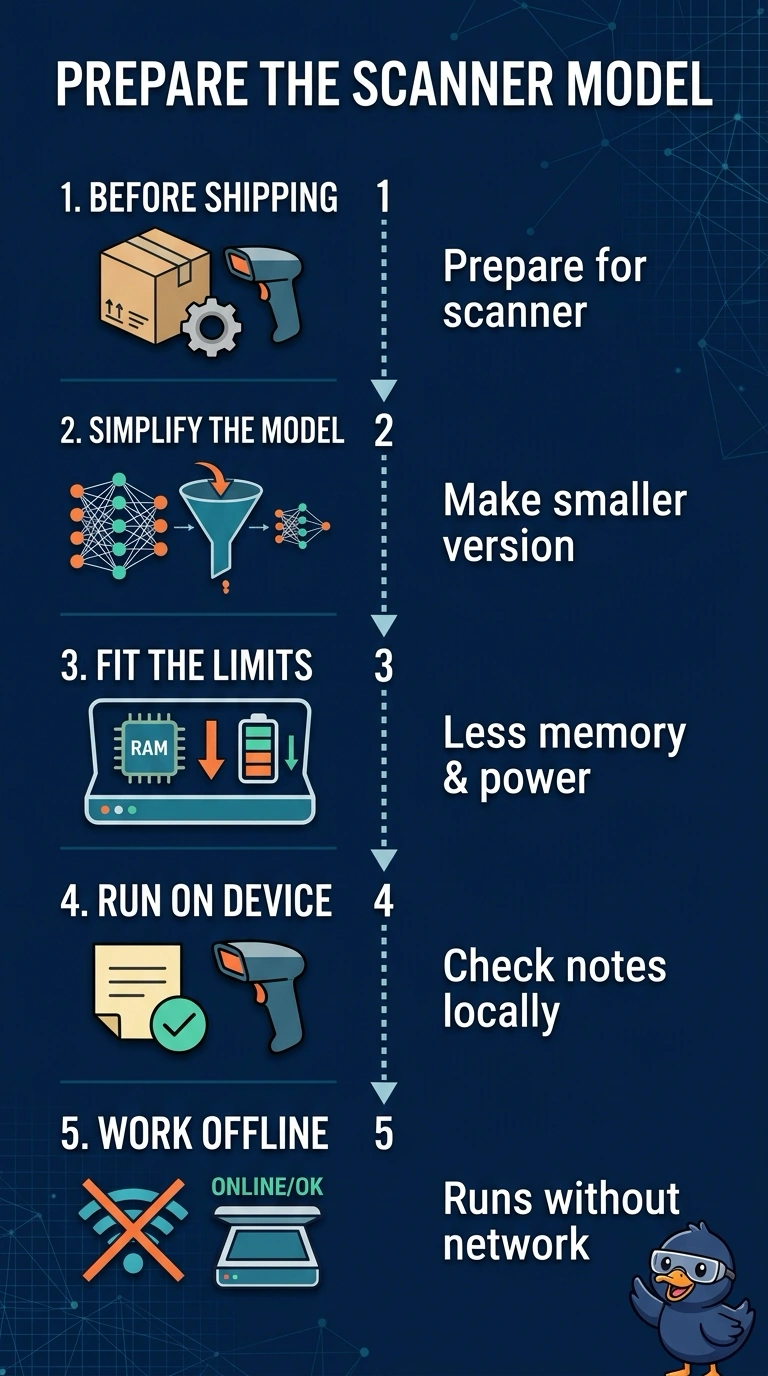
A scanner that loses its network cannot borrow the lab's big model in the middle of a check. You have to simplify the model so it fits that device's memory and power. The trap is streaming every scan to a cluster the check cannot reach.
Full Explanation
The scanner must classify the note on the device, with no reliable link, and the lab model uses more memory and more power than that device has. Simplifying the model, for example with a smaller architecture or a more compact numeric representation, produces a version that can still execute during the check. Leaving the lab model unchanged and streaming each scan to the training cluster requires the link the stem says is missing, so the check cannot finish. A frequency plot describes a repeating waveform, and a bill scan is not that signal; producing the plot also does not fit a model onto the scanner. Searching for a change-point marks an incident time in a stream and does not yield a counterfeit decision the scanner can run on its own. Exam caveat: a simpler model can miss cases the lab model caught, so the device version still has to be checked against the counterfeits the bank cares about. Operational check: load the simplified model on a scanner, disable the network, and confirm the decision completes within the scanner's memory and power.