
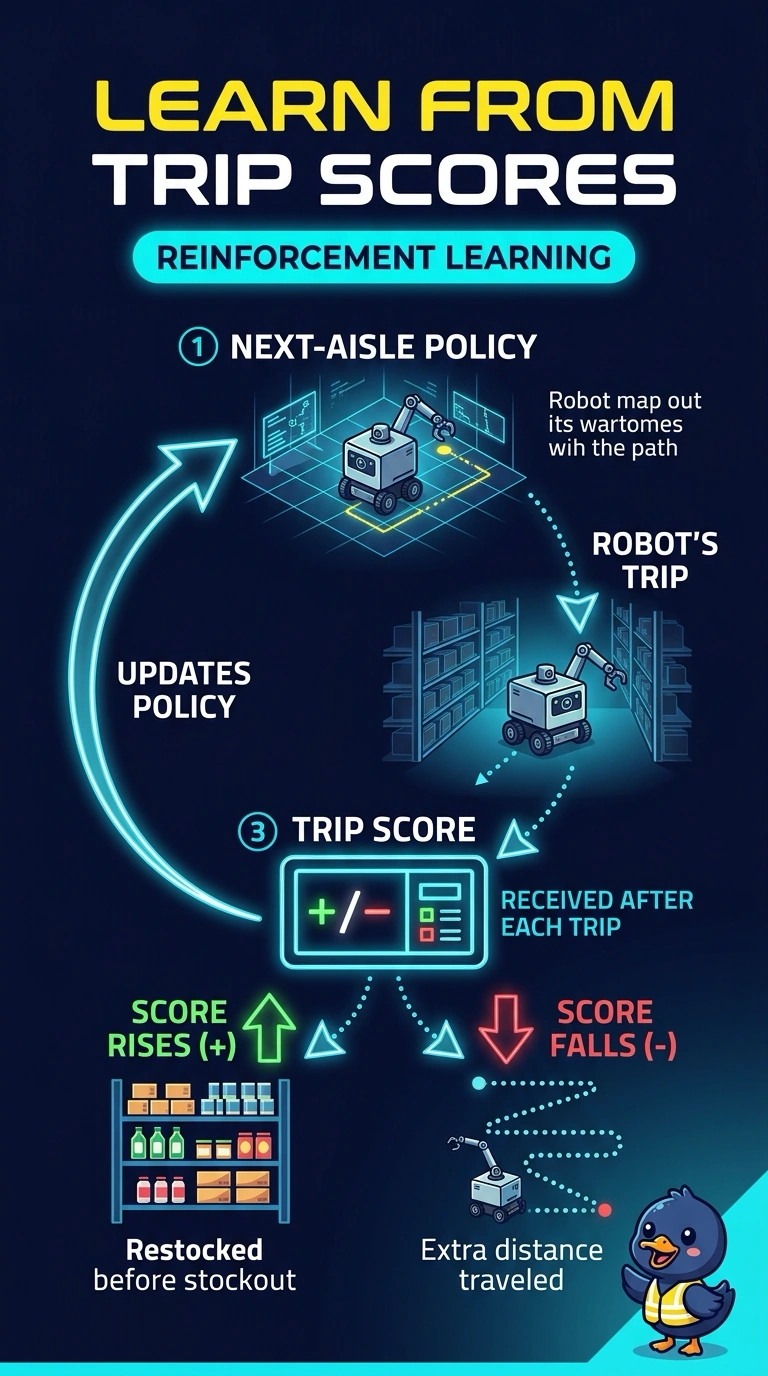
A retail chain wants a stockroom robot to choose the next aisle. No trip comes with a labeled correct aisle. The only feedback is a score that rises when shelves are restocked before a stockout and falls when the robot travels extra distance. Which learning setup matches that feedback?
Select an answer to reveal the explanation.
Short Explanation
A dog learns the route from the treat at the end, not from a map that marks one correct turn. You update the robot's aisle policy from the restock and travel score, because no trip names a correct aisle. The trap is treating that score as if it were a class label.
Full Explanation
Reinforcement learning adjusts a policy from the consequences of actions. The robot picks an aisle, then receives a score that rises when restocking beats a stockout and falls when extra distance is wasted, and that score is the reward used to change the next choice. The logs never name a correct aisle, so there is no target column to copy. Supervised learning would need that missing aisle label on every trip before it could update, and the stockroom does not record one. Unsupervised clustering can gather similar past trips, but the busiest aisle pattern is a frequency, not a reward, and it does not trade stockouts against extra travel. A fixed rule sheet that repeats yesterday's sequence when the score was positive freezes one historical route instead of improving the policy from new rewards. Exam caveat: a reward may blend several business outcomes, yet it is still not a class label on the chosen aisle. Operational check: open a trip record and confirm it stores the chosen aisle plus the later restock and travel score, with no field used as a correct-aisle label.