
A hospital vision team crops and scales surgical-video frames to train an instrument detector, but the box labels still mark positions on the original uncropped frame. What must happen to those labels?
Select an answer to reveal the explanation.
Short Explanation
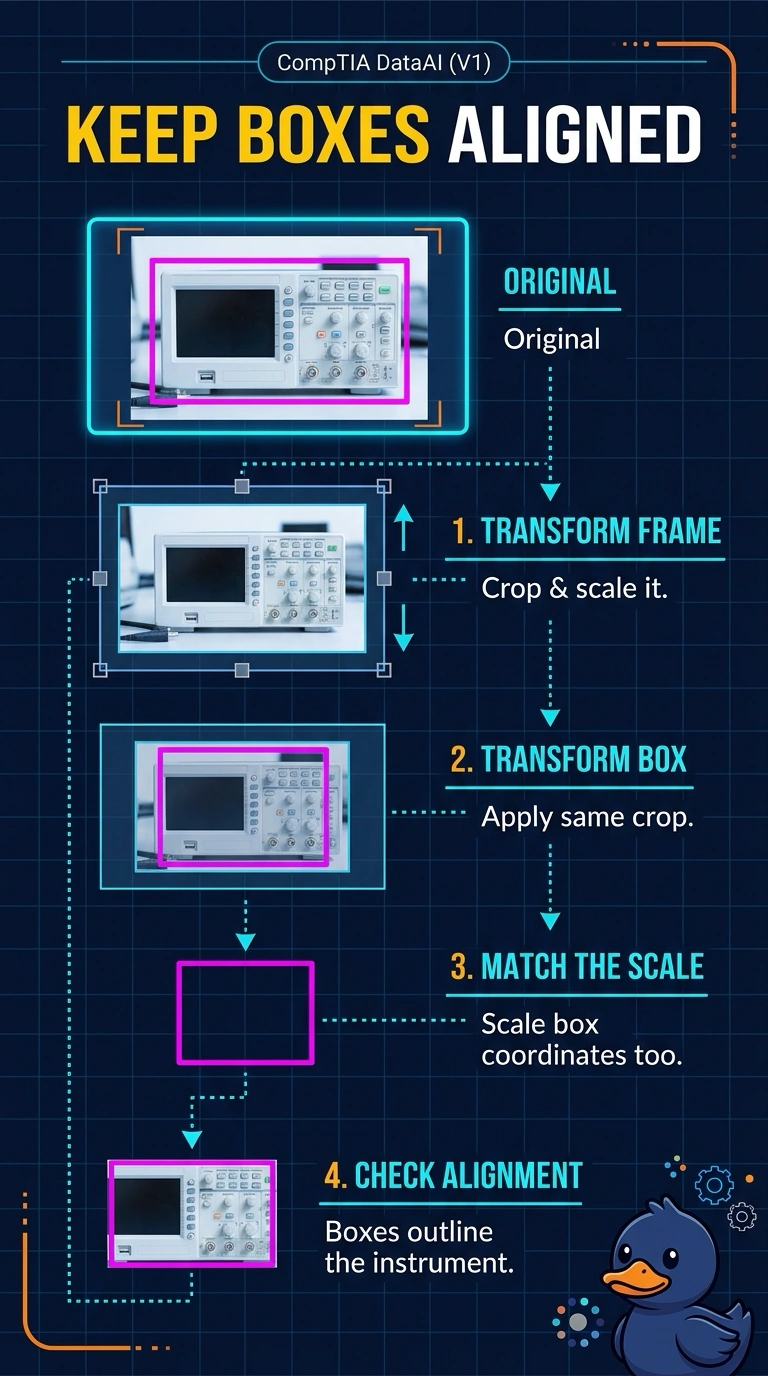
Crop a photo and the sticker on the instrument has to move with the pixels, or your box ends up pointing at empty frame. The box labels have to be cropped and scaled with the surgical images. Leaving the old coordinates in place trains the detector on boxes that no longer match.
Full Explanation
A box label is a set of coordinates in the same pixel grid as the image. Cropping removes a margin and scaling multiplies the remaining coordinates, so the box has to receive that same crop and scale or it no longer outlines the instrument. Leaving the original coordinates trains the detector to associate the transformed pixels with a box from a different grid. Dropping the boxes for an image-level present-or-absent tag abandons detection and answers a coarser question the team did not ask. Pinning every box at the center of the new frame ignores where the instrument moved and invents a location. The crop window and the scale factor are known when the frame is built, so each box corner can be converted with that same arithmetic. Training on the old coordinates teaches the detector a place that no longer matches the instrument, even when the instrument is clearly visible. Exam caveat: an image-level class label has no coordinates to transform, but this stem is a detector, and box coordinates must travel with the pixels. Operational check: draw the transformed boxes on the cropped, scaled frames and confirm they still outline the instrument before those frames are used for training.