
A grocery retailer builds each delivery route by appending the nearest unvisited store at every step. A planner finds a short first hop that forces a much longer trip later in the day. Which limitation of this route construction should the planner name?
Select an answer to reveal the explanation.
Short Explanation
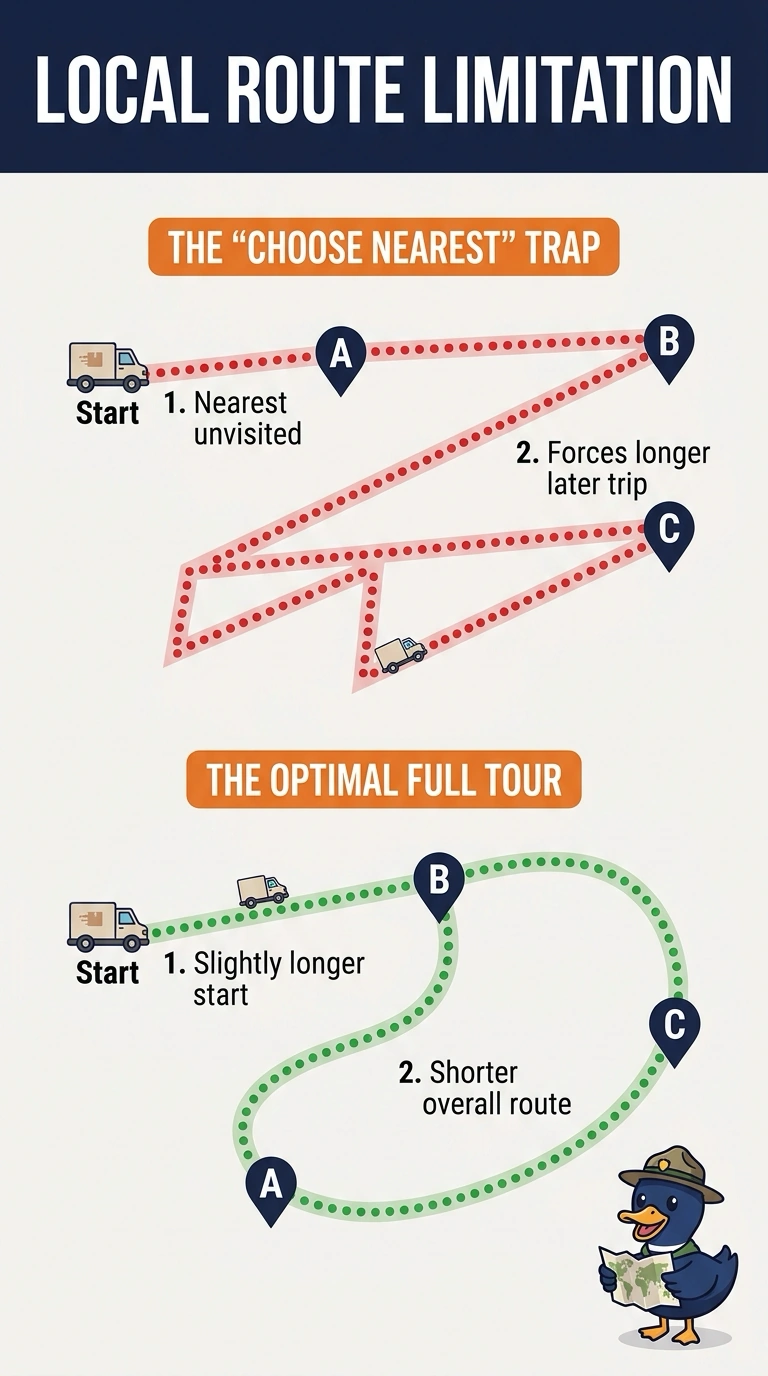
Grabbing the closest donut can leave you across the room from the short path. You are looking at a greedy route: each hop is the local best and can miss a shorter tour. The trap is believing the nearest store is optimal just because every individual hop looked smart.
Full Explanation
At every step this builder appends the nearest store not yet visited. That choice is best for the immediate hop and is made without revisiting earlier choices, so a cheap first hop can strand the truck far from the remaining stores and lengthen the full day. The limitation to name is that a greedy local choice can miss a globally shorter tour, including one that starts with a slightly longer first hop. Claiming each step already prices the full tour describes an exact search this builder does not do. Claiming failure only for negative distances is wrong for this construction: positive road miles still allow the nearest-neighbor tour to be longer than another feasible tour. Calling the next store random contradicts the stem, which appends the nearest store, a deterministic local rule, not a draw. Exam caveat: some greedy algorithms are exact on special structures; appending the nearest unvisited stop is not a proof of the shortest tour. Operational check: compare the greedy tour length with one alternate tour that accepts a longer first hop and see whether the full day gets shorter.