
A utility inspects aerial photos of power lines and needs every pixel labeled as wire, tree, or ground. Which vision task is that?
Select an answer to reveal the explanation.
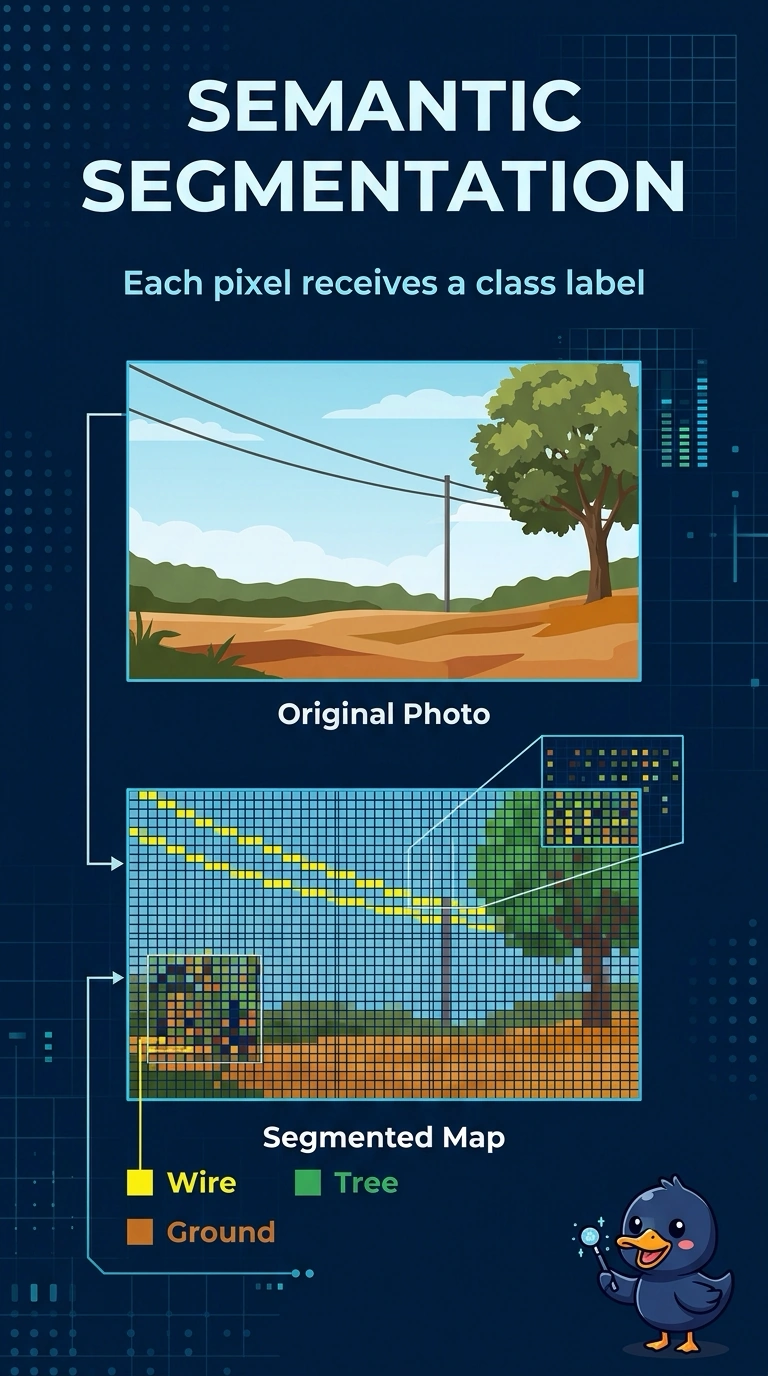
Short Explanation
Semantic segmentation is like coloring every tiny square of the photo by what it shows. You assign each pixel a class such as wire, tree, or ground. A single photo-wide label, or a box around a tree, does not color every pixel.
Full Explanation
Semantic segmentation classifies every pixel, producing a label map in which each pixel is wire, tree, or ground as requested. That dense labeling is the inspection task, not a single decision about the whole frame. Image classification returns one label for the entire photo and cannot say which pixels are wire. Object detection returns boxes around objects and leaves most pixels without a class. Optical character recognition reads text such as a tower plate and does not paint the scene by class. The useful output is a label map the same height and width as the photo, with every location marked as one of the three classes. That map lets an inspector see wire against tree against ground across the whole frame, rather than receiving the one photo-wide label that image classification returns. A box around a span still leaves the pixels inside and outside the box unclassified, and a plate reader returns characters from a sign while ignoring the vegetation and the wire. Exam caveat: drawing a box around a tree locates an object and still fails a request that every pixel carry a class. Operational check: inspect the output grid and confirm each pixel has exactly one of the three classes, with no unlabeled gaps inside the photo.