
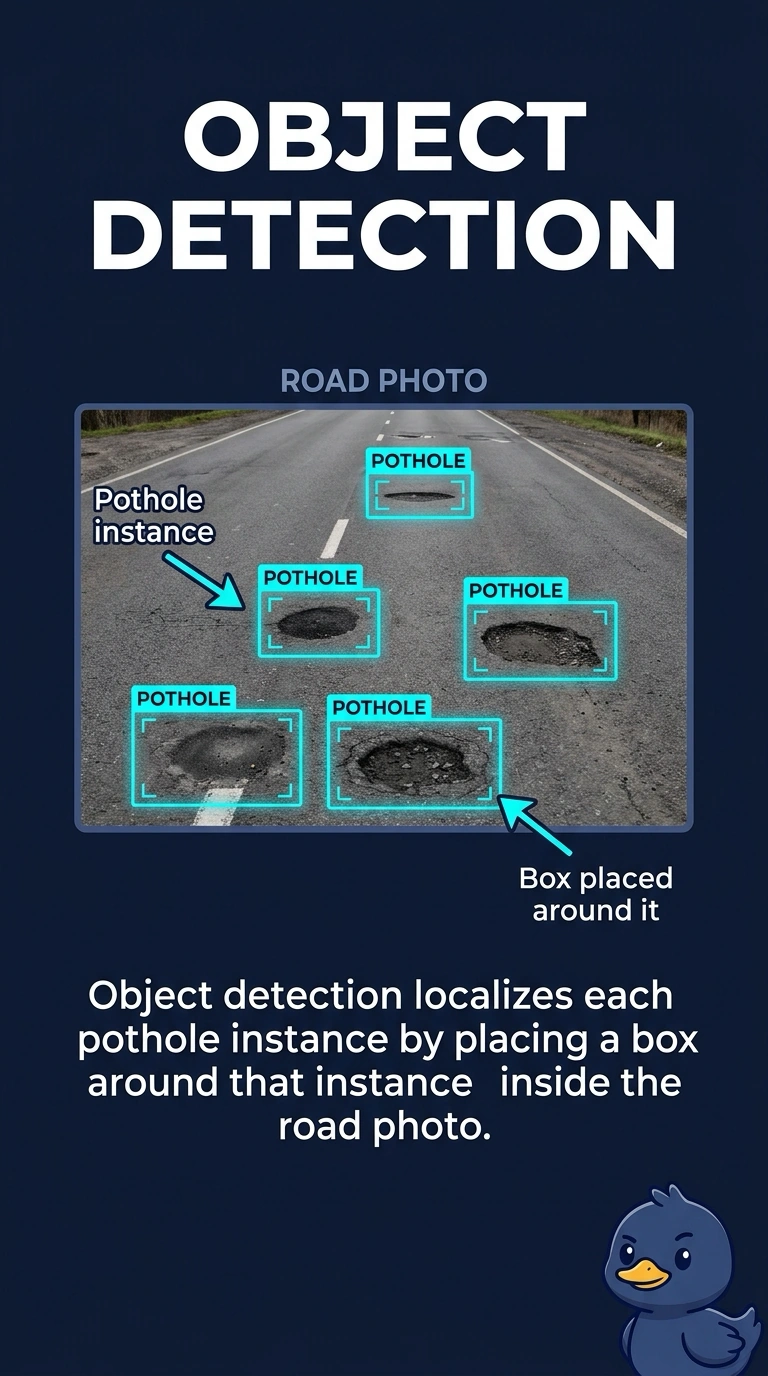
A transportation agency wants a camera model that places a box around each pothole in a road photo, rather than only tagging the photo as containing a pothole. Which task is that?
Select an answer to reveal the explanation.
Short Explanation
A tag on the whole photo is a sticky note, and you still would not know where the pothole sits. Object detection localizes each pothole with a box. Pixel labels and sign reading do not draw that instance box.
Full Explanation
Object detection finds individual instances and returns a location for each one, commonly a box, so each pothole in the road photo gets its own box rather than a single photo-level tag. Image classification assigns a label to the whole image, which matches the weaker request the agency said was not enough. Optical character recognition reads text in the image, such as a mile marker, and is not a pothole localizer. Semantic segmentation labels pixels by class and can mark road damage as a region of pixels, but that output is not an instance box around each pothole. The request has two parts that must both hold: more than one pothole can appear, and each one needs its own location. A detector returns an instance list, and each instance carries a box in the photo. A single tag collapses every pothole into one yes-or-no for the frame. Pixel classes can outline damage without ever saying which region is one pothole, and reading a road sign answers a text question this photo was not asked. Exam caveat: a photo-level tag can be true and still fail a job that requires a location for every instance. Operational check: review the model output on a photo with two potholes and confirm there are two boxes, each sitting on one pothole, not a single photo tag.