
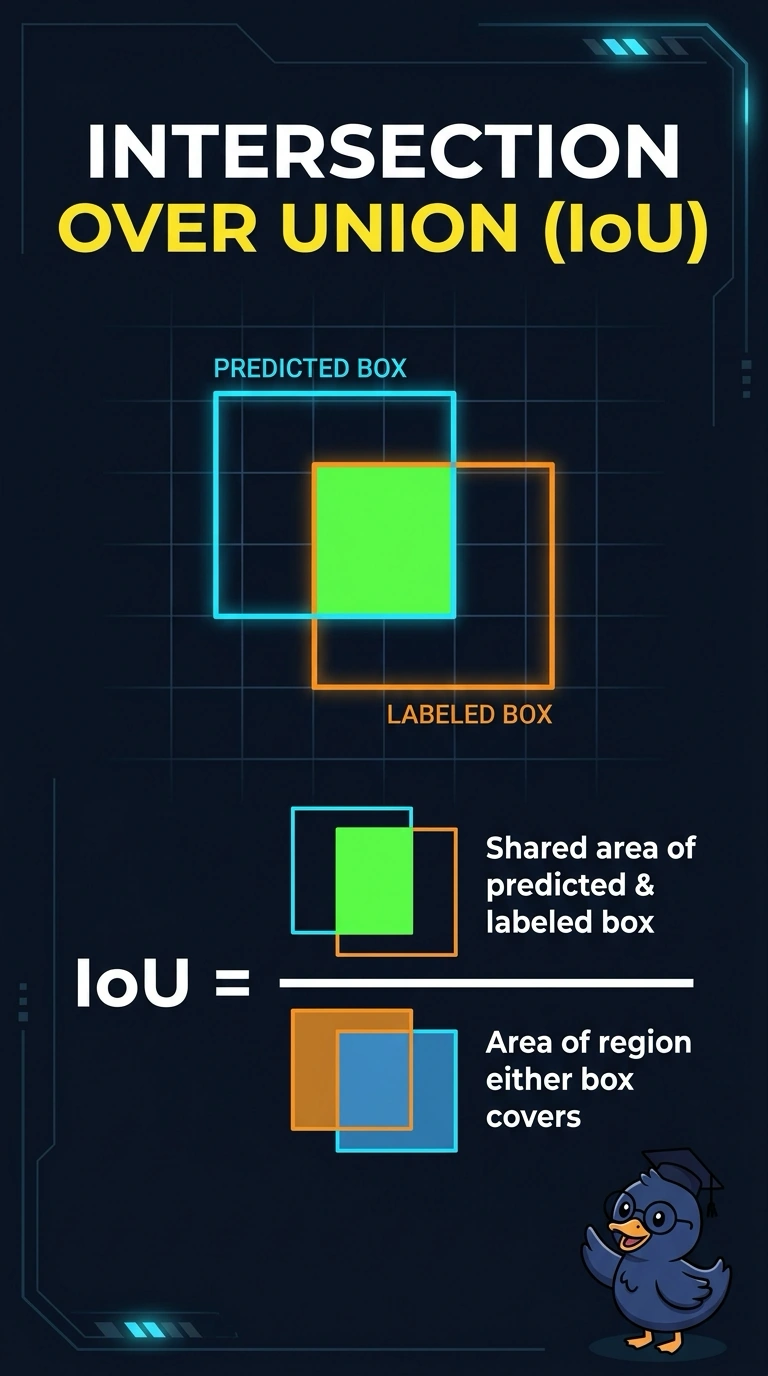
A factory camera flags defects on stamped parts by drawing a box. The predicted box and the labeled box cover much of the same metal, but the prediction also spills onto good metal. Which measure scores how much those two boxes overlap?
Select an answer to reveal the explanation.
Short Explanation
Two window frames can share a little glass or almost the same pane. You want the shared area divided by the area either frame covers, which is intersection over union. Whole-image accuracy, a matching defect name, or close centers can look fine while the boxes barely overlap.
Full Explanation
Intersection over union divides the area shared by the predicted box and the labeled box by the area of their union. Shared metal raises the score, and spill onto good metal enlarges the union without enlarging the intersection, so the score falls when the prediction overhangs the label. Pixel accuracy on the whole frame counts every pixel, and a frame that is mostly unmarked metal can score well even when the two boxes hardly overlap. A class-label match only checks that both boxes are called a defect; it is silent on how much metal they share. Distance between centers can be small when one box is much larger than the other, so the centers nearly agree while the overlap is poor. Exam caveat: a shop may set its own overlap threshold for a hit, but the measure itself is the ratio of intersection to union, not a fixed cutoff. Operational check: for one part, compute the shared area and the union area of the predicted box and the labeled box and confirm the reported score equals that ratio.