
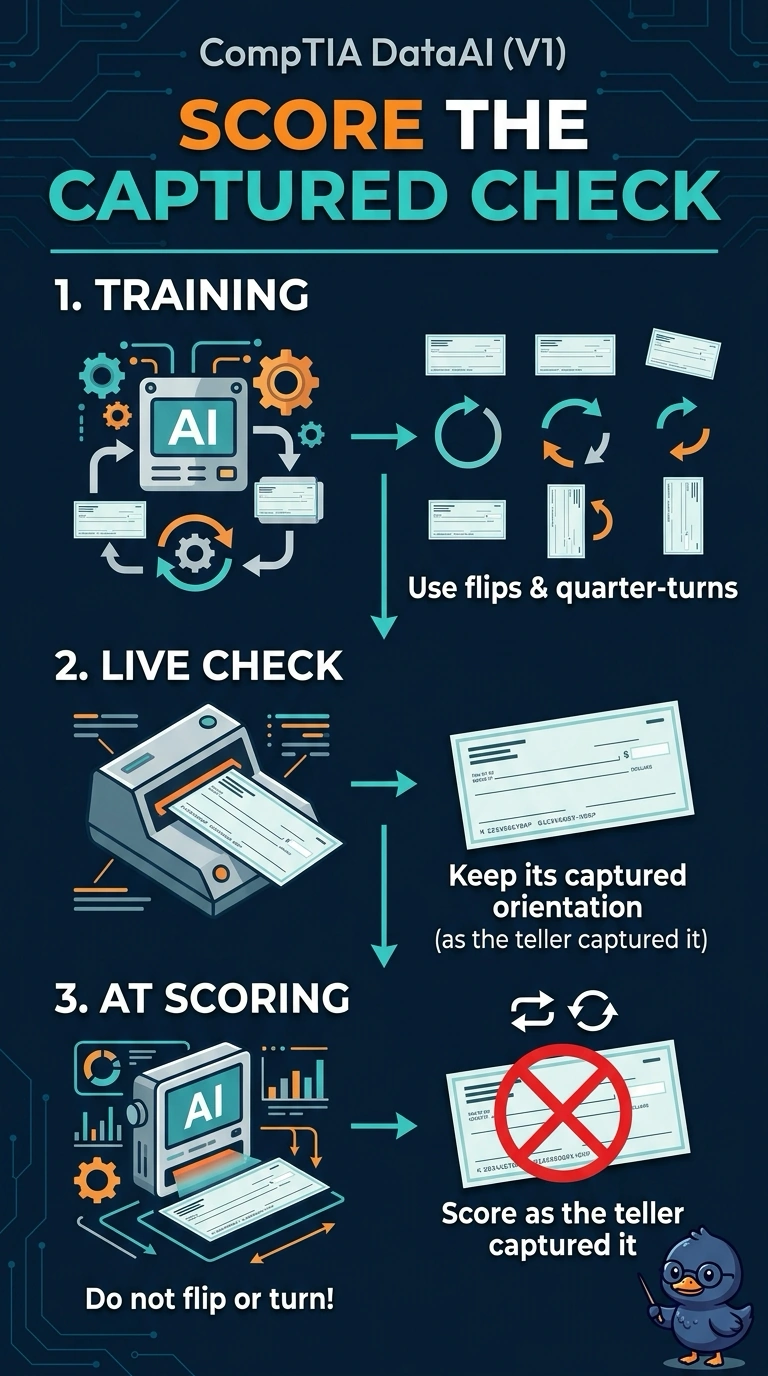
A bank trains a model to read the amount on check images and uses random flips and quarter-turns so training sees more orientations. At scoring time those same random flips and turns still rewrite the single live check, and the amount is often wrong. What should change?
Select an answer to reveal the explanation.
Short Explanation
Think of those flips and quarter-turns as practice variety, not something your live check needs. Turn them off at scoring time so you read the check in the orientation your teller captured. That keeps the scoring image aligned with the real check.
Full Explanation
Flips and quarter-turns give training more orientations than the raw checks provide; this is training augmentation. At scoring time, the model should receive the check in the orientation the teller captured, because that is the image whose amount it must read. Leaving random transforms on rewrites the live image and can make the amount wrong, so stop applying the training transforms to the live check. Keeping flips and quarter-turns only at scoring time would distort live checks while training sees each one in its original orientation, leaving the model unprepared for those transformed views. Adding a random rotation at scoring time when training did not use it would likewise expose the model to a surprise angle. Removing the transforms from training but keeping them on the live path would make production apply distortions the fitted model no longer expects. Exam caveat: averaging predictions over several deliberate views is a separate scoring method; one accidental random flip of a single live check is not that method. Practical check: score a known check with geometric transforms off and confirm that the amount matches the unflipped image.