
A logistics yard trains a camera model to read pallet labels, but stacked freight often covers part of a label. The team wants training images that stop the model from depending on one visible patch. Which augmentation does that?
Select an answer to reveal the explanation.
Short Explanation
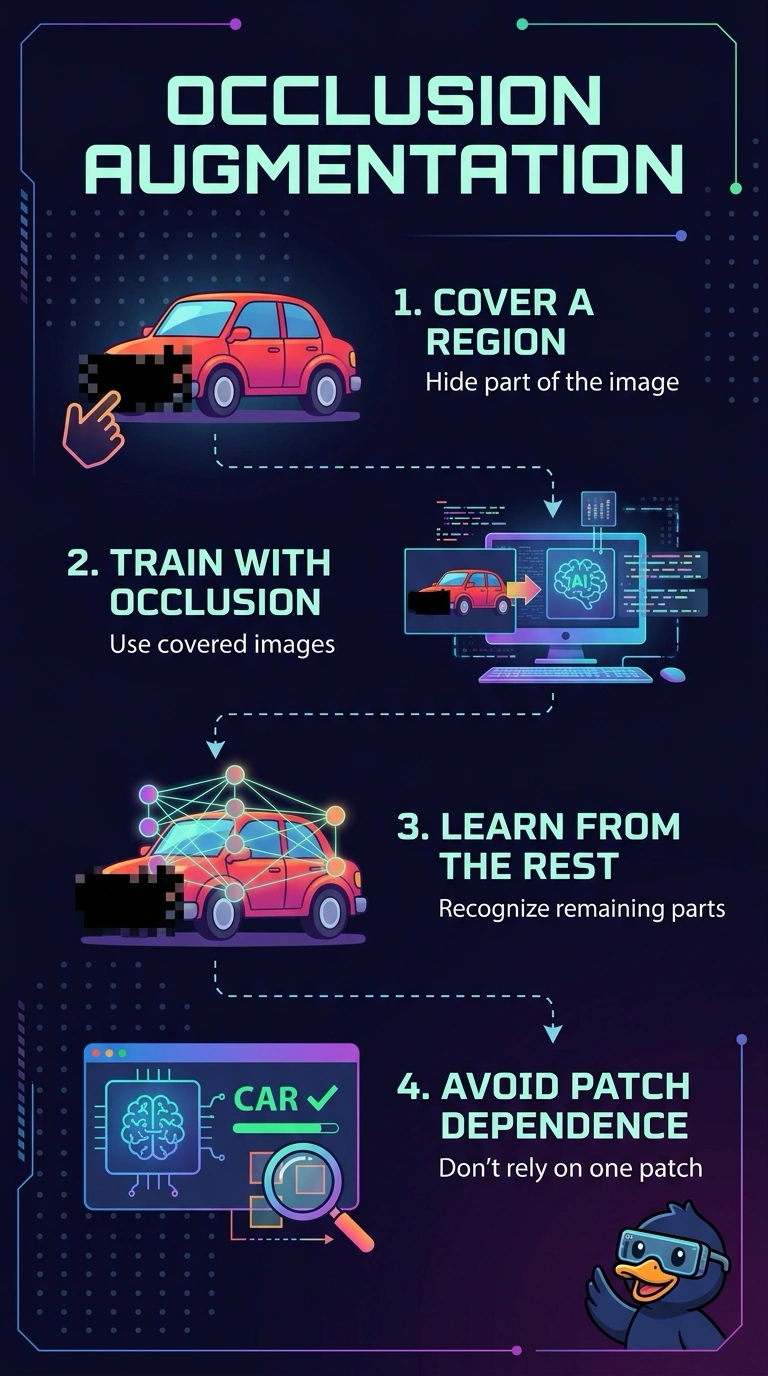
When stacked freight hides part of a pallet label, occlusion augmentation helps you train the model to recognize the label from the parts that remain visible. Color shifts, higher resolution, and shuffling batch order do not cover a region of the label.
Full Explanation
Occlusion augmentation deliberately covers part of a label in a training image, so the model must recognize it using the remaining visible parts rather than relying on one memorized patch. The label remains the training target, which matches the yard situation where stacked freight covers part of real labels. A color shift restyles dock lighting but leaves every part of the label visible, so it does not teach recognition from a partially hidden label. Increasing image resolution makes the label more detailed while keeping it fully visible; it does not cover a region. Shuffling batch order changes the sequence in which photos are presented, but does not alter the pixels or hide any label area. Exam caveat: the covered region should leave part of the label visible; covering the entire label removes the visual information needed for recognition. Practical check: inspect augmented frames to confirm that a portion of each label is covered while its training target still refers to that label.