
An agency records office must match person names that differ by a missing letter, an extra letter, or a substituted character. Which measure counts the cheapest set of string edits between two tokens?
Select an answer to reveal the explanation.
Short Explanation
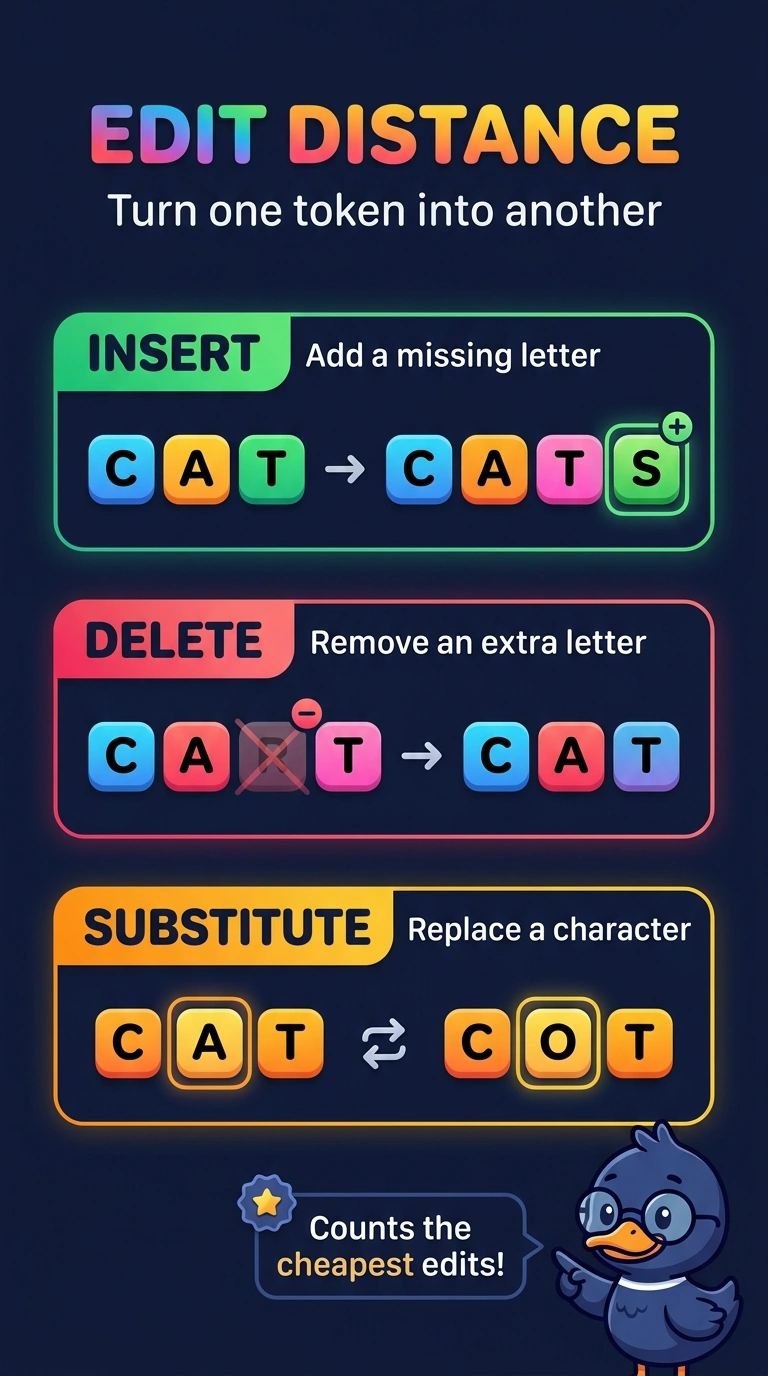
Edit distance is the cheapest set of typos that turns one name into the other. You count insertions, deletions, and substitutions, not whether two embeddings feel similar. Shared-word scores and stemmers are the tools that do not count those edits.
Full Explanation
Edit distance is the minimum number of string operations needed to turn one token into another. For names that differ by a missing letter, an extra letter, or a substituted character, those operations are insertions, deletions, and substitutions, and the cheapest total is the distance. A small distance means the strings are close as character sequences, which is the match signal the records office needs. Jaccard overlap compares sets of tokens and scores shared pieces. It does not count how many character edits separate two strings. Cosine similarity of embeddings scores geometric closeness of learned vectors, which can reflect meaning or spelling patterns in a model, but it is not a count of edits. Stemming maps each token to a crude root so that variants collide, and a shared root is not a tally of insertions, deletions, and substitutions. Exam caveat: the usual unweighted edit distance treats each allowed operation as one step, so a specific weighted scheme is a variant, not a different task. Operational check: compute the distance for a name and the same name with one deleted letter, and confirm the distance is a single edit.