
A hospital research group plans to run LDA on a large set of discharge summaries to find recurring themes such as infection and follow-up. There is no class label to predict. Which expansion of LDA matches that plan?
Select an answer to reveal the explanation.
Short Explanation
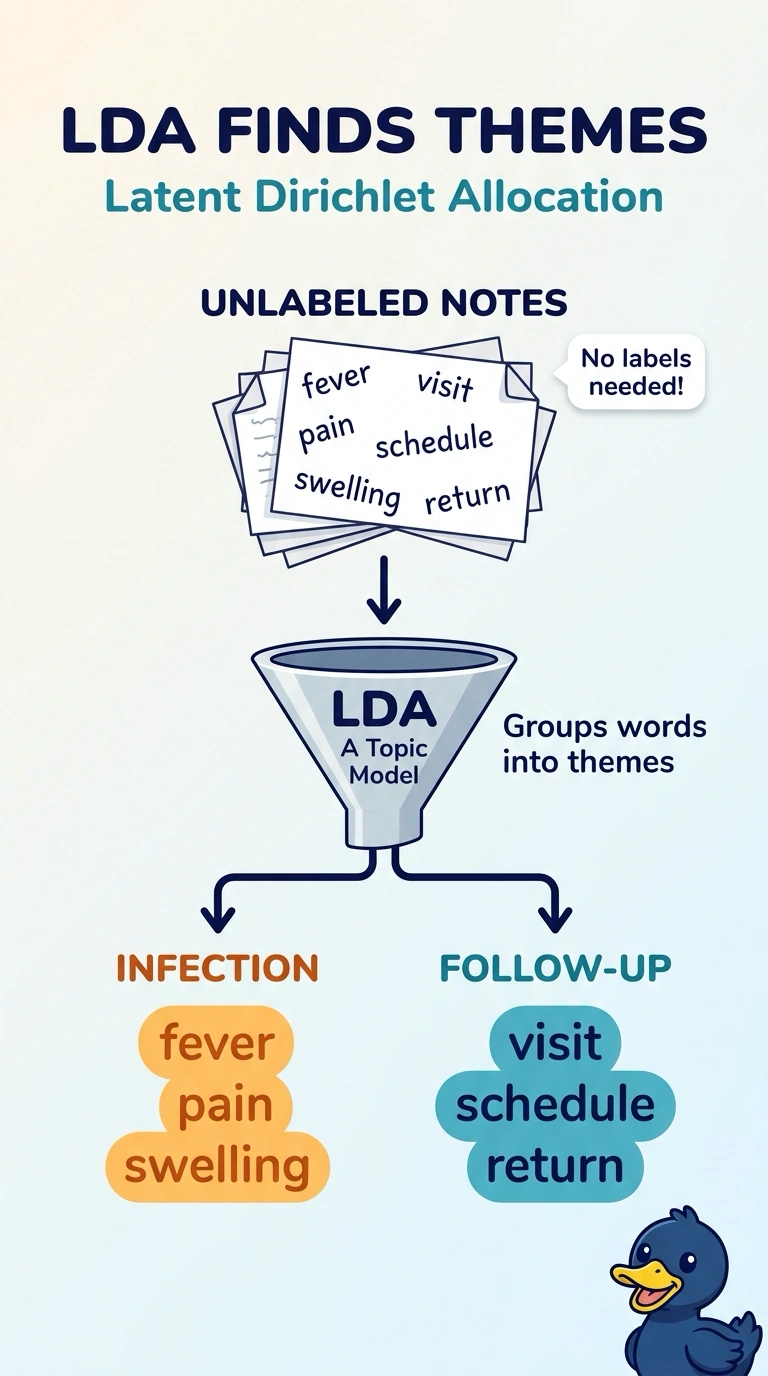
Two famous methods share the letters LDA, and only one of them hunts for themes in unlabeled notes. Latent Dirichlet allocation is the topic model you want when discharge summaries have no class label. The trap is linear discriminant analysis, a classifier that needs labeled groups and a shared covariance.
Full Explanation
In a topic-model setting, LDA means latent Dirichlet allocation. It treats each discharge summary as a mixture of themes and each theme as a mixture of words, and it does not need a class label to predict. Finding recurring themes such as infection and follow-up in unlabeled notes is that method. Linear discriminant analysis is the other expansion of the same letters: a classifier that separates labeled groups under a shared covariance, which cannot run when no class label exists. Latent semantic analysis also reduces a document-word matrix, but it is not the method named LDA, so it is the wrong expansion of the acronym the group used. Quadratic discriminant analysis gives each labeled class its own covariance and still requires the labels these notes do not have. Exam caveat: the acronym alone is ambiguous; the unlabeled text and the goal of themes select latent Dirichlet allocation, while labeled classes would select a discriminant analysis instead. Operational check: confirm the job's inputs are raw notes without a class column and its outputs are topic shares per document, not predicted class labels.