
An appliance factory builds a bag-of-words model from technician notes. Articles and conjunctions dominate the counts but do not name a defect. Which preprocessing step targets those words?
Select an answer to reveal the explanation.
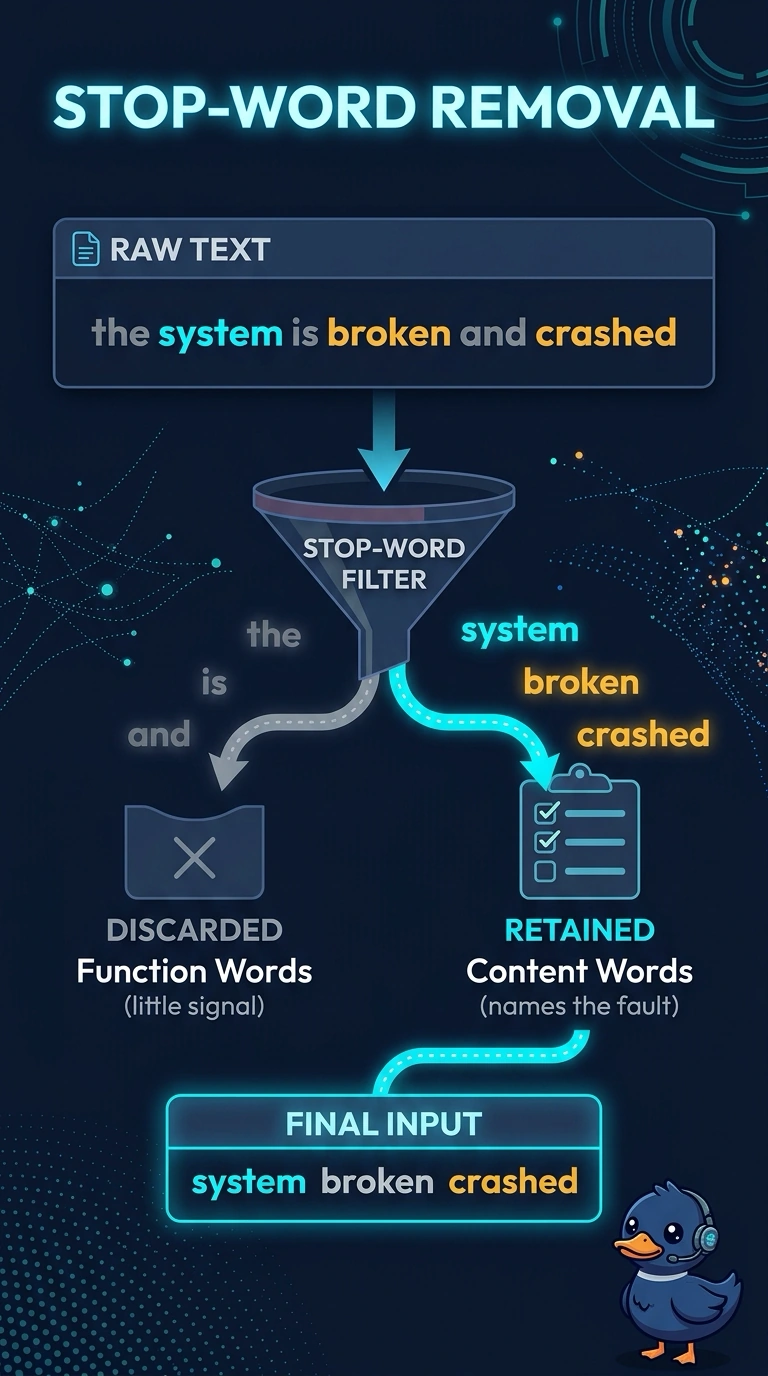
Short Explanation
Function words are the packing peanuts in a note: they fill the box and tell you nothing about the defect. Stop-word removal drops those low-signal words so your bag-of-words can hear the content terms. The trap is lemmatization, which tidies word forms and still leaves articles and conjunctions in the counts.
Full Explanation
Stop-word removal drops function words such as articles and conjunctions that occur in almost every note and carry little information about the defect topic. After they are removed, the bag-of-words counts are dominated by content words that actually name faults, which is what the appliance factory needs. Lemmatization maps variants to a dictionary form and still keeps those function words in the counts. Stemming chops endings off content words and likewise leaves articles and conjunctions untouched. Named-entity recognition finds spans such as part names and serial numbers; it labels them and does not delete the filler words that are drowning the counts. The step deletes words from the vocabulary; it does not rewrite the content terms that remain. A note that was mostly function words should shrink to the defect language the technicians wrote. Exam caveat: a stop list can be harmful when a short word carries polarity or a domain meaning, so the list has to be reviewed against real notes rather than applied blindly. Operational check: compare the vocabulary before and after removal and confirm the function words dropped while the defect terms the technicians use are still present.