
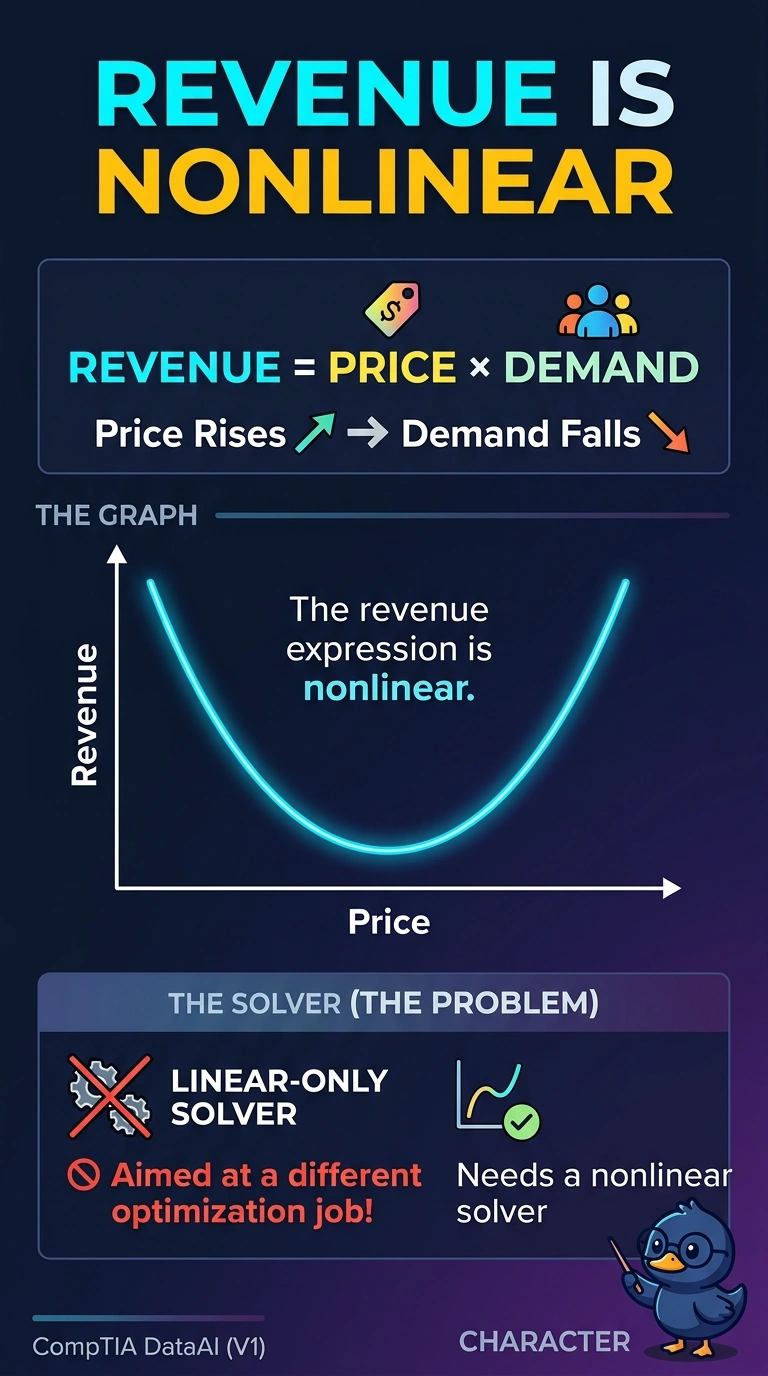
A media buyer wants to maximize revenue defined as price multiplied by a demand that falls when price rises, so the objective is not a straight function of price. The buyer plans to hand that expression to a solver that accepts only linear objectives. Why is that solver the wrong tool?
Select an answer to reveal the explanation.
Short Explanation
A straightedge cannot draw the curve you actually need to maximize. You handed price times a price-dependent demand to a solver that accepts only linear objectives. The trap is blaming integers or inequalities when the revenue expression itself is not a straight function of price.
Full Explanation
A solver that accepts only linear objectives can optimize a function that is a constant-rate sum of the decision variables, subject to linear constraints. Revenue defined as price multiplied by a demand that itself falls as price rises is not linear in price. The product makes the objective curve, so the expression is outside the class of problems that solver is built to optimize. Handing it over asks a linear tool to solve a nonlinear objective. Whole-number ad counts are an integrality question. The stem never requires integer decisions, and a linear objective is not defined by rejecting every indivisible choice. Inequality constraints are a normal part of linear problems. An inequality does not, by itself, bend a linear objective into a nonlinear one. Treating the falling demand as a side constraint that leaves revenue linear in price misreads the expression. Demand depends on price, and revenue is their product, so the objective itself is the curved piece, not a straight function with an extra rule beside it. Exam caveat: some solvers extend past linear objectives, but a tool limited to linear objectives does not become appropriate by renaming the product. Operational check: write the revenue expression in the decision variables and confirm it is not a constant-rate sum before you select a linear solver.