
A utility classifies trouble tickets with a representation that counts how often each token appears. It treats the phrase 'power not out' the same as 'power out not' whenever those token counts match. What does this representation keep, and what does it drop?
Select an answer to reveal the explanation.
Short Explanation
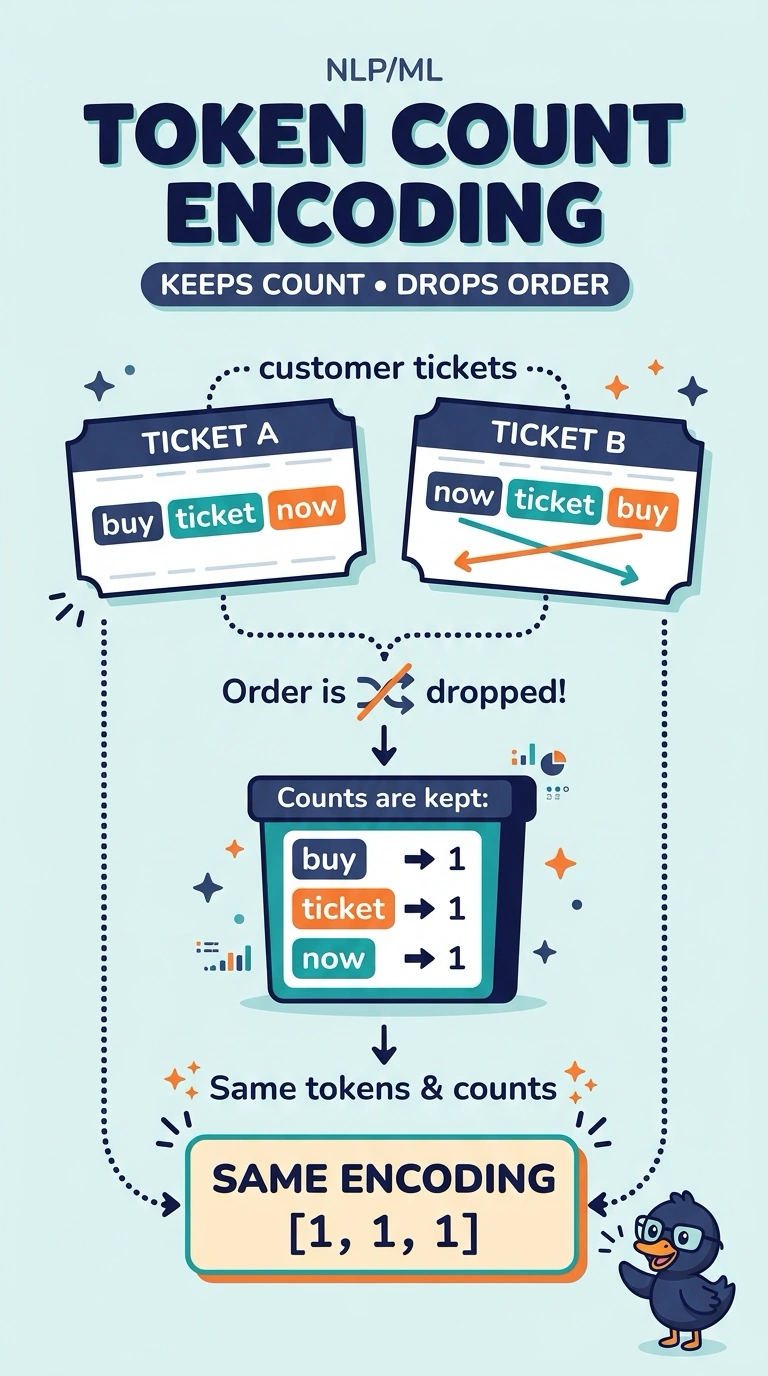
A grocery bag cares how many apples you bought, not the order you dropped them in. You count tokens and treat 'power not out' the same as 'power out not' when the counts match. The trap is thinking that representation kept word order, counted edits, or stored only a topic name.
Full Explanation
A bag of words represents a document by how many times each token appears. Position is discarded. If two trouble tickets contain the same tokens with the same frequencies, their vectors match even when the words are rearranged. That is why 'power not out' and 'power out not' collide whenever their counts match. The representation keeps counts and drops order, including the order that would let the word 'not' change the meaning. The opposite claim, that order is kept and repeated tokens are stored only once, describes a sequence or a set, not a count bag. The stem says frequency is what is recorded and that matching counts produce the same treatment, so repeats are counted and order is not. Edit distance measures how many insertions, deletions, or substitutions turn one string into another. Those two phrases are not the same string, and an edit encoding would not declare them identical merely because the token totals match. A topic label compresses the ticket to a theme. The representation in the stem still depends on token counts, not on replacing the tokens with a single topic name. Exam caveat: dropping order is useful and lossy at the same time, because a negation can share a vector with a phrase that does not mean the same thing. Operational check: encode both phrases and confirm the count vectors are identical, then decide whether that collision is acceptable for the ticket classes you care about.