
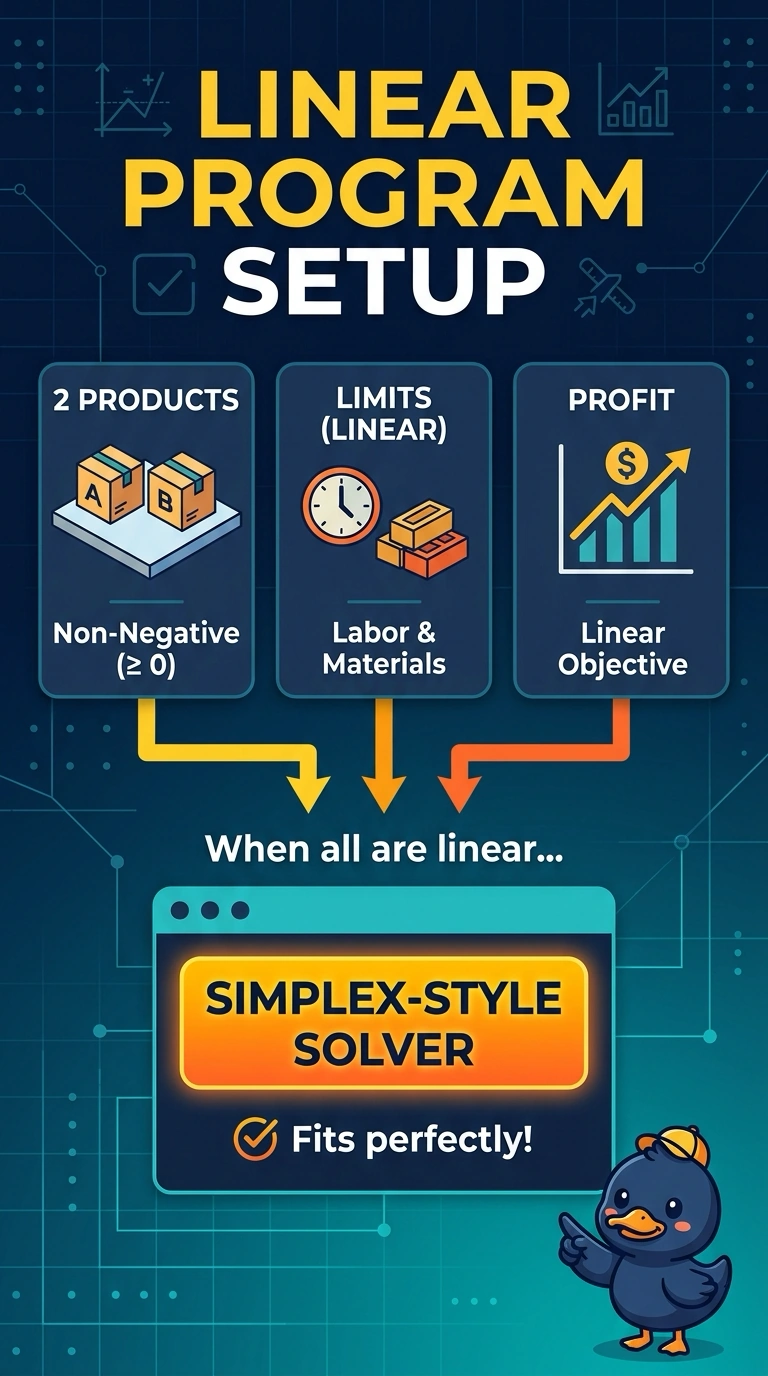
A factory may make any non-negative amount of two products. Profit is a linear function of the two quantities, and every labor and material limit is a linear inequality. Which solver setup fits?
Select an answer to reveal the explanation.
Short Explanation
Straight-line profit and straight-line limits are the shape a linear program is built to carry. You can hand that model to a simplex-style solver. An integer straitjacket, or a product of the two quantities, would describe a different plant than the one in front of you.
Full Explanation
A linear program maximizes or minimizes a linear objective subject to linear constraints. Here profit is a linear function of the two quantities, every labor and material limit is a linear inequality, and any non-negative amount is allowed, so the decision variables need not be integers. A simplex-style solver is built for that linear form. An unconstrained search that ignores the labor and material limits can recommend quantities the factory cannot staff or supply. An integer program that forces whole units adds restrictions the plant did not state and is a different model from the linear program. A nonlinear program whose objective multiplies the two quantities does not match a profit statement that is linear in each quantity. Exam caveat: simplex-style methods fit linear programs; a product term or a whole-unit rule would take the model outside the form those methods assume. Operational check: write profit and each limit as a linear expression in the two quantities, confirm none of them multiply the quantities together, and confirm the chosen solver is set up for a linear program.