
A fashion retailer chooses which promotional offer to show each arriving shopper. Several offers are still uncertain, and one offer currently looks best. The team wants to keep learning without ignoring that current winner. Which method fits?
Select an answer to reveal the explanation.
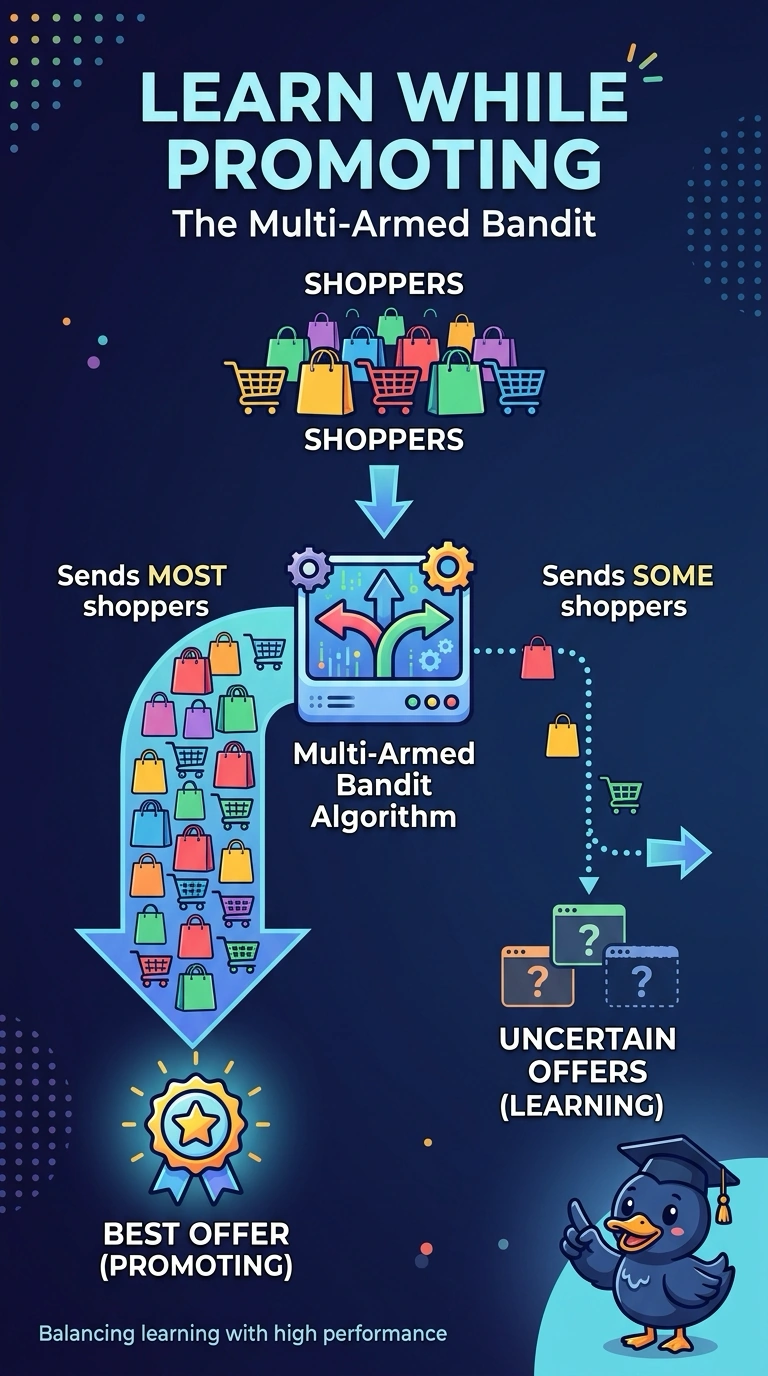
Short Explanation
A bandit keeps tasting the uncertain dishes often enough to learn, while still serving the dish your customers already favor. The trap is locking today's winner, handing every shopper to a one-shot optimizer, or clustering shoppers and calling that a test. You want a method that still tries the unsure offers and uses the current best more often.
Full Explanation
A multi-armed bandit treats each offer as an arm and repeatedly balances exploration with exploitation. Uncertain offers still receive some shoppers so their performance can be learned, while the offer that currently looks best receives more of the traffic. That is the tradeoff the retailer described. A one-shot comparison that locks the current winner and stops collecting data on the others abandons learning, which breaks the request to keep learning. A linear program that assigns every shopper to the highest known margin and leaves no traffic for a test is pure exploitation; it uses the current best and does not try the uncertain offers. Clustering past shoppers and freezing one offer per segment is a segmentation rule decided before new traffic arrives, not a policy that keeps updating the explore-versus-use balance as results come in. Exam caveat: particular bandit rules differ in how they split traffic, but the method this question asks for is the explore-and-use balance, not a named sampling formula. Operational check: review live assignments and confirm that offers other than the current winner still receive some shoppers while the current winner receives more.