
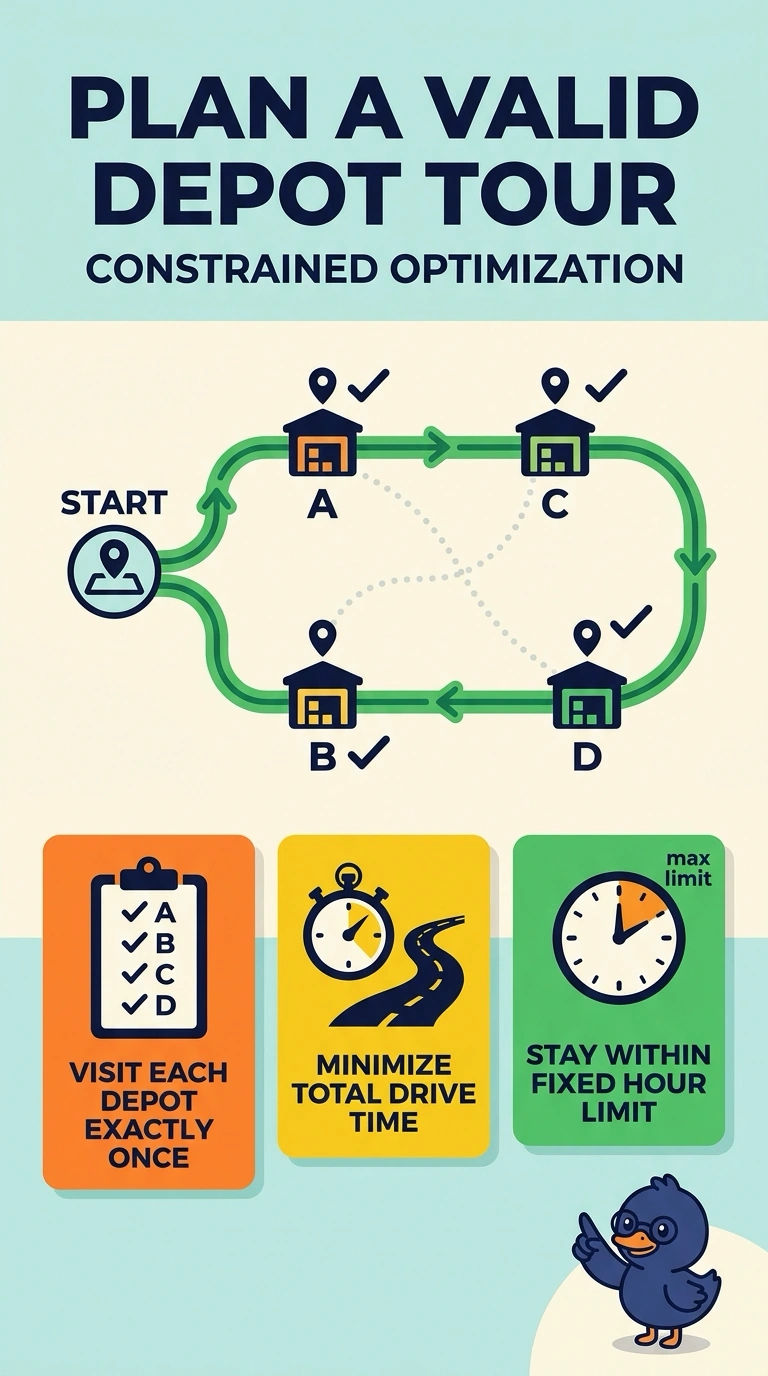
A logistics planner must minimize total drive time, visit each depot exactly once, and finish the tour inside a fixed hour limit. Which formulation matches that job?
Select an answer to reveal the explanation.
Short Explanation
You are building a delivery loop that has to hit every stop and still beat the clock. That is a route with rules, which is constrained optimization. A forecast of one hop, or a busy-or-quiet label, will not produce a tour that obeys the hour limit.
Full Explanation
The planner has an objective, total drive time, and hard requirements: every depot is visited once and the tour finishes inside the hour limit. That combination is constrained optimization, because candidate tours are scored on the objective and rejected when they break a constraint. An unconstrained local search that is free to skip depots or run past the hour limit is a different problem; a shorter drive that misses a depot is not a feasible tour. A regression of drive time on distance can estimate one hop, but it does not choose an order of visits or enforce the hour cap. A classifier that labels depots busy or quiet produces categories, not a route that covers each depot once. Exam caveat: the hour limit and the visit-once rule are constraints, not optional notes to apply after a free search has already kept an infeasible tour. Operational check: take the chosen tour and verify every depot appears once, no depot is skipped or repeated, and the summed drive time sits inside the hour limit.