
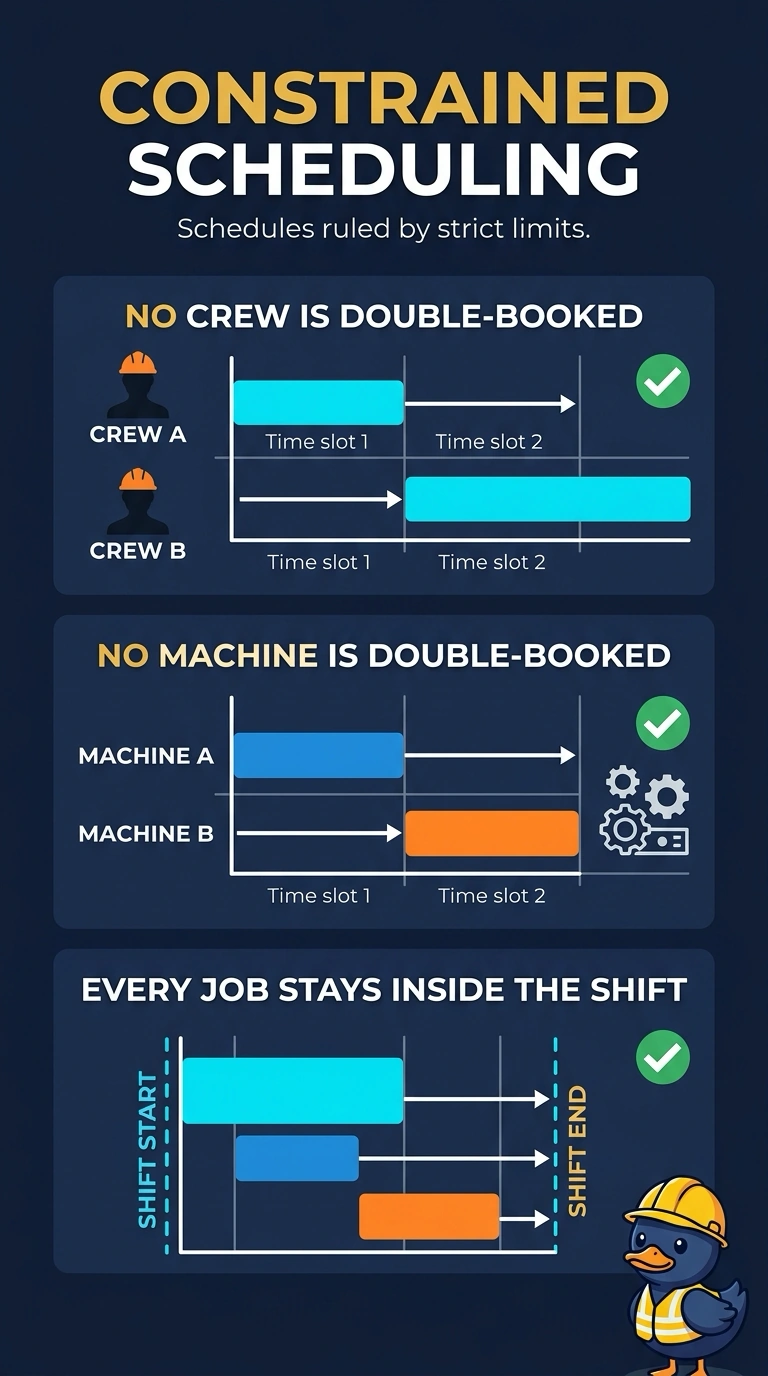
A factory must schedule maintenance crews and machines so that no crew and no machine is double-booked and every job stays inside the shift. A colleague says to search locally and keep any roster that looks full. Which description fits the job?
Select an answer to reveal the explanation.
Short Explanation
A roster that double-books the only crane is not a plan, however full it looks. You are facing a constrained schedule, and a free local search that ignores crew and machine limits misses the job. Forecasting breakdowns, or clustering old tickets, will not place crews without conflicts.
Full Explanation
The factory's roster has hard limits: a crew cannot be in two places, a machine cannot be double-booked, and each job must sit inside the shift. Those limits make the job a constrained schedule. A free local search that keeps any roster that looks full can return a busy plan that breaks the limits, so that advice describes the wrong formulation. Treating the limits as notes for later, and calling every full-looking roster feasible, drops the constraints that define the problem. A regression of next month's breakdowns forecasts a count and, with crew names removed, does not assign crews or machines. Clustering past jobs groups history; using the double-booking rules only as labels after the groups exist does not build a feasible roster. Exam caveat: a local search can still be used as a heuristic, but only if infeasible rosters are rejected; a free search that keeps them is not this schedule. Operational check: for the published roster, confirm no crew and no machine appears twice at the same time and every job's start and finish sit inside the shift.