
A logistics firm runs a route planner that is modest on ordinary nights and much larger during the week before a holiday. Hardware that sits idle the rest of the year is wasted spend. Which deployment matches that rise and fall?
Select an answer to reveal the explanation.
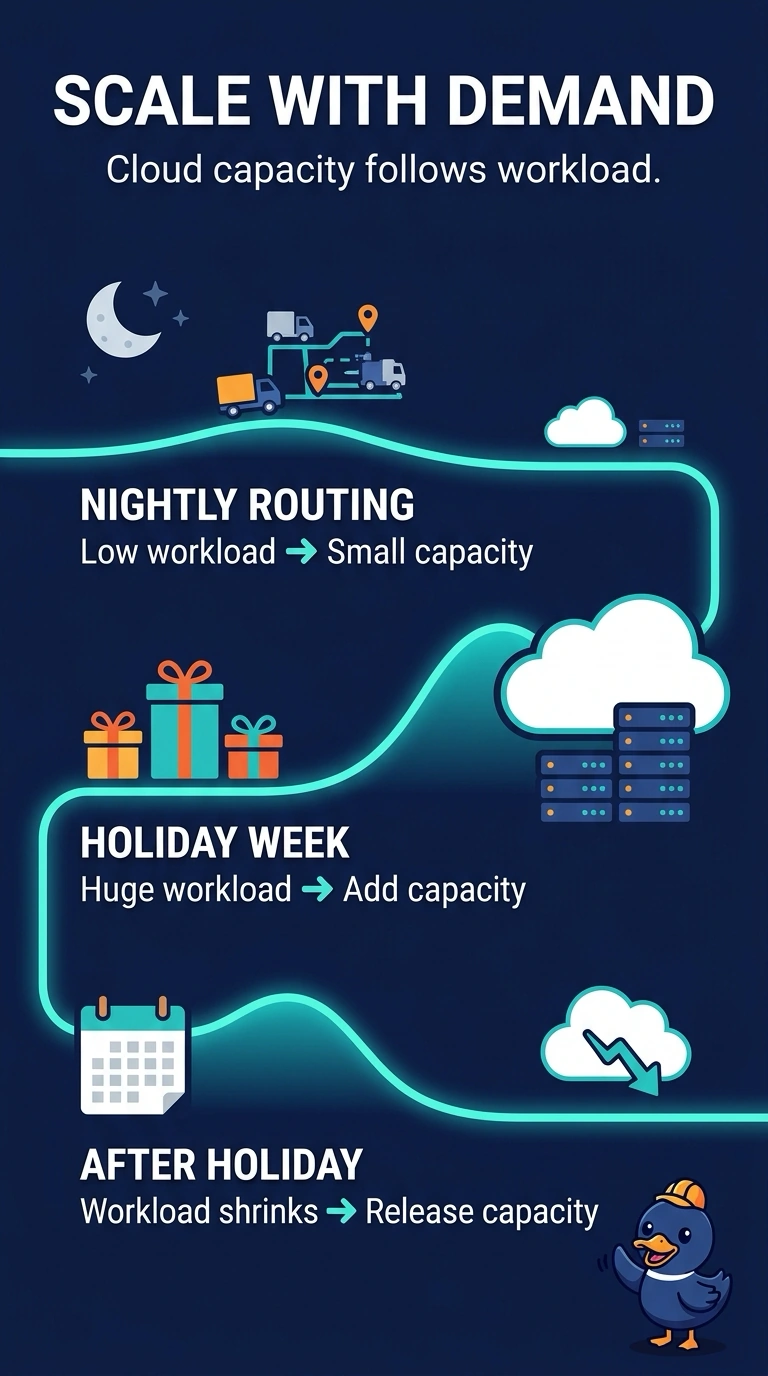
Short Explanation
Renting extra chairs for a holiday rush and sending them back the next week is the pattern you want. You want a cloud deployment that adds capacity while the route job is large and releases it when the night is small again. The trap is a hall sized for the peak that stays lit all year.
Full Explanation
Cloud elasticity means the capacity allocated to the route planner grows when the holiday job is large and is released when ordinary nights are small again, so the firm is not paying for a peak-sized fleet every quiet night. An on-premises hall built for the holiday peak keeps that large footprint powered all year, which is the idle spend the firm is trying to avoid. An edge computer on each truck is a response to a device with little memory and a tight power budget, and this planner's problem is a job whose size changes, not a truck-mounted device. A fixed machine pool whose count is chosen once does not add or remove capacity as the nightly job grows and shrinks, so it misses the rise and fall even if the machines are rented. Exam caveat: a cloud account held as a reserved block of unchanging size is that fixed pool, not the elastic property this planner needs. Operational check: record the capacity in use during the holiday week and during the following ordinary week, and confirm it rises with the large job and falls when the small night returns.